
Buying a small online business can be the fastest way to own a cash-flowing asset. It can also be the fastest way to buy someone else's problem. The difference is diligence.
You do not need a law firm and a forensic accountant to buy a $40,000 content site or a $150,000 micro-SaaS. But you do need a repeatable checklist that keeps you from skipping the unglamorous checks that kill deals after closing. This is the one I would hand a friend.
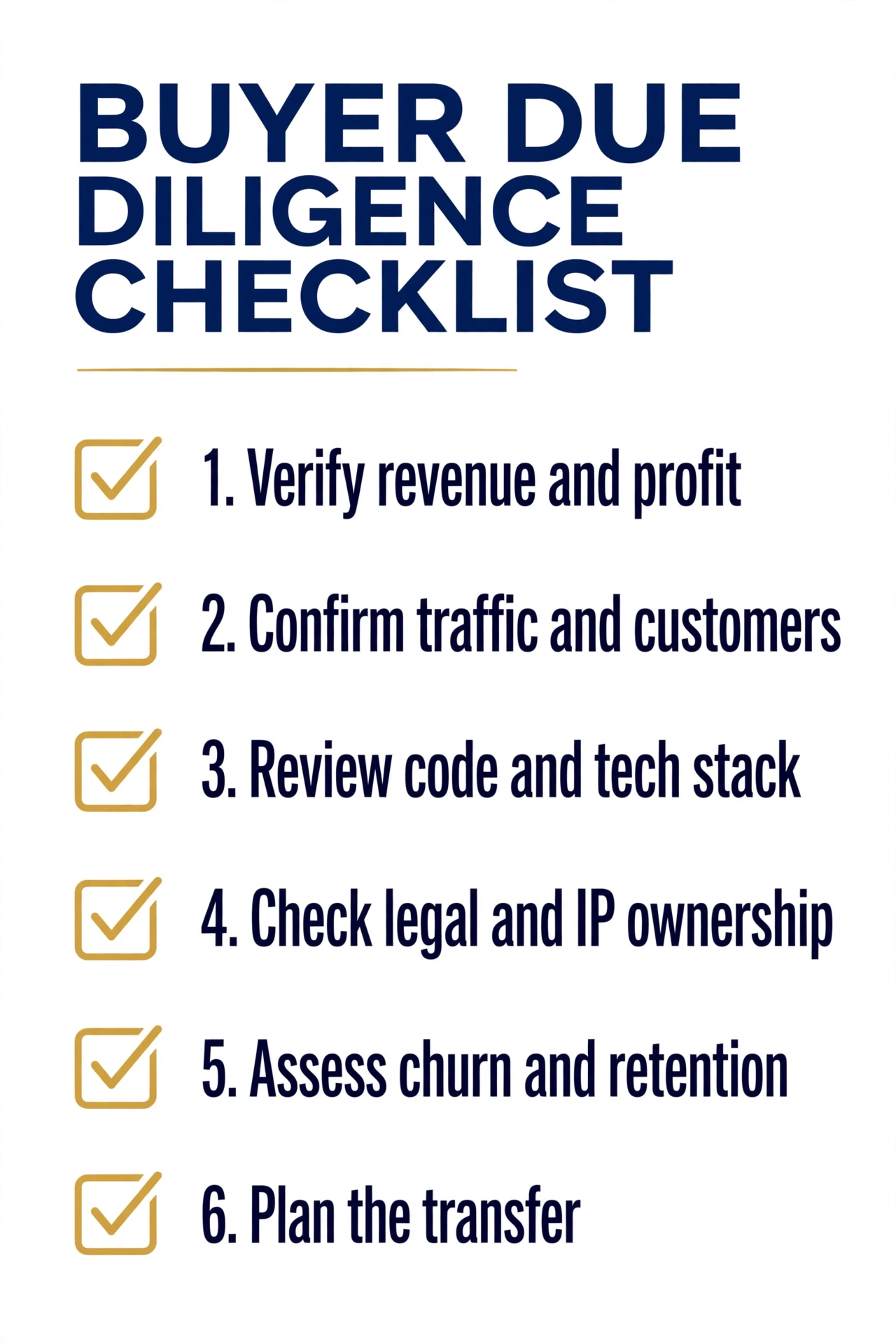
1. Verify revenue and profit
Every diligence process starts here. A listing's numbers are a starting point, not a fact.
- Ask for 12 to 24 months of proof. Payment processor statements (Stripe, Paddle, PayPal) beat P&L spreadsheets every time.
- Match revenue to bank deposits. If the Stripe dashboard says $8,200 a month but only $5,000 hits the bank, ask why before you ask anything else.
- Separate owner costs from business costs. Many small businesses bury personal expenses in the P&L. Rebuild the numbers with only costs a new owner would actually pay.
- Watch for one-time spikes. A launch, a press mention, or a single whale customer can make a trailing-12-month average look better than the real run rate.
2. Confirm traffic and customer sources
A business is only as stable as its customer acquisition. Ask where buyers come from, then verify it.
- Request read-only analytics access. Google Analytics or the ad account tells the truth about traffic sources and trends.
- Flag single-channel dependence. If 80% of traffic comes from one SEO keyword or one paid channel, that is concentration risk, and the price should reflect it.
- Check the trend line, not just the total. Flat or gently declining traffic with stable revenue is fine. A cliff in the last 90 days is a conversation.
- Talk to customers if you can. For B2B deals, a few reference calls with active customers reveal more than any spreadsheet.

A good test: ask the seller to name the three customers most likely to leave in the next six months, and why. An honest answer tells you more about the business than any pitch deck. A defensive answer tells you something too.
3. Review the code and tech stack
If software is part of the asset, the code is part of the asset. Treat it like one.
- Confirm what you are actually buying. Custom code, third-party licenses, open-source dependencies, and the repos they live in.
- Ask about technical debt. "It works, but only on my laptop" is a real sentence sellers say. Get a developer you trust to spend an hour in the codebase.
- List every recurring infrastructure cost. Hosting, APIs, SaaS tools, app store fees. These come straight out of your profit.
- Check deployability. Can a new owner deploy from scratch, or does the whole thing run on one server the seller configured by hand three years ago?
4. Check legal, IP, and contracts
This is the section buyers skip because it feels boring. It is also the section that produces the worst surprises.
- Confirm IP ownership in writing. Was the code, brand, or content created by contractors? Get the assignment agreements, not just the seller's word.
- Review trademarks and domains. Who owns the trademark, and is the domain registration in the seller's name? Both must transfer cleanly.
- Read the key contracts. Supplier agreements, affiliate terms, ad network contracts. Look for change-of-control clauses that could cancel a deal's best revenue line.
- Check for disputes. Ask directly about past legal disputes, DMCA claims, or chargeback patterns. Put the answer in the purchase agreement.
5. Assess churn, retention, and unit economics
Revenue tells you what happened. Retention tells you whether it keeps happening.
- Know the churn rate. For subscription businesses, monthly logo churn above 5 to 8% deserves a hard look at why customers leave.
- Segment revenue by cohort. Are new customers replacing lost ones, or is the base quietly shrinking under a stable top line?
- Check unit economics. Customer acquisition cost versus lifetime value. If it costs more to win a customer than they are worth, growth is just expensive.
- Ask about support load. Hours per week of founder support is a hidden cost. A business that needs 20 hours of the seller's week is a job, not an asset.
6. Plan the transfer before you sign
Deals fall apart after closing more often than before it, and the cause is almost always a sloppy handoff.
- Get a written transfer checklist. Domains, code repos, hosting accounts, ad accounts, social profiles, customer lists, documentation. Every account, with the login handoff method spelled out.
- Negotiate a transition period. 30 to 90 days of seller support, with response times defined, protects you while you learn the business.
- Use escrow. A neutral third party holds funds until the transfer milestones are met. It is cheap insurance on deals of any size.
- Document everything in the agreement. Verbal promises from a seller you may never speak to again are worth exactly nothing.
Your 30-minute pre-offer checklist
Before you make an offer on any online business, confirm you can check these six boxes:
- Revenue verified against payment processor records, not just spreadsheets.
- Traffic sources confirmed with read-only analytics access.
- Code reviewed or technical risks priced into the offer.
- IP ownership and key contracts reviewed.
- Churn, retention, and true owner workload understood.
- Transfer plan and escrow agreed in writing.
Do these six things and you will walk into more deals than most buyers ever look at, and you will walk away from the ones that would have hurt you. That is the whole game.
Looking for your next acquisition? Browse live deals on Startexus, or list your business for sale and let qualified buyers come to you.
Tags
- online business
- acquisition
- due diligence
- saas
- ai
- growth