
Valuing a small SaaS business feels like guesswork until you learn the language buyers actually speak. This guide gives you that language: the MRR multiple, the factors that move it, and the mistakes that cost sellers money.
The MRR multiple, explained simply
Most micro-SaaS deals are priced as a multiple of monthly recurring revenue. A business doing $2,000 MRR selling at a 30x multiple goes for $60,000. The multiple is shorthand for how many months of revenue the buyer is paying for upfront.
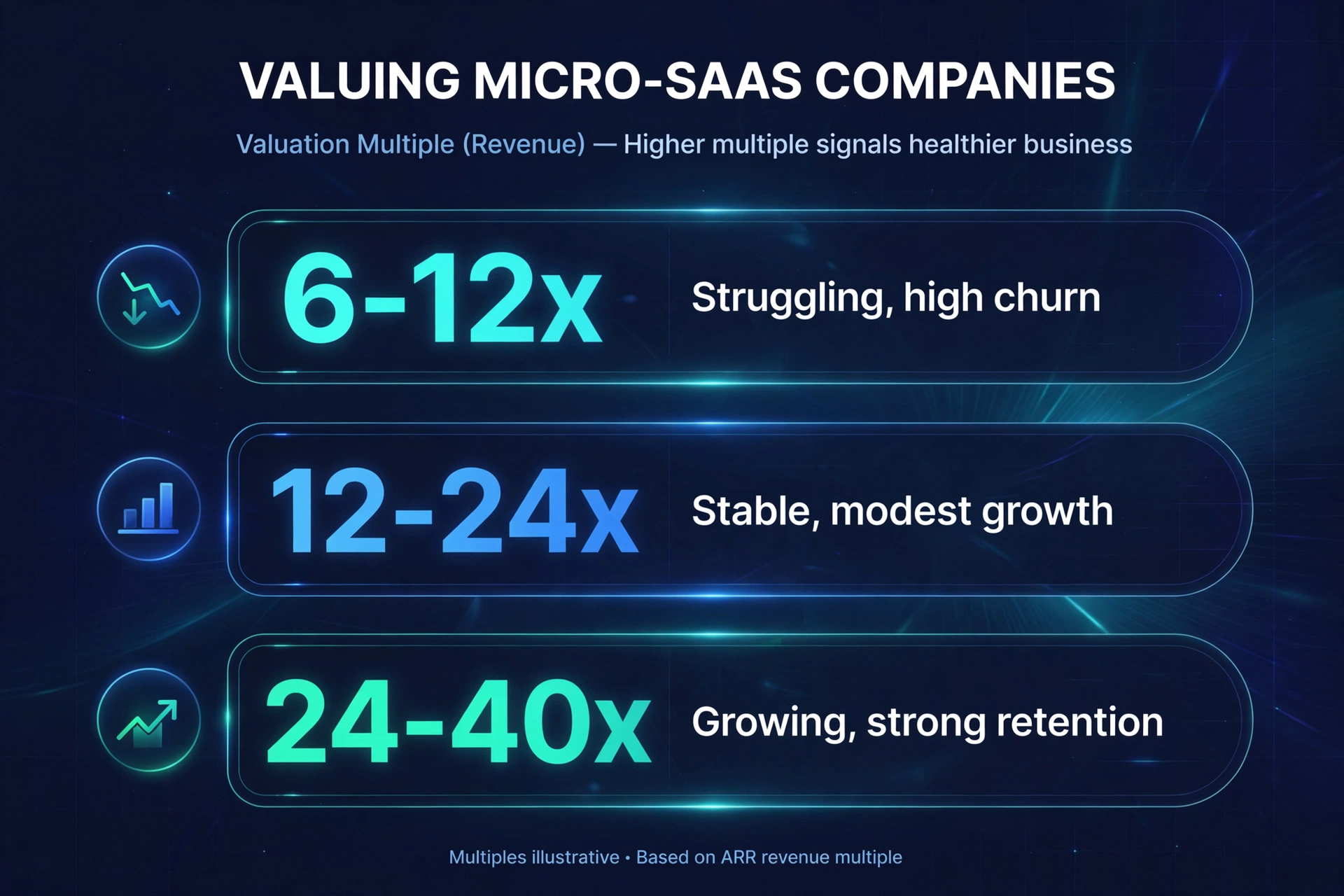
Typical ranges
- 6 to 12x MRR - a struggling or declining product with high churn
- 12 to 24x MRR - a stable small SaaS with modest growth
- 24 to 40x MRR - a growing product with strong retention and clean books
- Above 40x - rare air, reserved for businesses with real momentum
What pushes multiples up
- Growth. A product growing 10 percent month over month commands a far higher multiple than a flat one at the same revenue.
- Low churn. Buyers pay for revenue that sticks around.
- Clean, verifiable financials. Twelve months of consistent Stripe or Paddle payouts lets buyers bid with confidence.
- Low owner involvement. A business that runs without its founder is worth more than one needing forty hours a week of the seller's time.
What pushes multiples down
- High churn. The fastest way to kill a valuation.
- Customer concentration. If one client is half your revenue, buyers see risk, not upside.
- Messy books and unprovable revenue. Undocumented code and numbers you cannot back up drag the price down.
- Urgency. A seller who needs to close this week negotiates from weakness.

Pre-revenue deals
Not every deal has revenue. Pre-revenue products sell on assets: working code, a user base, a domain, a distribution channel. These usually price like a project, not a business, often in the hundreds or low thousands. The buyer is paying for a head start, so be honest about what the head start is actually worth.
Profit matters too
Revenue multiples get the headlines, but smart buyers look at profit. A $2,000 MRR product with 90 percent margins is a very different asset from one with the same revenue and 20 percent margins after server and support costs. If your margins are strong, say so. It moves the number.
A quick worked example
Take a SaaS doing $3,000 MRR, growing 8 percent monthly, with 4 percent monthly churn and 85 percent margins. That profile comfortably supports a 24 to 30x multiple: $72,000 to $90,000. The same revenue with flat growth and 10 percent churn? More like 12 to 18x: $36,000 to $54,000. Same top line, half the price. The multiple is where the story of the business gets priced in.
Common mistakes sellers make
- Pricing off hope instead of comps. Look at what similar businesses actually sold for, not what you wish yours were worth.
- Hiding the bad numbers. Buyers always find them, and finding them late kills trust and the deal.
- Forgetting the transfer. A smooth handover of code, domains, accounts, and customers is part of what the buyer pays for. Document it before you list.
The bottom line
Valuation is not a formula, it is a negotiation informed by data. Know your multiple, know your comps, and present your numbers honestly. Buyers reward clarity with better offers.
If you are thinking of selling, browse current listings on Startexus to see what businesses like yours are asking, or list your own and let the market tell you what it is worth.
Tags
- valuation
- saas
- ai
- growth