
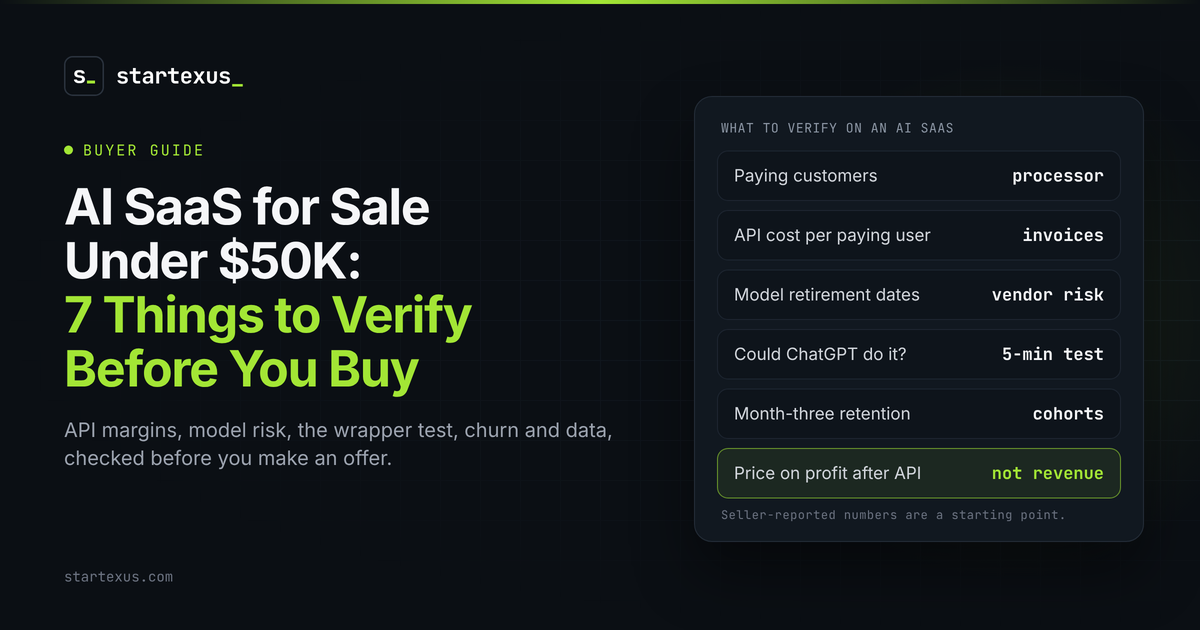
An AI SaaS under $50K can look like the cheapest way into the hottest category in software. It can also be the fastest way to buy someone else's API bill.
On a listing page, AI products look like any other SaaS. Underneath, every customer action costs money, the core feature runs on a model you do not control, and a competitor can copy the surface in a weekend.
Here are the seven things I would verify before making an offer on any AI SaaS for sale. They sit on top of normal due diligence, not instead of it.
1. Revenue, or just a repo
Start with the simplest question. Is anyone paying?
- Verify in the processor. Twelve months of charges, refunds and disputes in Stripe or Paddle, live. Not screenshots.
- Credit packs are not MRR. A burst of one-off credit purchases after a launch is not recurring revenue.
- Price pre-revenue as code. No customers means you are paying for the build and the time saved. Price it like that.
Real data: Of 36 AI-branded listings with an asking price under $50K that StartExus tracked recently, 31 reported $0 or no monthly revenue. The five with revenue reported between $14 and $269 a month, all seller-reported. At this size you are usually buying a product, not a business.
2. API costs and true gross margin
Classic SaaS costs almost nothing per extra user. AI SaaS pays for every request.
- Get the provider invoices. Six to twelve months from OpenAI, Anthropic, Google or whoever runs the model, next to revenue for the same months.
- Work out cost per paying user. Then look at the heaviest ten. Flat-rate plans can make power users unprofitable.
- Count the free tier. Free users burn tokens too. Ask what share of API spend serves people who never pay.
- Find the hidden spend. Embeddings, vector databases, transcription, image generation, retries and logging tools all add up.
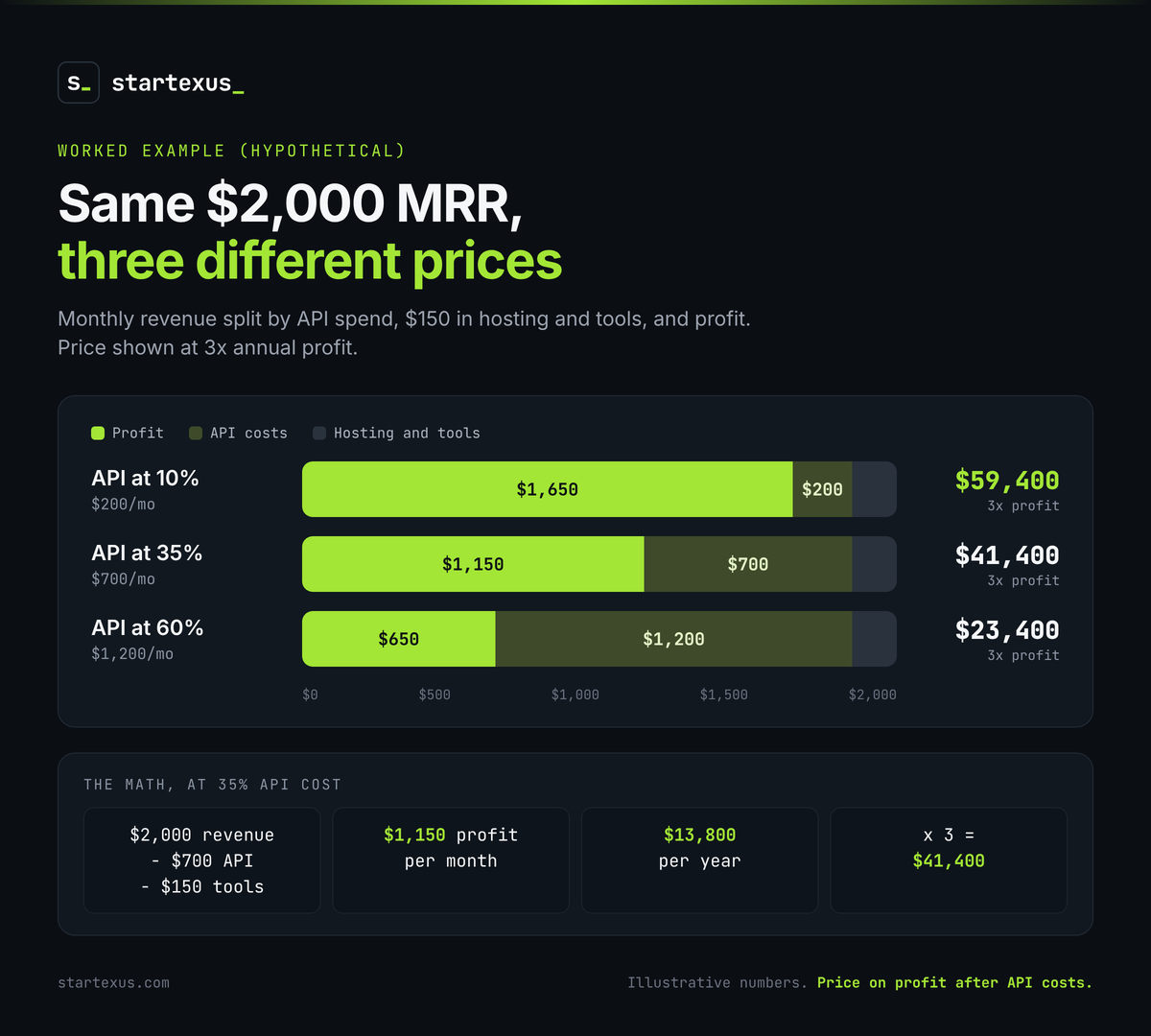
Worked example (hypothetical): Say a tool does $2,000 MRR with $150 a month in hosting and tools. If API costs are 10% of revenue, profit is $1,650 a month. At 35%, it is $1,150. At 60%, it is $650. At 3x annual profit, that is $59,400, $41,400 or $23,400 for the same revenue line.
3. Model dependency and vendor risk
The core feature runs on a model someone else can reprice or retire.
- Models retire on a schedule. OpenAI promises at least six months' notice for generally available models and as little as two weeks for previews. Anthropic promises at least 60 days for publicly released models.
- It is happening now. On October 14, 2026, OpenAI told developers that certain GPT-4o, GPT-4o mini and GPT-4.1 models leave its API on January 14, 2027.
- Search the code for model IDs. Hard-coded names across the codebase turn every retirement into a migration project.
- Ask for an eval set. Saved test inputs with expected outputs let you swap models without guessing. Most small products lack one. Budget for building it.
- Check for a fallback. One abstraction layer and a tested second provider are worth real money.
4. Wrapper risk and where the moat lives
Every AI product faces the same question. Why would a customer not just use ChatGPT?
- Run the five-minute test. Paste the core task into a general chat app. If you get 80 percent of the result, so can the customers.
- Find the real moat. A workflow inside a tool customers already use, proprietary data, integrations, an SEO channel or a niche audience. Not the prompt alone.
- Locate the prompts. They are IP. They should live in the repo, versioned, and transfer with the sale. If they sit in the seller's OpenAI dashboard as reusable prompt objects, they need to move: OpenAI is shutting that API down on November 30, 2026.
- Read the licenses. Starter kits and open-weight models come with terms. Know what you can resell.
5. Usage-based pricing and churn
AI pricing often means credits, tokens or usage tiers. That makes revenue lumpier than it looks.
- Separate recurring from prepaid. Unused credits customers already paid for are a promise you inherit.
- Measure churn by cohort. Users from a viral launch month can leave fast. Look at month-three retention, not month one.
- Check caps on heavy use. If the top plan is unlimited, one customer can erase the margin.
6. Data, privacy and provider accounts
AI products send customer data to third parties by design. Know exactly where it goes.
- Map the data flow. What user content goes to which provider, what gets stored and for how long.
- Match the privacy policy to reality. It should name the subprocessors and what they receive.
- Check sensitive niches twice. Health, kids, legal and HR data raise the bar on consent and storage.
- Provider accounts do not move like a domain. API keys belong to the seller's organization. Plan to open your own accounts. New accounts can start on lower rate-limit tiers.
- Fine-tunes and stored files stay put. Ask how they move, or whether you can rebuild them from the training data.
7. Price it on profit after API costs
At this size, AI does not earn a premium multiple by default. Margin and durability do.
- Use profit, not revenue. Apply the multiple to annual profit after API costs. Revenue multiples hide the token bill.
- Know what sellers ask. Four of the five AI listings above that reported revenue asked between 2.8x and 4.6x annual revenue. The fifth asked about 30x. Asking prices, not closed sales.
- Discount single-model risk. If one retirement notice forces a rebuild, price that in.
- Structure the rest. Escrow, a paid handover period and part of the price tied to revenue after 90 days.
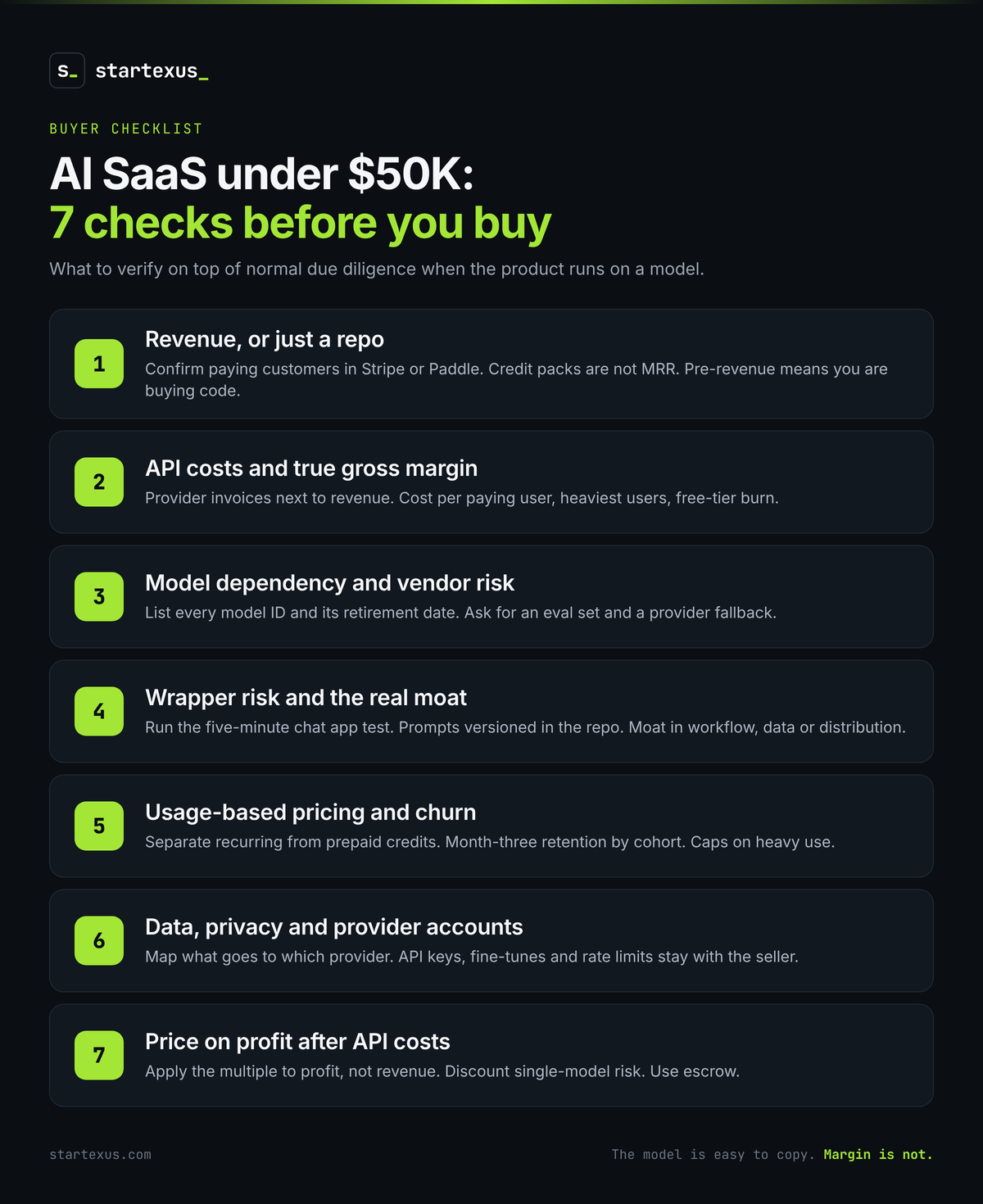
Your 30-minute pre-offer checklist
- Confirm paying customers and 12 months of revenue in the processor.
- Put provider invoices next to revenue and work out gross margin.
- List every model ID in the code and check its retirement date.
- Run the five-minute test against a general chat app.
- Pull month-three retention by signup cohort.
- Map where customer data goes and read the privacy policy.
- Price on annual profit after API costs, with escrow.
The bottom line
Under $50K, the AI is the easy part to copy. What you are really buying is a margin, a set of customers and a workflow they come back to.
Check that each one survives a price change and a model retirement. Cheap to buy. Expensive to get wrong.
Browse current deals on StartExus, including AI tools and micro-SaaS under $50K, or list your AI SaaS for sale for free.
Tags
- due diligence
- saas
- ai