
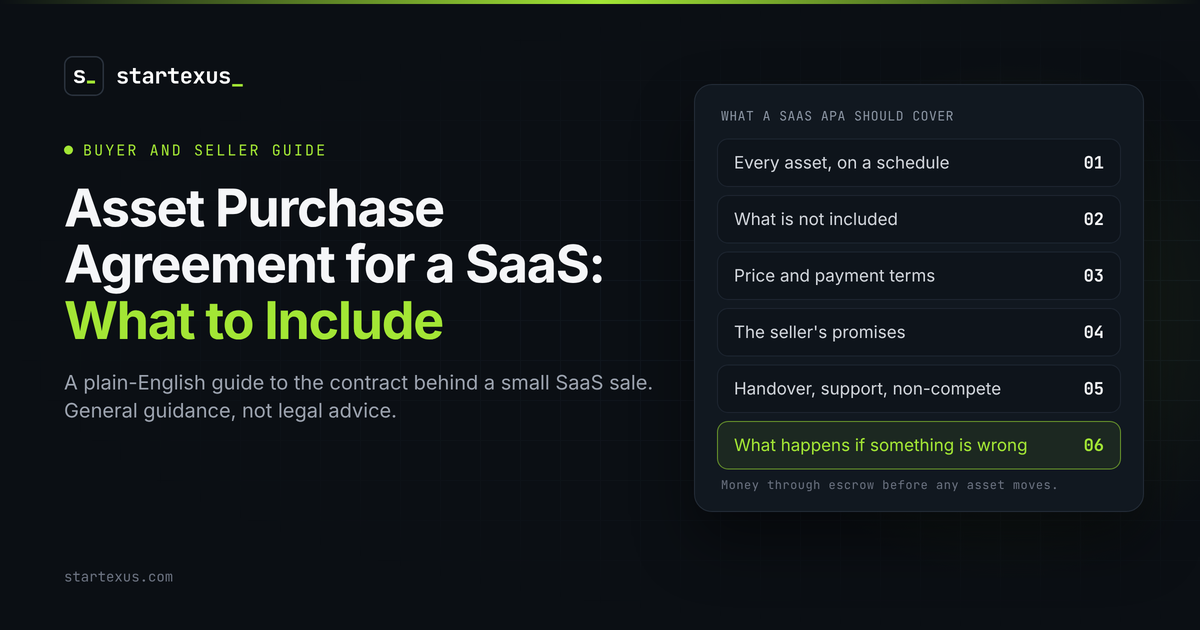
Shaking hands on a price feels like the end of a deal. It is the middle. The asset purchase agreement is where the price turns into a promise, and where most of the later arguments are won or lost.
A good one is not long. It is specific. What moves, when the money moves, and what happens if something is wrong.
Here is what to put in an asset purchase agreement for a small SaaS, in plain English, for buyers and sellers. This is the checklist I would hand a friend. General guidance, not legal advice.
What an asset purchase agreement does
Most small SaaS sales are asset sales. The buyer buys the product, not the company that owns it. The asset purchase agreement, or APA, is the contract that makes that work.
- It defines the deal. What is sold, for how much, on what terms.
- It splits the risk. Who is responsible for what happened before the sale, and what after.
- It is between you two. StartExus is not a party to any transaction between buyers and sellers. The agreement is yours to write and sign.
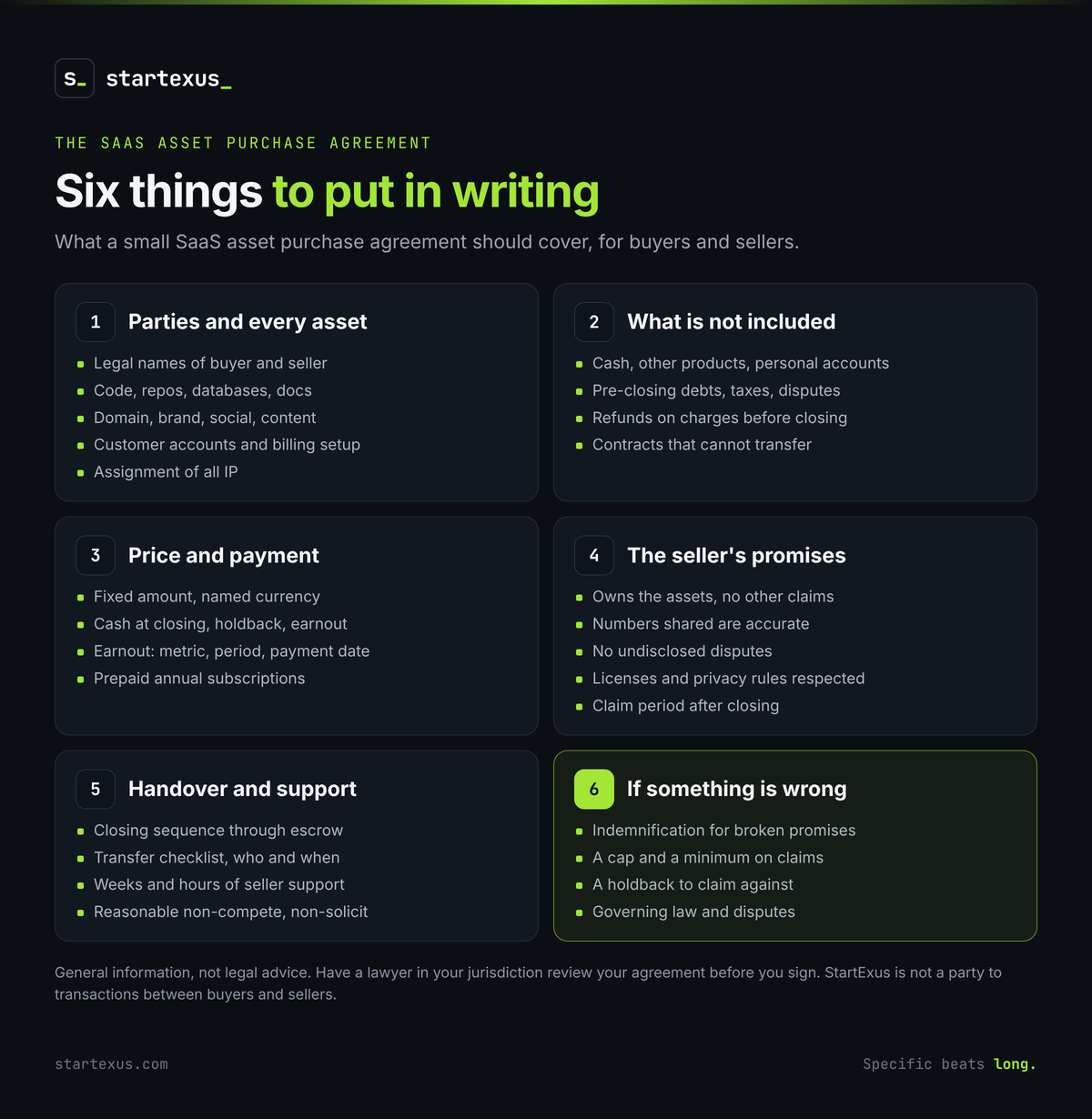
1. Name the parties and list every asset
Start with who is buying and selling, then attach a schedule of everything included. If it is not on the list, assume it is not in the deal.
- The legal names. Whoever actually owns the assets, and the buyer entity that will hold them.
- The product. Source code, repositories, databases, infrastructure and documentation.
- The brand. Domain names, trademarks, logos, social accounts and content.
- The customers. Customer accounts, subscriber lists and the billing setup.
- The intellectual property. A clear assignment of all rights in the code, design and content to the buyer.
2. Spell out what is not included
What stays behind matters as much as what goes. Buyers of assets usually do not take on the seller's past.
- Excluded assets. Cash in the bank, other products and personal accounts.
- Excluded liabilities. Debts, taxes and disputes from before closing usually stay with the seller. Say so.
- Refunds and chargebacks. Decide who pays for a refund on a charge made before closing.
- Third-party contracts. Some tool and supplier agreements cannot simply be handed over. List which transfer and which the buyer opens fresh.
3. Set the price and how it gets paid
The headline price is one number. The payment terms decide what it is actually worth.
- The purchase price. Written as a fixed amount, in a named currency.
- How it is paid. Cash at closing, a holdback, an earnout or part paid later. On StartExus, offers can include terms such as part of the price paid later.
- Earnouts need a formula. Name the metric, the period, how it is measured and when it is paid. "If it does well" is not a formula.
- Prepaid subscriptions. If customers paid annually, the buyer will serve months the seller already collected. Agree how that is handled.
Worked example (illustrative): A SaaS sells for $24,000. The APA pays $20,000 through escrow at closing and holds back $4,000 for 90 days to cover refunds or problems found later. One customer paid $1,200 for a year with three months left at closing. That is $300 of service the buyer will deliver, so the parties agree to knock $300 off the price.
4. Write down the seller's promises
Representations and warranties are the facts the seller promises are true. They protect the buyer from surprises.
- Ownership. The seller owns the assets, and nobody else has a claim on them.
- The numbers. Revenue, costs and customer figures shared during due diligence are accurate.
- No hidden problems. No undisclosed disputes or legal claims.
- Clean code and data. Third-party and open-source licenses are respected, and customer data was collected in line with the privacy rules that apply.
- How long they last. A set period after closing during which the buyer can still claim.
5. Plan the handover, support and non-compete
Small deals go wrong at the transfer. Put the order and the help in writing.
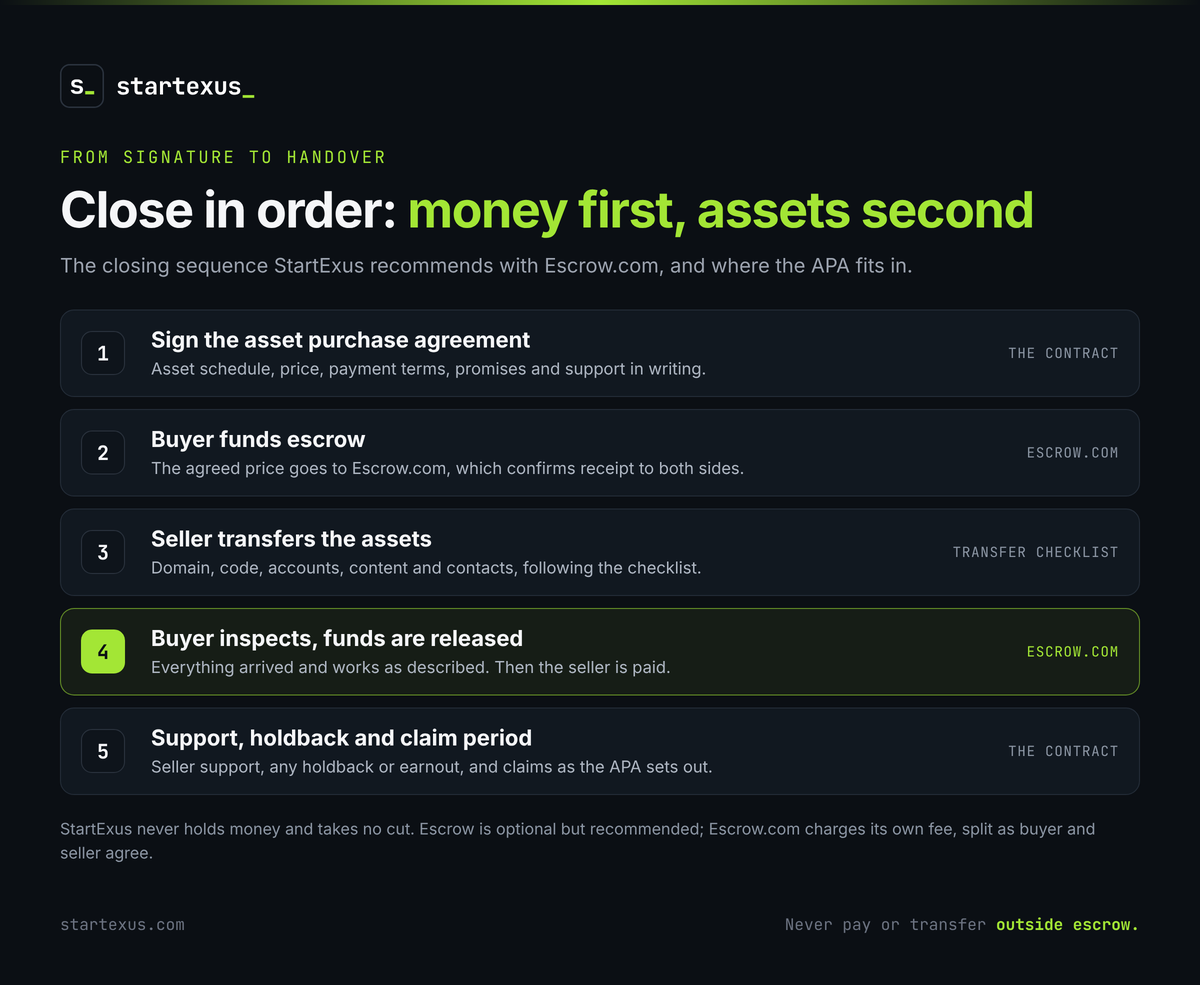
- The closing sequence. StartExus recommends Escrow.com: the buyer funds escrow, the seller transfers, the buyer checks everything arrived and works as described, then funds are released.
- A transfer checklist. Domain, code, hosting, payment, email and social accounts, with who does what by when.
- Transition support. How many weeks and hours the seller helps, and how.
- Non-compete and non-solicit. The seller agrees not to launch a competing product or poach customers for a set time. Keep the scope reasonable. Whether these hold up depends on where you are.
6. Decide what happens if something is wrong
Every agreement should answer one question: if a promise proves false, what then?
- Indemnification. The party who broke a promise covers the other side's resulting losses.
- Limits. A cap on how much can be claimed, often tied to the price, and a minimum before claims count.
- The holdback. Money kept back for a set period gives the buyer something practical to claim against.
- Disputes and governing law. Which law applies and how disagreements are settled. With Escrow.com, transfer disputes are handled under its process before money is released. Later claims rely on the agreement.
Your 30-minute pre-signing checklist
- Every included asset is on a written schedule.
- Excluded assets and pre-closing liabilities are named.
- The price, currency and payment timing are exact.
- Any earnout has a metric, a period and a payment date.
- Prepaid subscriptions and refunds are dealt with.
- The seller's promises match what was shown in due diligence.
- The transfer checklist and transition support are in writing.
- Money moves through escrow before any asset does.
Pro tip: Read the draft as the other side. Ask what you would claim if things went badly. If the agreement does not answer it clearly, fix that clause before you sign.
The bottom line
An asset purchase agreement is not paperwork after the deal. It is the deal. Specific lists, exact terms and clear promises protect both sides.
Keep it plain and complete. Starting from a template is fine. Have a lawyer in your jurisdiction review it before you sign. This is general information, not legal advice.
For the closing steps, see how escrow works on the trust and verification page, and read the StartExus seller guide before you list.
Browse current SaaS businesses for sale on StartExus, or list your business for sale for free. No listing fee, no success fee, no buyer fee.
Tags
- due diligence
- saas
- ai