
Ten thousand dollars will not buy you a business you can quit your job for. It can buy you a head start: a working product, a few paying customers, sometimes a small check every month.
The trick is knowing which of those you are actually paying for. Most listings under $10K are code with a price tag. A few are tiny businesses. Very few are both cheap and proven.
We went through all 170 listings in the StartExus under-$10K category on October 24, 2026, and set them against public data on what small software actually sells for. Here is what the money realistically gets you, with real deals, and what to check before you pay.
What $10K buys right now
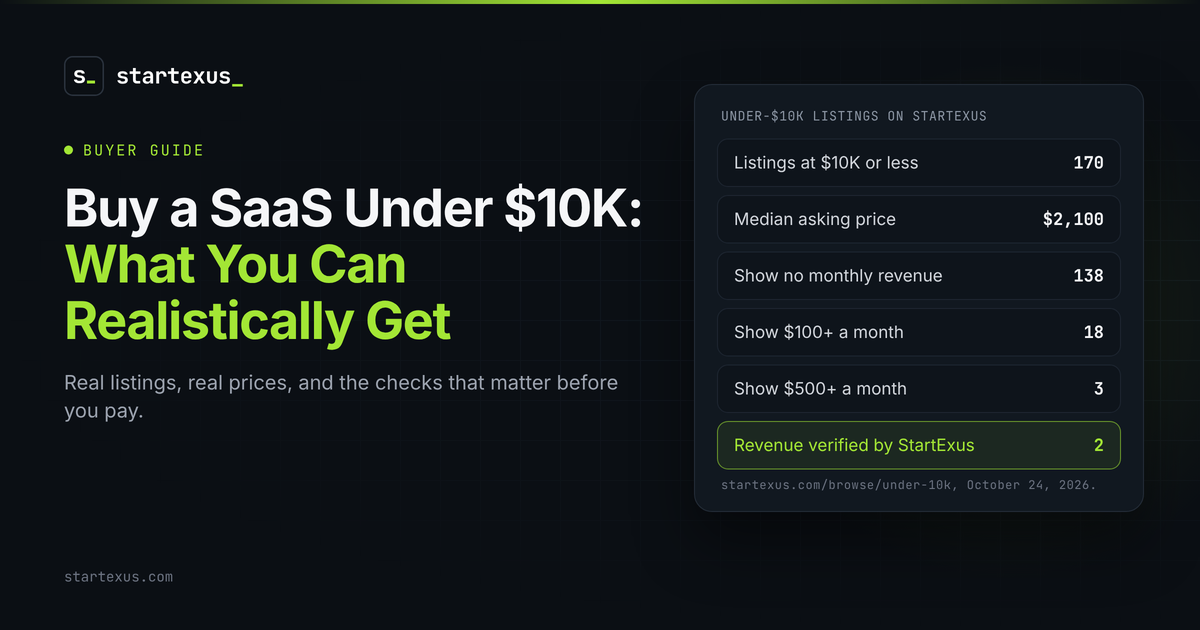
Start with the shape of the market. This is every listing at $10,000 or less on StartExus on October 24, 2026.
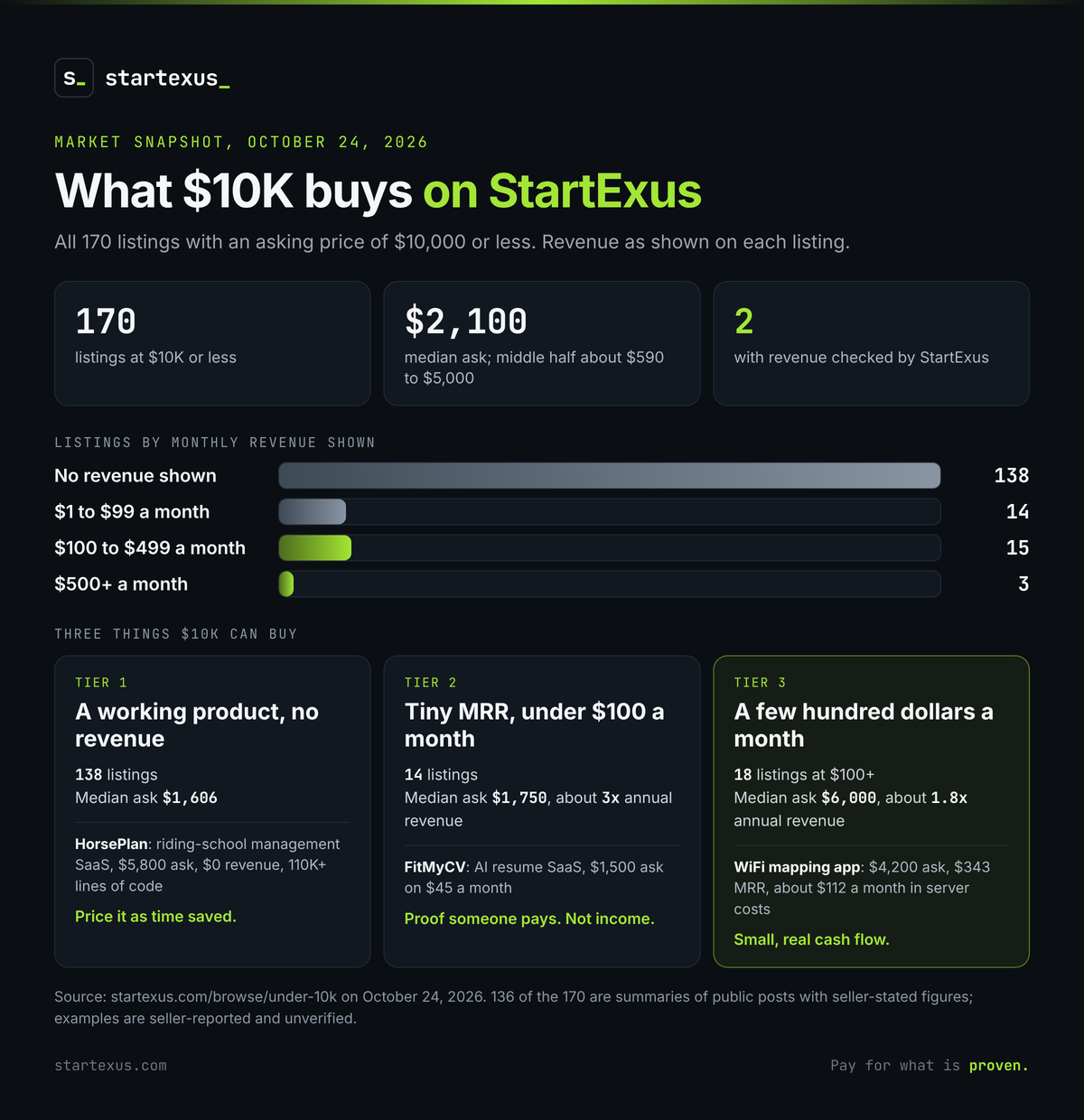
- 170 listings, median ask $2,100. The middle half asked roughly $590 to $5,000. 60 asked $1,000 or less.
- Mostly software. 95 SaaS products and 34 apps. The rest are content sites, marketplaces, e-commerce and other projects.
- Most show no revenue. 138 of 170 list $0 or no monthly revenue at all. Their median ask is about $1,600.
- 32 show revenue, and it is small. The median is $100 a month. Only 3 show $500 a month or more.
- Proof is rare. 136 are summaries of public posts, with figures as the seller stated them. Only 2 have revenue checked by StartExus.
1. Tier one: a working product with no revenue
This is most of the market. You are buying a build, not a business.
- What you get. Source code, a domain, sometimes a live demo. No customers to keep.
- Real example. HorsePlan, a management app for French riding schools, asks $5,800. The seller reports $0 revenue, 110,000+ lines of code and 3,700+ automated tests, with running costs from about EUR 40 a month.
- Price it as time saved. Ask what it would cost you to build, then discount hard. Nobody has proven they will pay for it yet.
- Other marketplaces price it low too. Acquire.com only accepts pre-revenue listings that are functional SaaS or AI products, and says most successful ones are priced conservatively, often under $25,000.
2. Tier two: tiny MRR, under $100 a month
Here the revenue proves someone pays. It does not pay you.
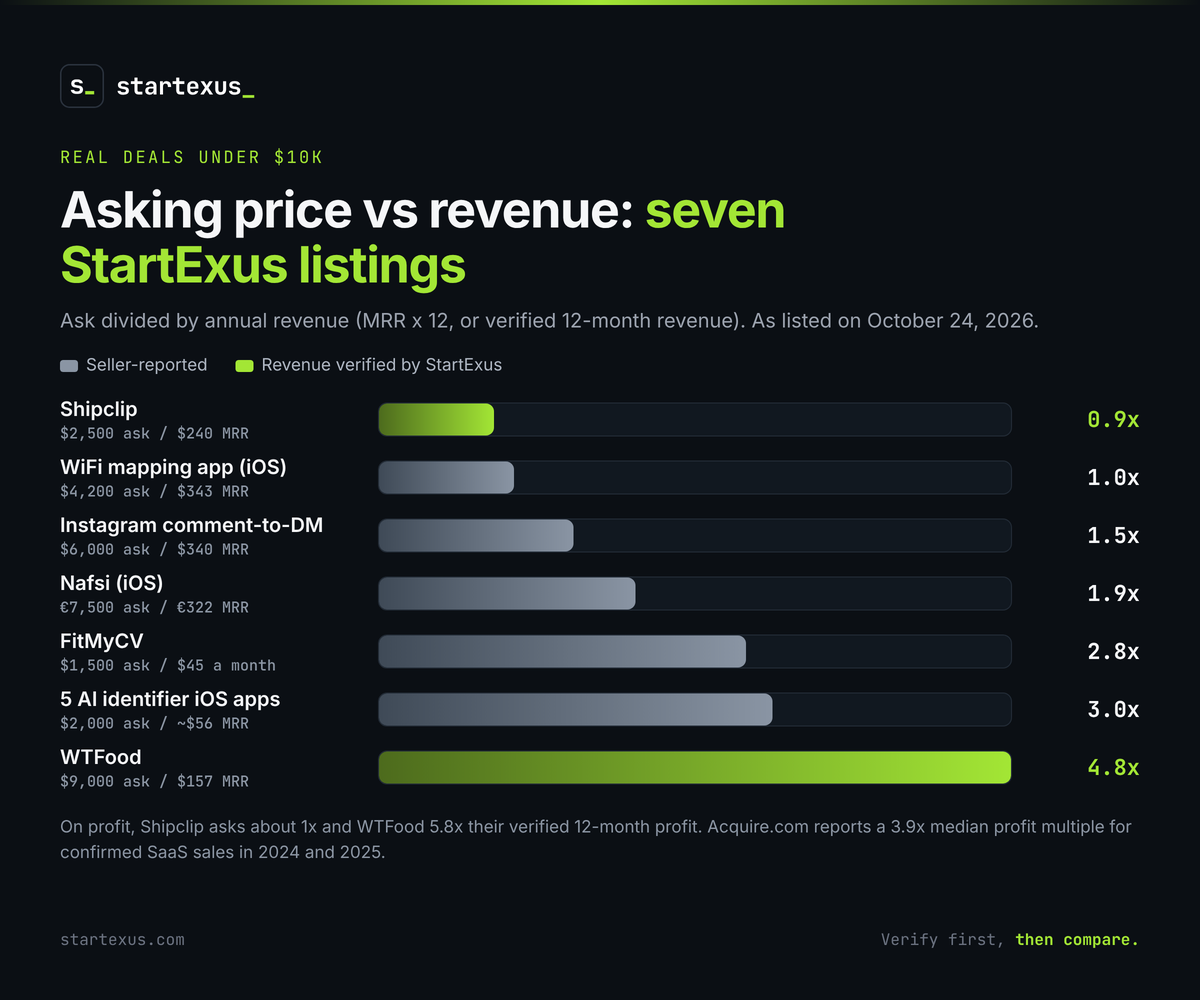
- Real example. FitMyCV, an AI resume-tailoring SaaS, asks $1,500 on $45 a month, as stated by the seller.
- Real example. A bundle of five AI identifier iOS apps asks $2,000. The seller cites about $56 MRR and roughly $460 in lifetime proceeds from App Store Connect.
- Multiples look high and mean little. The 14 listings in this band asked a median of about 3x annual revenue. At this size the revenue barely moves the price.
- What you are really buying. Payments already wired up, a few real users, and a product that is live and working.
3. Tier three: a few hundred dollars a month
This is the realistic ceiling under $10K. Small, real cash flow.
- Real example. A WiFi mapping app for iPhone asks $4,200. The seller reports $343 MRR, $750 in the last 30 days and about $112 a month in server costs.
- Real example. An Instagram comment-to-DM automation tool asks $6,000 on about $340 MRR, seller-reported.
- Real example. Nafsi, an iOS subscription app, asks €7,500. The seller cites €322 MRR from 79 subscribers in RevenueCat and no monthly costs.
- Cheaper per dollar of revenue. The 18 listings showing $100 a month or more asked a median of about 1.8x annual revenue, on a median ask of $6,000.
4. Verified beats cheap
An unchecked number is a claim. Two listings in the category have revenue StartExus checked against source records.
- Shipclip, $2,500. Three AI micro-SaaS products with $240 verified MRR and $2,400 verified profit over 12 months. About 1x profit. The seller puts the workload at 5 hours a week.
- WTFood, $9,000. A macro-tracking SaaS with $157 verified MRR, $1,560 verified 12-month profit and 12.8K verified monthly visitors. That is 5.8x profit for a product under a year old.
- The benchmark. Acquire.com's multiples report says SaaS businesses sold at a median 3.9x profit in both 2024 and 2025. One of these asks well below that line, one well above.
- Small exits do close. Microns lists recent sales including an iOS app with $487 in annual revenue sold for $1,050, and an AI outreach platform with $250 in annual revenue sold for $2,000.
5. The costs on top of the price
A $5,000 deal never costs exactly $5,000.
- Escrow. Escrow.com charges 2.6% with a $50 minimum up to $5,000, and 2.4% with a $130 minimum from $5,000.01 to $50,000. Paying by card or PayPal adds 3.05% on the smaller tier.
- Running costs. Hosting, AI API calls and developer accounts keep billing after you own it. Get the monthly number in writing.
- App transfers have rules. Apple says a transferred app keeps its ratings and reviews. Apps with auto-renewable subscriptions need an app-specific shared secret handed over first.
- History stays behind. After an App Store transfer, the new owner only sees sales from the transfer onward. Export the history before you close.
Worked example: The WiFi app asks $4,200 on $343 MRR. That is $4,116 a year in run-rate, so about 1x annual revenue. Take off $112 a month in server costs and about $231 a month is left, or $2,772 a year. If those numbers hold, the price comes back in roughly 18 months. Escrow.com's standard fee on $4,200 is $109.20, split however you agree. Every input here is seller-reported. Verify it before you trust the payback.
Your 15-minute under-$10K checklist
- Decide which tier you are buying: a build, a tiny MRR product or small cash flow.
- Divide the ask by annual revenue, and by annual profit if you have it.
- Ask for read-only access to Stripe, RevenueCat or App Store Connect, not screenshots.
- Get monthly running costs in writing: hosting, APIs, accounts.
- List exactly what transfers: code, domain, store listing, subscribers, users.
- Ask how many hours a week the seller spends on it.
- Close through escrow and add its fee to your budget.
Pro tip: Under $10K, the bigger risk is not overpaying by $1,000. It is buying revenue that depends on the founder. Ask where the last 10 customers came from, and whether that channel transfers to you.
The bottom line
Under $10K you can realistically buy a working product, a handful of paying customers, or a small app making a few hundred dollars a month. Not a salary. Rarely all three at once.
Pay for what is proven. Price the rest as code. Add escrow and running costs before you make an offer.
Sanity-check a price with the free valuation tool, see wider benchmarks in MRR multiples in 2026, and follow the full process in how to buy your first micro-SaaS under $50K.
Browse current businesses for sale under $10K on StartExus, or list your business for sale for free. No listing fee, no success fee, no buyer fee.
Tags
- valuation
- saas
- ai
- ecommerce
- acquisition
- exit strategy