
Selling your first SaaS feels like one big decision. It is really seven small ones, made in the right order. Get the order wrong and you spend months answering questions for buyers who never offer.
Most first-time sellers start with the listing. That is step four. The work that decides your price happens before anyone sees it.
We looked at all 165 SaaS listings on StartExus on October 25, 2026, to see what a new listing competes with. Then we mapped the process from first spreadsheet to final payout. This is the guide I would hand a friend selling for the first time.
What a new SaaS listing competes with
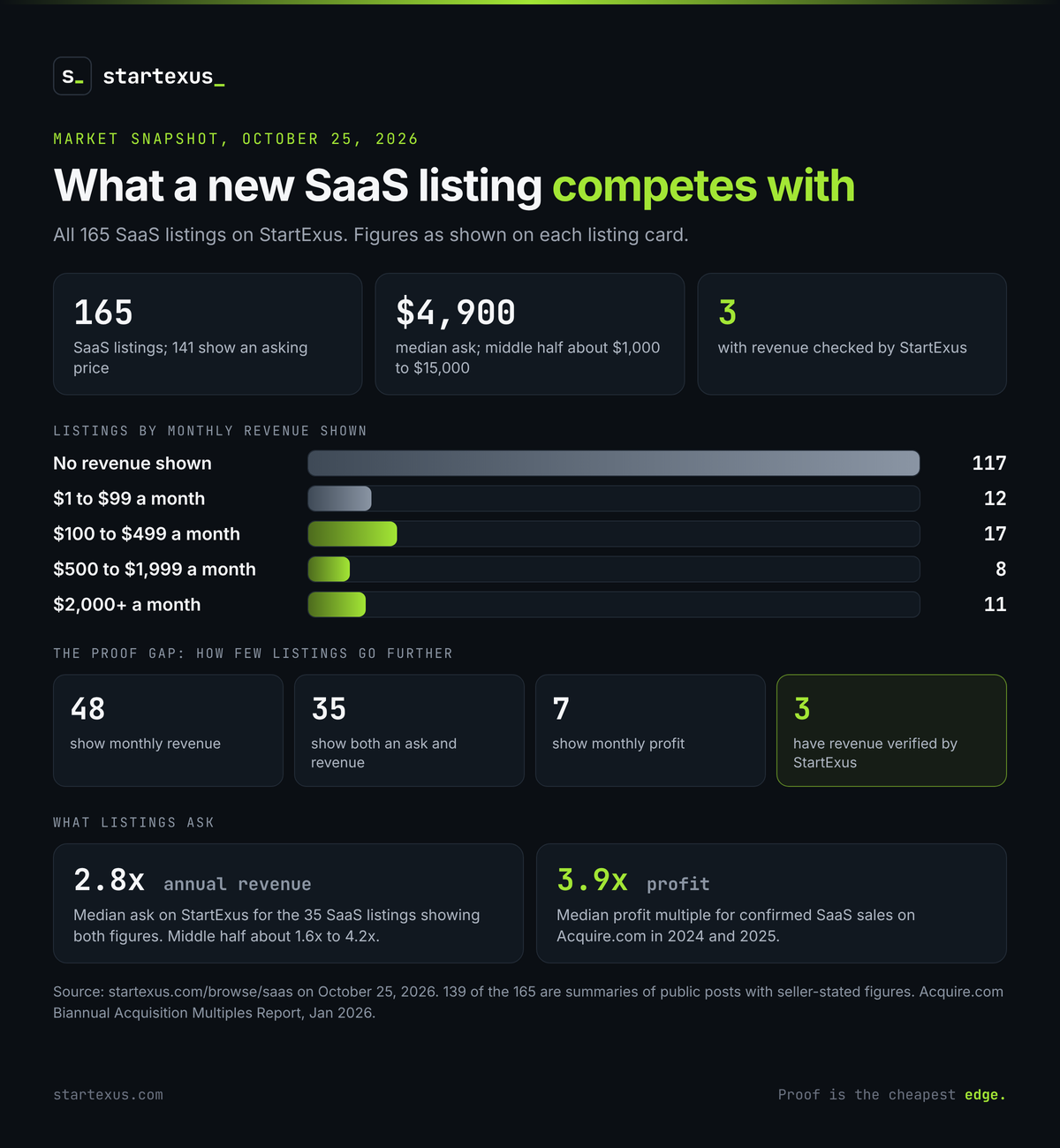
Here is the field you walk into: every SaaS listing on StartExus on October 25, 2026, with figures as shown on each listing card.
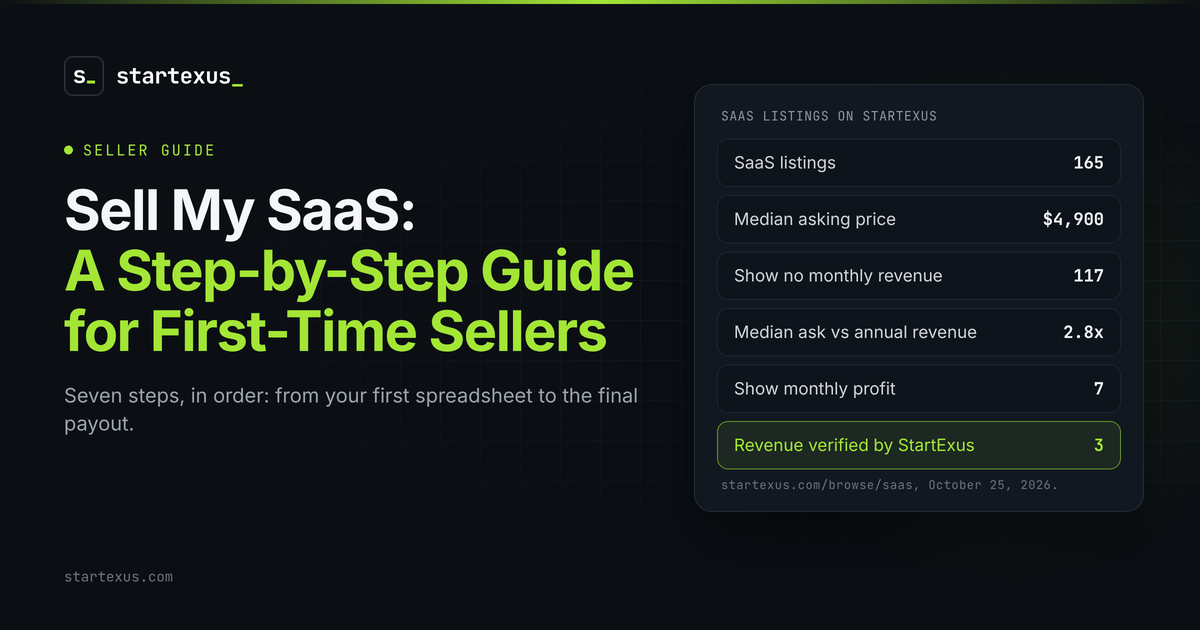
- 165 SaaS listings. 141 show an asking price. The median ask is $4,900, and the middle half asks roughly $1,000 to $15,000.
- Most show no revenue. 117 of 165 show no monthly revenue at all. Their median ask is $3,200.
- 48 show revenue. The median is about $275 a month, and their median ask is $12,000.
- Price follows revenue loosely. The 35 listings showing both an ask and revenue ask a median of 2.8x annual revenue. The middle half sits between about 1.6x and 4.2x.
- Profit and proof are rare. Only 7 show monthly profit. Only 3 have revenue checked by StartExus against source records.
That last point is your opening. Clean, proven numbers put you in a very small group.
1. Decide what you are selling and why
Before you price anything, be clear about the deal. Buyers ask this first.
- Know what is included. Most small SaaS sales are asset sales: code, domain, brand, customer accounts, content and the tools that run it. Write the list down now.
- Have a reason buyers believe. "New job", "no time" and "moving to another product" are fine. Vague answers make buyers look for the problem you are hiding.
- Set a walk-away number. Decide the lowest price you would take before the first offer arrives, not during the negotiation.
- Keep it running. The seller guide on StartExus is blunt about this: do not neglect the business during the sale. A dip in month two shows up in every buyer's spreadsheet.
2. Put your numbers in one sheet
Buyers price what they can check. Give them one place to check it.
- 12 to 24 months of revenue, by month. Pull it from Stripe or your payment processor, and make sure it matches your bank deposits.
- Every recurring cost. Hosting, APIs, email, domains, paid tools. Profit is what is left, and it is what most buyers anchor on.
- Customers and churn. Active subscribers, cancellations per month, refunds.
- Your hours. How many hours a week it really takes. Low owner time pushes the price up.
3. Price it with a formula, not a feeling
Your price is a claim. Back it with a multiple a buyer would recognize.
- Start from profit. Acquire.com's multiples report says SaaS businesses sold at a median 3.9x profit in both 2024 and 2025, mostly businesses under $10 million in value.
- Expect the ask to come down. The same report notes that asking prices are often higher than final outcomes, and that realistic prices attract more serious buyers.
- Check the local market. On StartExus, SaaS listings showing revenue ask a median 2.8x annual revenue. If you ask 8x, have a reason.
- Pre-revenue is priced as an asset. Without revenue, buyers value the code, domain and time saved. Price it as a build, not a business.
Worked example: Say your SaaS makes $600 a month and costs $90 a month to run. That is $510 a month in profit, or $6,120 a year. At 3x profit it is worth about $18,400. At the 3.9x median it is about $23,900. A sensible ask sits near the top of that range, with room to negotiate. Run your own numbers through the free valuation tool before you commit to one.
4. Write a listing a buyer can trust
A good listing answers the first ten buyer questions before they are asked. It takes about 15 minutes on StartExus once your sheet is ready.
- A specific title. Lead with what it is and its strongest proven number, like "B2B invoicing SaaS, recurring revenue, about 4 hrs/week". Not the brand name.
- A plain description. The problem it solves, who pays, how customers find it, and why you are selling.
- The asset list. Code, domain, subscribers, social accounts, docs. Everything you wrote down in step one.
- The honest weak spots. Churn, one big customer, a channel that stopped working. Buyers find these anyway. Better they hear it from you.
5. Get the numbers verified
An unchecked number is a claim. A checked one is a reason to make an offer.
- Domain ownership. Add a DNS TXT record starting with "startexus-verification=", or show admin access to your registrar.
- Revenue. A reviewer compares your listed revenue with Stripe, another processor or bank statements.
- Traffic. Your numbers are compared with your analytics, usually Google Analytics 4.
- Each passed check becomes a green badge. Anything not confirmed is labelled seller-reported, so buyers know what to ask for.
- Stay private if you need to. You can hide your name and URL and require a click-through NDA before buyers see details.
6. Talk to buyers and weigh offers
This is where first-time sellers lose deals. Usually by going quiet.
- Reply fast. Same day if you can. Momentum matters more than polish.
- Share in layers. Summary for everyone, URL and financials after the NDA, read-only access only for a serious buyer.
- Compare terms, not just price. Cash at closing, any earnout, how long you support the buyer after the sale, and exactly what is included. Acquire.com notes that higher multiples often come with conditions like earnouts or seller financing.
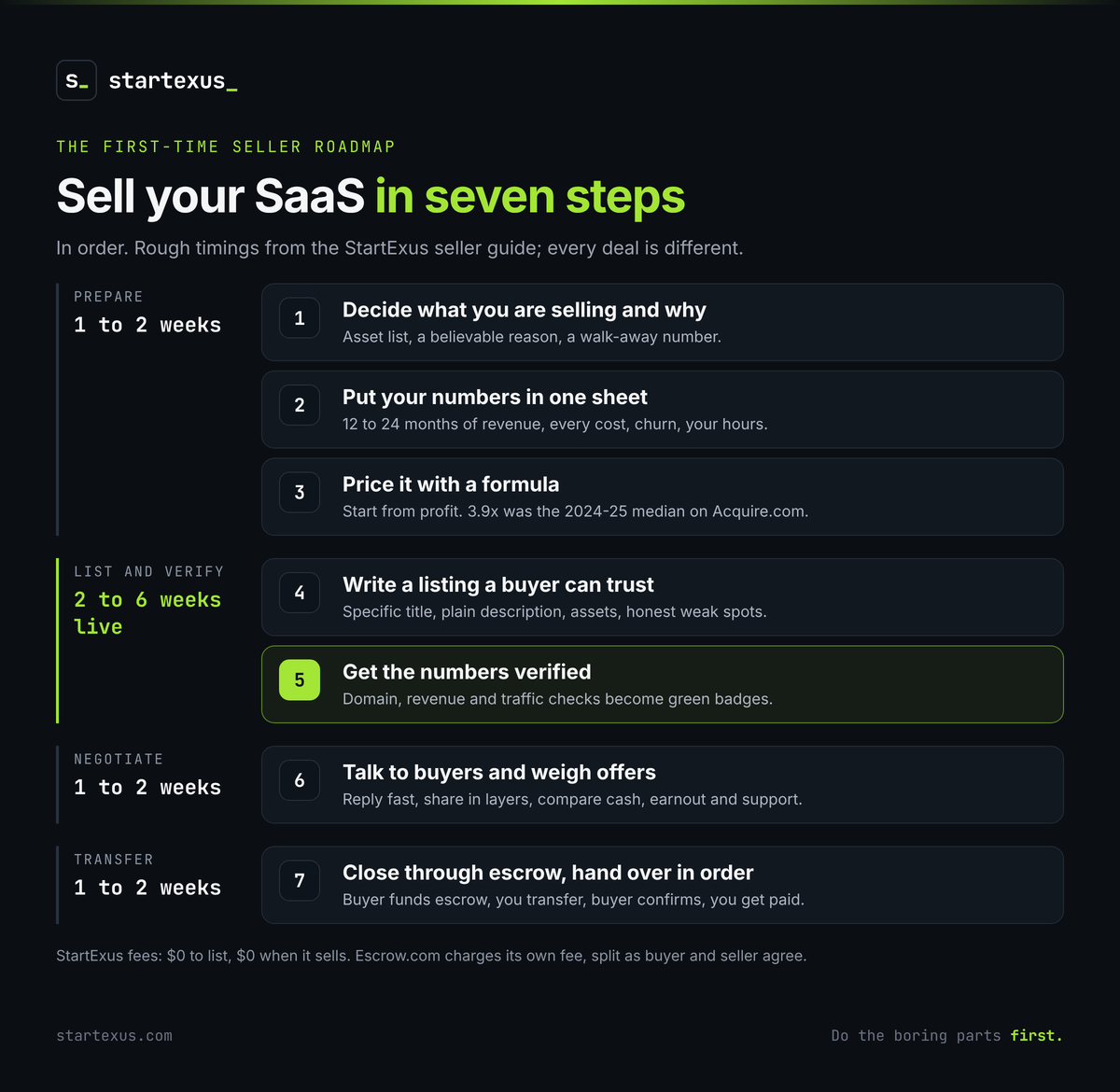
- Expect weeks, not days. The StartExus seller guide gives rough ranges: 1 to 2 weeks to prepare, 2 to 6 weeks of buyer conversations, 1 to 2 weeks each to negotiate and transfer. Acquire.com reports an 81-day average time on market for SaaS sales.
7. Close through escrow and hand over in order
The order protects both sides. Money first, assets second, payout last.
- The buyer funds escrow. With Escrow.com, the agreed price is held until the transfer is confirmed. Never hand over assets before the money is secured.
- You transfer. Domain, code repository, hosting, payment and email accounts, customer data, docs. Work from a written checklist.
- The buyer inspects, then funds are released. If something is not as described, it is sorted out before you are paid.
- Know the fees. StartExus charges $0 to list and $0 when it sells. Escrow.com charges its own fee: 2.6% with a $50 minimum up to $5,000, and 2.4% with a $130 minimum from $5,000.01 to $50,000. On an $18,400 sale that is about $442, split however you agree.
Common first-time seller mistakes
- Listing before the numbers are in one sheet.
- Pricing on effort or emotion instead of profit.
- Leaving revenue as seller-reported when it could be verified.
- Hiding a weakness the buyer will find in due diligence.
- Letting the business slide while the sale drags on.
- Transferring the domain or code before the money is in escrow.
Pro tip: Before you list, ask one question. Could a stranger run this for 30 days using only what you plan to hand over? If the answer is no, write the missing docs first. That is often the difference between an offer and a polite pass.
The bottom line
Selling a SaaS for the first time is not complicated. It is sequential. Decide, document, price, list, verify, negotiate, close.
Do the boring parts first. Clean numbers and verified revenue do more for your price than any listing copy.
For the details, read the StartExus seller guide, see exactly what gets checked on the trust and verification page, and work through the 8-week sellability playbook if you need time to get ready.
Browse current SaaS businesses for sale on StartExus, or list your business for sale for free. No listing fee, no success fee, no buyer fee.
Tags
- due diligence
- valuation
- saas
- ai
- acquisition