
Most side projects do not need a broker to sell. They need a clear number, a clean handover and the right buyers seeing the listing.
Brokers earn their fee on big, messy deals. On a $25,000 side project, a minimum fee can take a large share of the exit. Or the broker simply passes, because the deal is too small to be worth their time.
This is the guide I would hand a friend who wants to sell a side project on their own. Six steps, real math, no hype.
Why selling without a broker can make sense
Brokers are usually paid a success fee when the deal closes. That model works on larger exits. On small ones, the math gets tight.
- Minimum fees bite small deals. Empire Flippers, a well-known brokered marketplace, lists a $10,000 commission on sales up to about $66,667 and 15 percent above that, up to $700,000 (seller FAQ, checked October 2026).
- Exclusivity slows you down. The same FAQ asks for at least two months of exclusive listing. That is two months you cannot test other channels.
- Small deals are simple. A project with one codebase, one payment account and a domain does not need a team to transfer it.
- A broker still fits sometimes. If the deal is large, the business is complex or you have zero time, paying for process can be the right call.
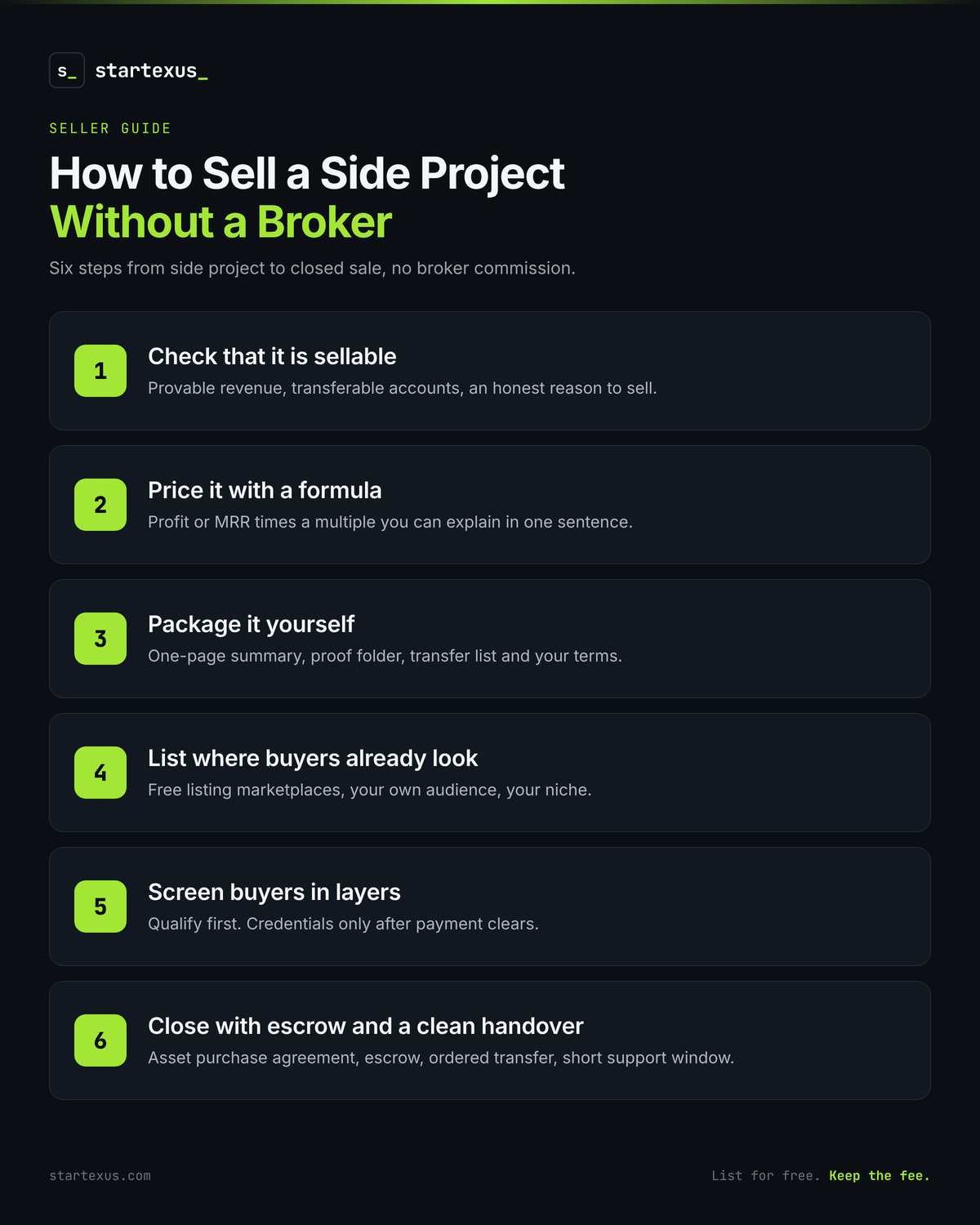
1. Check that it is sellable
Buyers pay for cash flow and assets they can actually take over. Before you list, make sure you have both.
- Revenue you can prove. Stripe, Paddle or App Store exports beat screenshots. Several months of history is a solid start.
- Assets in transferable accounts. Domain, repo, hosting and payment accounts should move cleanly to a new owner.
- A reason that is not a red flag. "New full-time job" is fine. "Churn is climbing and I am tired" needs disclosure, not spin.
- Low owner dependence. If it only works because you answer every email in ten minutes, write that process down.
2. Price it with a formula
An ask without a formula reads like a guess. Anchor it to profit or recurring revenue and a multiple you can explain.
- Start from profit. Revenue minus hosting, tools, ads and contractors. That is the number buyers will rebuild anyway.
- Pick a multiple you can defend. Growth, churn, age and weekly workload all push it up or down.
- Show the math on the listing. "$700 monthly profit, asking 3x annual" invites a conversation. A bare number invites lowballs.
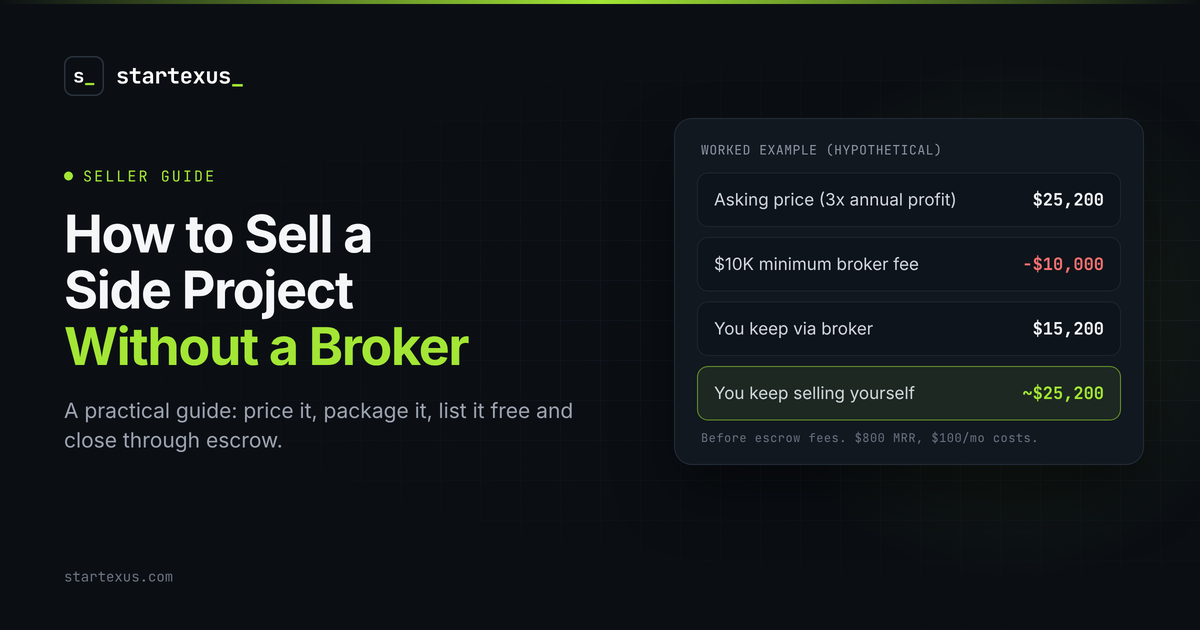
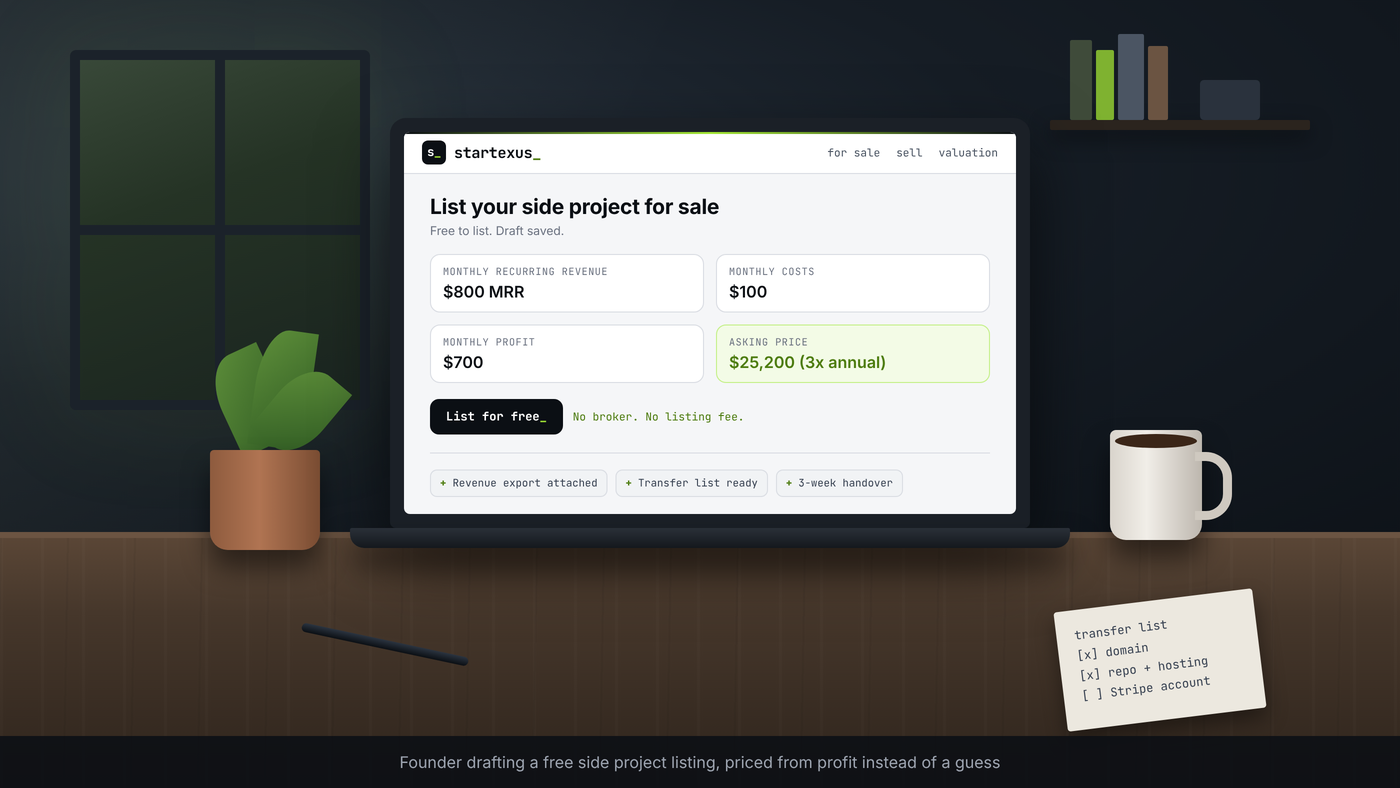
Worked example (hypothetical): Say your project makes $800 MRR with $100 a month in costs. That is $700 profit a month, or $8,400 a year. At 3x annual profit, the ask is $25,200. If a brokered marketplace with a $10,000 minimum commission took the deal, you would keep about $15,200. Sell it yourself and your main costs are an escrow fee and a few evenings of buyer questions. That gap is close to $10,000.
3. Package it yourself
A broker's real product is packaging. You can do it in an afternoon.
- One-page summary. What it does, who pays, trailing revenue and profit, asking price and why you are selling.
- Proof folder. Payment exports, analytics, an expense list and churn numbers, shared only after a buyer is screened.
- Transfer list. Every account and asset that changes hands, and how each one moves.
- Your terms. Price, cash or earnout, and how many weeks of handover support you will offer.
4. List where buyers already look
Without a broker, distribution is your job. Go where people already shop for small online businesses.
- Free listing marketplaces. On StartExus you can list a business for sale at no cost, and founders can claim existing listings for free.
- Your own audience. A post on X, LinkedIn or your newsletter reaches people who already understand the product.
- Founder communities. Indie hacker and side project groups, where the rules allow sale posts.
- Adjacent companies. A tool in your niche may value your users more than any marketplace buyer.
5. Screen buyers in layers
Your time is the scarce resource now. Qualify buyers before you share anything sensitive.
- Ask three questions first. Budget, timeline and what they plan to do with the project.
- Share in layers. Summary for everyone, proof folder after a short call, credentials only after payment clears.
- Use a simple NDA if you want one. It filters out tire kickers before the proof folder.
- Recap every call in writing. A short email after each conversation prevents surprises at closing.
Pro tip: If a buyer wants admin access before a signed agreement and funded escrow, the answer is no. A screen share during a call answers nearly every honest diligence question.
6. Close with escrow and a clean handover
This is the step a broker usually manages. Keep it boring and documented.
- Sign a simple asset purchase agreement. List the assets, price, handover period and any non-compete. Have a lawyer review it if the amount matters to you.
- Use a third-party escrow service. The buyer funds escrow, you transfer, the buyer confirms and funds release. Neither side has to trust the other first.
- Transfer in a set order. Code and hosting, then domain, then payment and email accounts, with a checklist both sides tick off.
- Offer a short support window. Two to four weeks of email support is a reasonable offer on a small deal and reassures buyers.
Your no-broker exit checklist
- Revenue proof exported from your payment processor.
- Every asset sitting in an account you can transfer.
- Asking price written as profit or MRR times a multiple.
- One-page summary, proof folder and transfer list ready.
- Listing live on at least one free marketplace plus your own channels.
- Three screening questions ready for every buyer.
- Asset purchase agreement and escrow service chosen before the first offer.
The bottom line
Selling a side project without a broker is not about avoiding help. It is about not paying for help a small deal does not need.
Price it with a formula, package it once, show it to the right buyers and close through escrow. Keep the fee. Keep the control.
Browse current deals on StartExus, check the valuation guide, or list your side project for sale for free.
Tags
- online business
- valuation
- ai
- growth
- exit strategy