
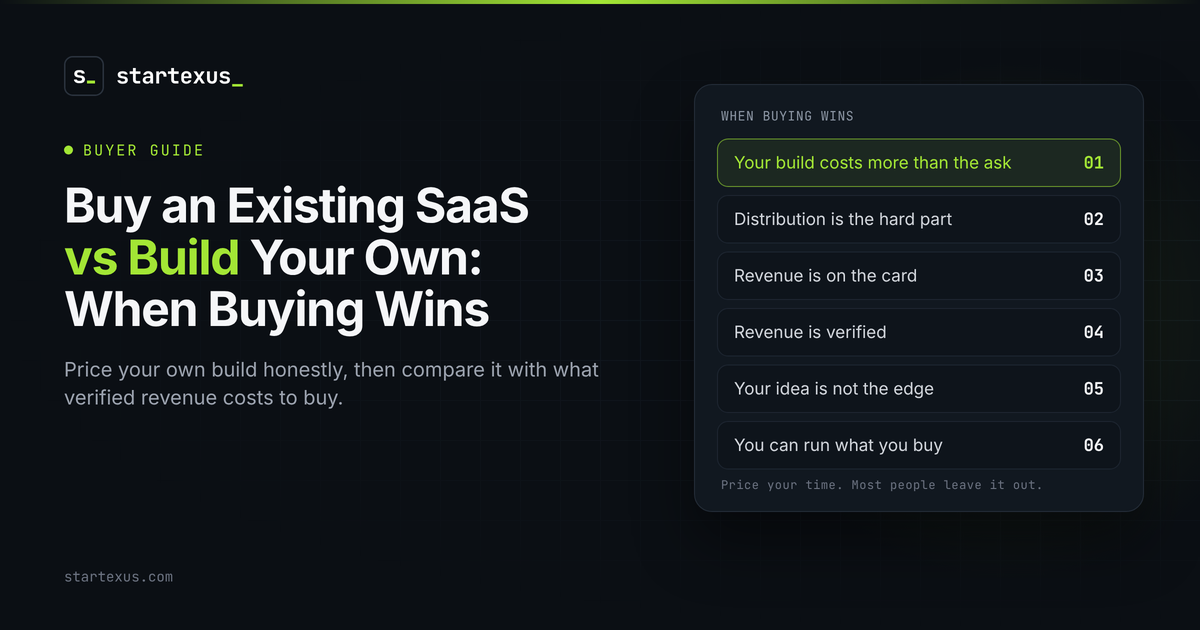
Building a SaaS has never been cheaper. Getting it to its first paying customers costs what it always did: months of your time, with no promise at the end.
Buying an existing SaaS flips that trade. You pay up front, and you start with a product, users and revenue on day one. You also inherit someone else's decisions.
Neither path is always right. This is the test I would use to decide which one fits you, with real asking prices from StartExus.
1. Price your build honestly
Most founders compare an asking price with zero. Building is not free. It just bills you in hours.
- Count your hours. Evenings and weekends add up fast. Put a dollar value on them, even a modest one.
- Add the running costs. Hosting, AI APIs, email, a domain, the tools you will pay for while revenue is still $0.
- Count the months to revenue. The product is the easy part. Launch, feedback and the first ten customers take longer.
- Be honest about the odds. Plenty of shipped products never reach meaningful revenue.
Worked example: you build nights and weekends, 8 hours a week for 6 months. That is about 208 hours. At $50 an hour, that is $10,400 of your time, plus a few hundred dollars in tools, and you start at $0 MRR. A small SaaS earning $300 a month, at 33 months of revenue, asks about $9,900. Similar money. Only one comes with customers.
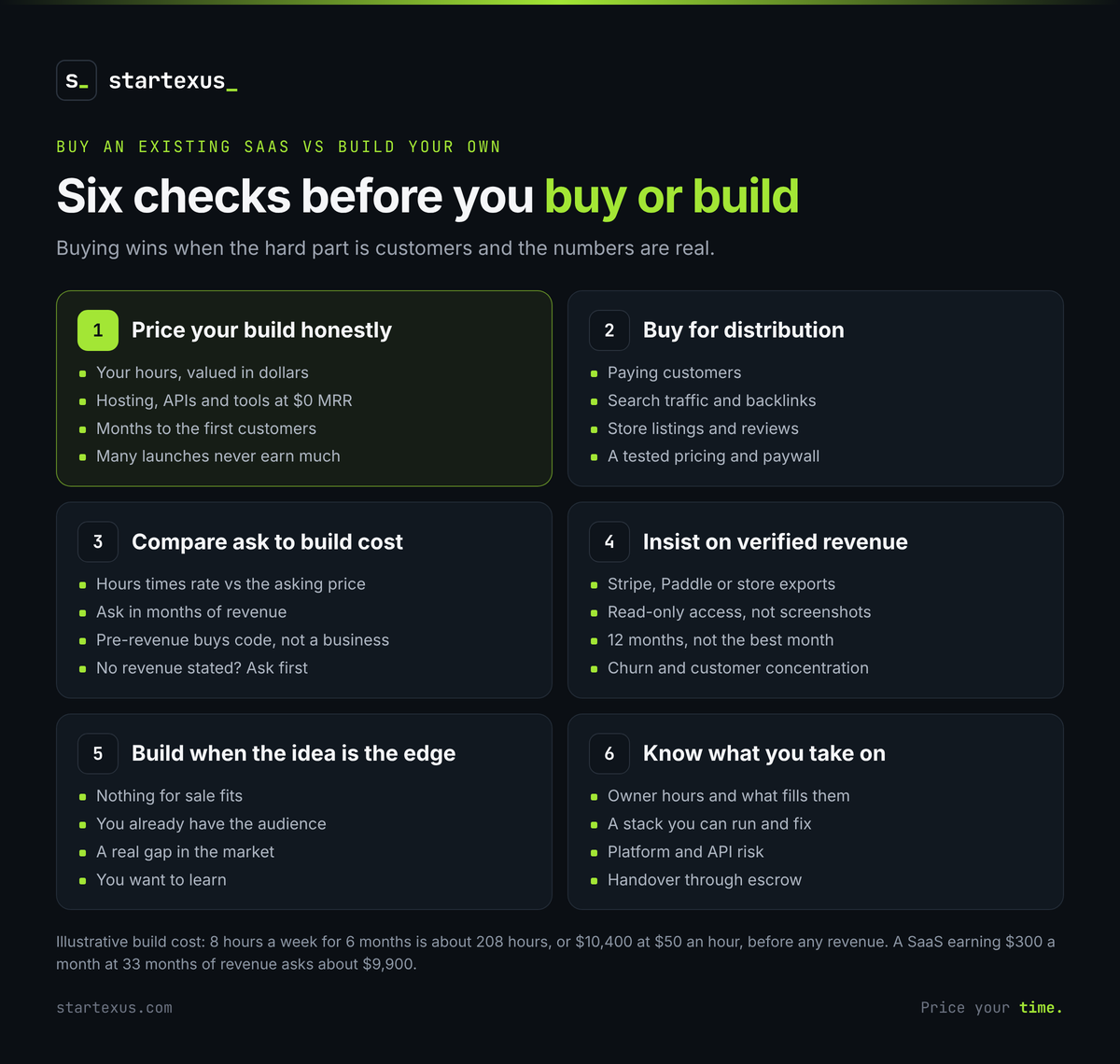
2. Buy when distribution is the hard part
Code is rarely the moat in a small SaaS. The customers, the search rankings and the integrations usually are.
- Paying customers. Each one already found the product, trusted it and pulled out a card.
- Search traffic and backlinks. An aged domain that ranks takes years to rebuild.
- Marketplace listings and reviews. App store, plugin directory or integration pages with ratings.
- A working funnel. Pricing, onboarding and a paywall that someone already tested.
If you are a strong builder and a weak marketer, this is where buying wins.
3. Compare the ask to what building would cost
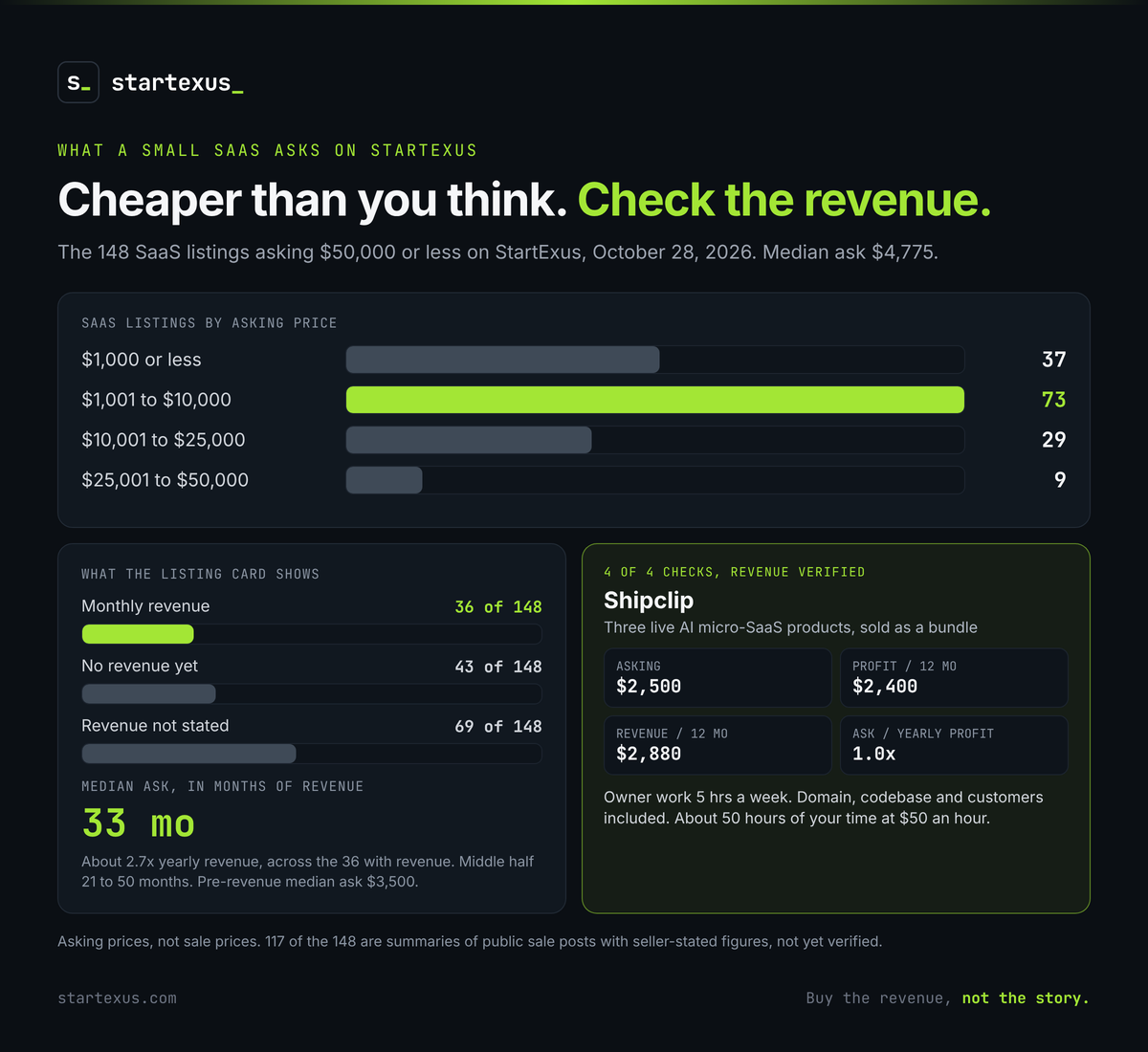
Small SaaS businesses are cheaper than most first-time buyers expect. On StartExus on October 28, 2026, 148 SaaS listings asked $50,000 or less. Their median ask was $4,775, and 110 of them asked $10,000 or less.
- Revenue on the card. 36 of the 148 showed monthly revenue. Their median ask was about 33 months of revenue, roughly 2.7x yearly revenue. The middle half ran from 21 to 50 months.
- Pre-revenue code. 43 showed no revenue yet. Their median ask was $3,500. That buys a finished product, not a business.
- No number at all. 69 did not state revenue. Ask before you get interested.
Those are asking prices, not sale prices. And 117 of the 148 were summaries of public sale posts with figures not yet verified.
4. Buy when the revenue is verified
A cheap SaaS is only a bargain if the numbers are real. Check them before you compare anything.
- Source records. Stripe, Paddle or App Store exports, or read-only access. Not screenshots.
- Twelve months. A steady year beats one good month.
- Churn and concentration. How many customers leave each month, and how much of the revenue sits with one of them.
Example: Shipclip, a bundle of three live AI micro-SaaS products, asks $2,500. Its listing shows $2,880 revenue and $2,400 profit over 12 months, both verified, about 1.0x yearly profit, with 5 hours a week of owner work. Domain, codebase and customers are included. Small, but it is a running business with checked numbers, for the price of 50 hours of your time at $50 an hour.
5. Build when the idea is the edge
Buying is not always the answer. Build when what you bring cannot be bought.
- Nothing for sale fits. If every listing in your niche is a stretch, do not force it.
- You already have the audience. A newsletter, a community or a client list makes the first customers cheap.
- The idea is new. A real gap in the market is worth more than someone else's version of a crowded one.
- You want to learn. Building teaches things buying cannot. Just do not call it an investment.
6. Know what you are taking on
When you buy, you buy the past along with the revenue. Read it before you sign.
- Owner workload. Five hours a week of support is a job. Ask what fills them.
- The stack. Can you run, fix and deploy it? A stack you cannot maintain is a liability.
- Platform risk. Products built on one marketplace or one API can lose everything to a policy change.
- The handover. Domain, code, payment accounts and customer data, all transferred through escrow.
Your buy-or-build test
- What would building cost in hours, tools and months to revenue?
- Is distribution or code the hard part for you?
- Does a listing in your niche ask less than that build cost?
- Can the seller prove 12 months of revenue from source records?
- Can you run the product and the support without the seller?
The bottom line
Buy when the hard part is customers, the revenue is verified and the ask is below what your own build would really cost. Build when you have the audience, the idea or the time that nobody can sell you.
Either way, price your time. It is the number most people leave out.
Ready to compare? Browse SaaS businesses for sale on StartExus, check what a listing is worth with the free valuation tool, or list your business for sale for free, with no listing fee and no success fee.
Tags
- investment
- valuation
- saas
- ai