
Under $50K is where a lot of first-time buyers start. It is also where the best deals and the worst ones look almost identical. Same clean landing page. Same confident revenue number. Same "selling because I have no time."
The difference is never on the listing card. It is in what the seller can prove, how the money is trending and how much of your week the business will eat.
Here is how to spot a good deal on a small online business for sale, before you spend a weekend on due diligence. This is the filter I would hand a friend.
What a good deal under $50K actually looks like
A good deal is not the cheapest listing. It is a business where the price matches what you can verify, and the risk is one you understand.
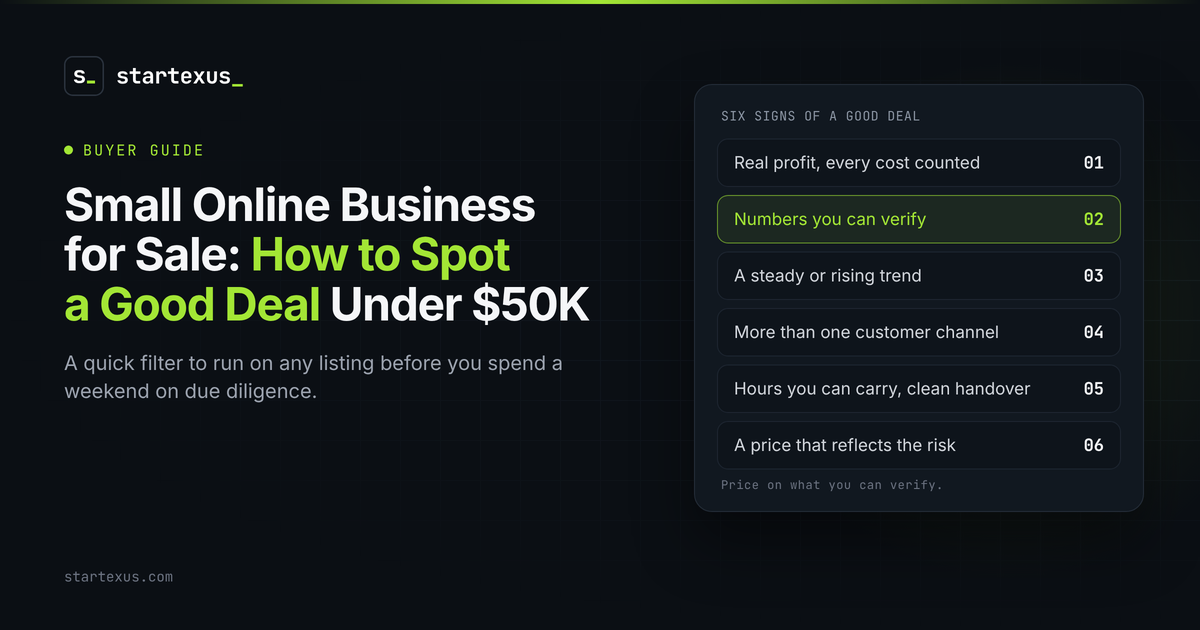
- Real profit. Money left after every cost, not just revenue.
- Proof. Numbers checked against Stripe, the app store, ad networks or analytics, not screenshots.
- A steady or rising trend. Not one great month.
- Customers from more than one place. One channel is a single point of failure.
- A workload you can carry. Hours a week you can actually give it.
- A clean handover. Domain, code, accounts and content that really transfer.
Most listings fail at least one of these. That is normal. A good deal is one where you know which one, and the price reflects it.
1. Start with profit, not revenue
Revenue is the number sellers lead with. Profit is the number you live on.
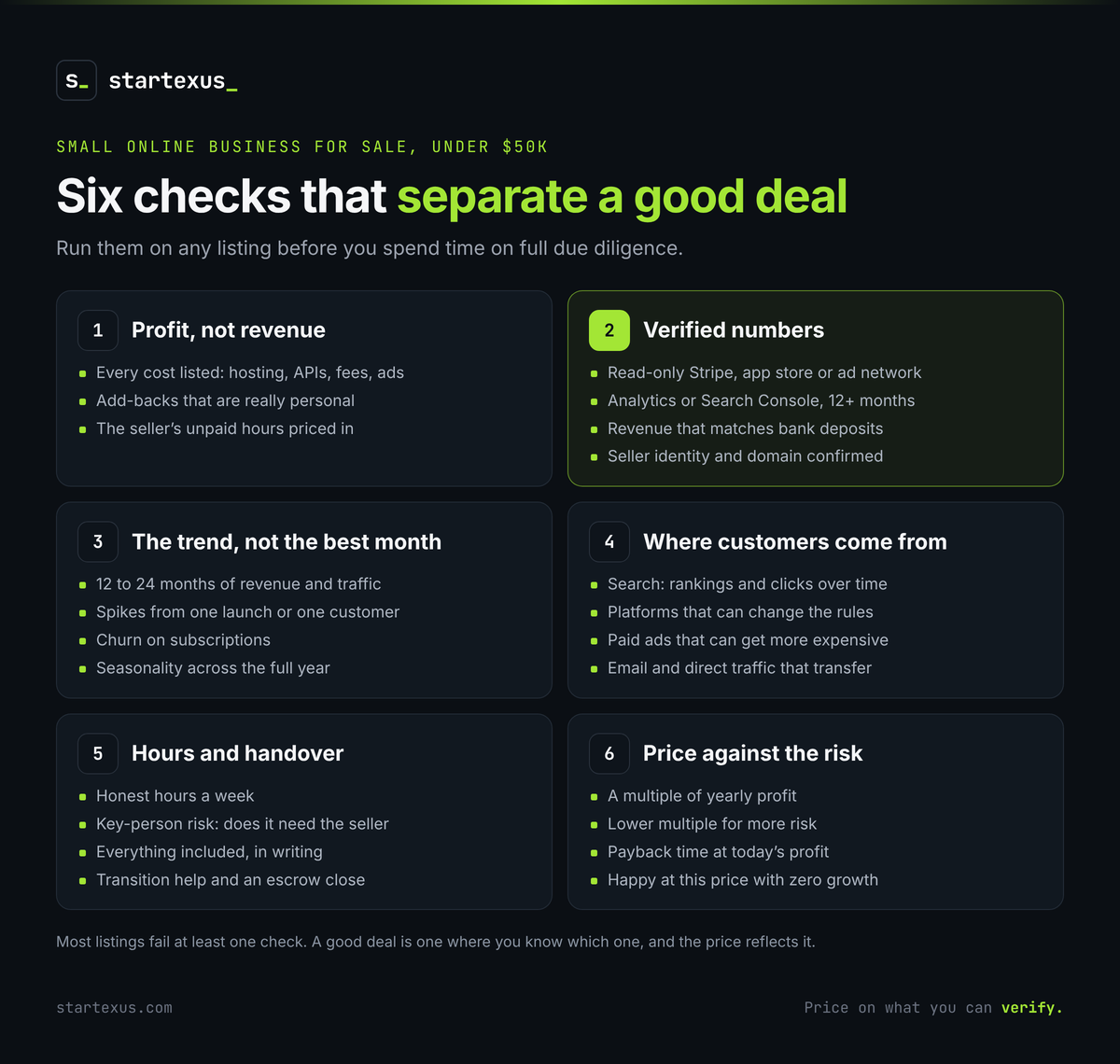
- List every cost. Hosting, APIs, software, payment fees, contractors, ads, app store cuts.
- Add back carefully. A seller's personal expenses can come out. Real costs of running the business cannot.
- Price your own time. If the seller does 15 hours a week of support for free, that work still has to get done.
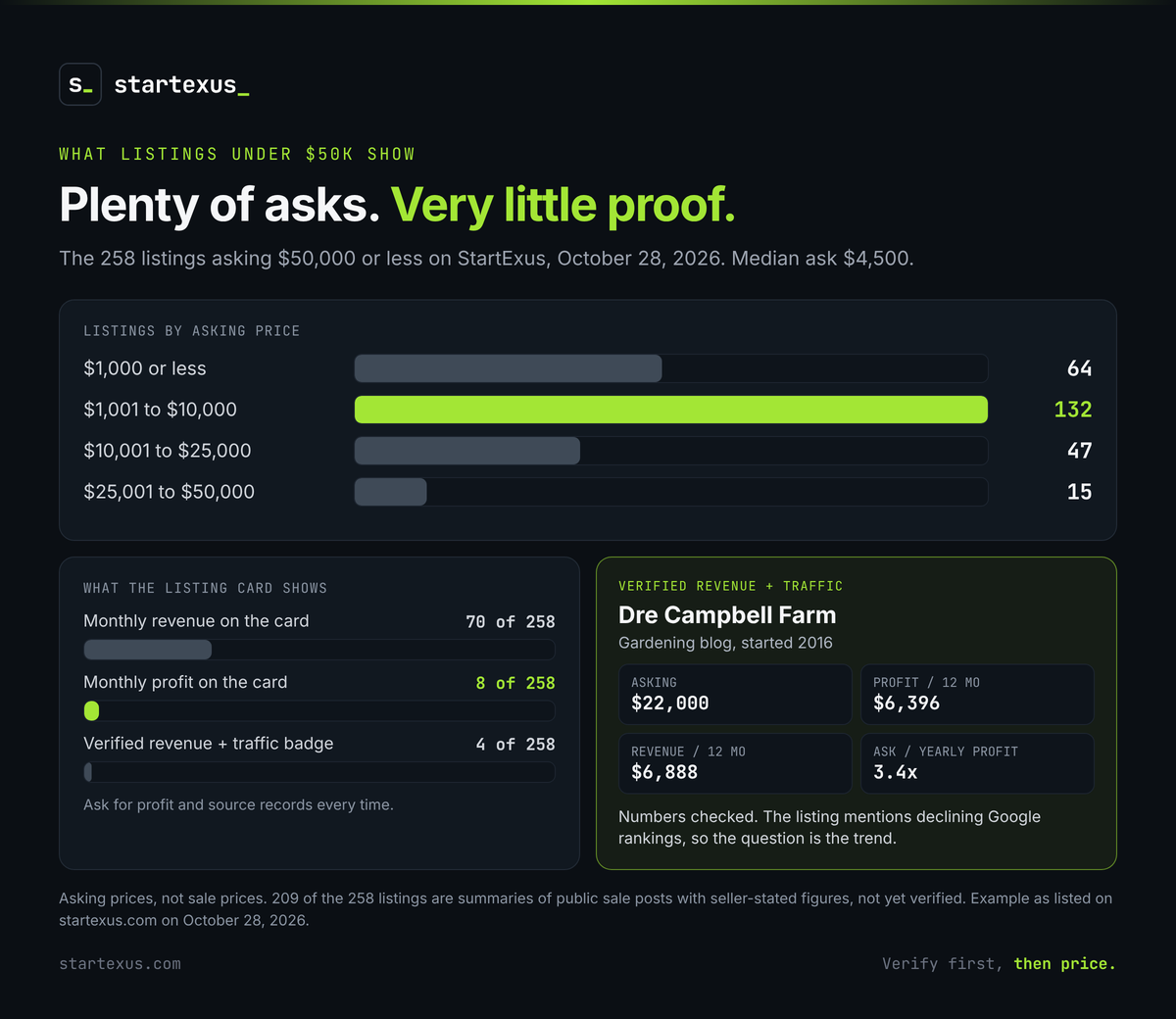
On StartExus on October 28, 2026, only 8 of the 258 listings asking $50K or less showed a monthly profit figure on the listing card. Ask for it every time.
2. Check the numbers are verified
At this price, nobody is auditing the books for you. Verification is your job.
- Source records, not screenshots. Read-only access to Stripe, App Store Connect, Google Play, AdSense or the affiliate dashboard.
- Analytics access. Google Analytics or Search Console, ideally 12 months or more.
- Bank deposits. Revenue should match what actually landed in the account.
- Identity and domain. Confirm the seller is who they say and controls the domain.
In the same snapshot, 4 of the 258 listings carried a verified revenue and traffic badge. That is not a reason to skip the rest. It means you do the checks yourself.
3. Read the trend, not the best month
A business earning $800 a month and falling is worth less than one earning $500 and climbing.
- Ask for 12 to 24 months. Monthly revenue, profit and traffic, side by side.
- Look for spikes. One launch, one viral post or one big customer can flatter the average.
- Check churn. For subscriptions, how many customers are still paying after a few months.
- Note seasonality. Some niches peak once a year. Price on the full year.
4. Find out where customers come from
Small businesses often live on one channel. Know which one before you buy.
- Search. Check rankings and clicks over time. Algorithm updates can move small sites a lot.
- Platforms. App stores, marketplaces, social networks and browser stores can change rules.
- Paid ads. Profit can disappear if costs rise.
- Direct and email. Usually the most durable. An email list that transfers is a real asset.
5. Count the hours and what transfers
You are buying a job as much as an asset. Know how big it is.
- Hours a week, honestly. Support, content, fixes, marketing.
- Key-person risk. Does the business depend on the seller's name, network or face?
- What is included. Domain, code, accounts, content, social pages, lists, supplier deals. In writing.
- Transition help. A few weeks of questions answered is worth asking for.
- A safe close. Use escrow so money moves only after the assets do.
6. Price it against the risk
Small online businesses are often priced as a multiple of yearly profit. The multiple should drop as risk goes up.
Worked example: A site makes $1,000 a month in profit, so $12,000 a year. At 2.5x yearly profit, that is $30,000. If it takes 10 hours a week, about 43 hours a month, you are earning roughly $23 an hour and waiting about 2.5 years to earn the price back, if nothing breaks. Fine for some buyers. Not for everyone.
Then compare with real asks. Dre Campbell Farm, a gardening blog on StartExus started in 2016, asks $22,000 on $6,396 of verified profit over 12 months, about 3.4x. The numbers are checked. The listing itself mentions declining Google rankings and a traffic recovery plan, so the question for a buyer is the trend, not whether the revenue is real.
Red flags that should slow you down
- Revenue with no profit figure.
- Screenshots instead of read-only access.
- One month that carries the whole average.
- All traffic from one source with no history shown.
- A business that only works because the seller is in it.
- Pressure to pay quickly, outside escrow.
- A price far below what the numbers suggest, with no clear reason.
Test question: If revenue stayed flat for two years, would you still be happy at this price? If yes, it may be a good deal. If you need growth to make it work, you are paying for the seller's plan.
The bottom line
A good deal under $50K is not a bargain on paper. It is a business whose profit you have verified, whose trend you understand and whose workload you can carry, at a price that reflects the risks you found.
Filter hard. Most listings fail. The ones that pass are worth a serious look.
Estimate what a business is worth with the StartExus valuation calculator, and read how StartExus verifies listings before you make an offer.
Browse online businesses for sale under $50K on StartExus, or list your business for sale for free. No listing fee, no success fee, no buyer fee.
Tags
- online business
- due diligence
- valuation
- ai
- growth