Selling an app is not hard because buyers are rare. It is hard because most sellers show up with a price they cannot back up and a handover they have never tested.
A broker fixes some of that. They also take a cut of the sale, and some will not take small deals at all. For a small iOS or Android app, you can do the job yourself.
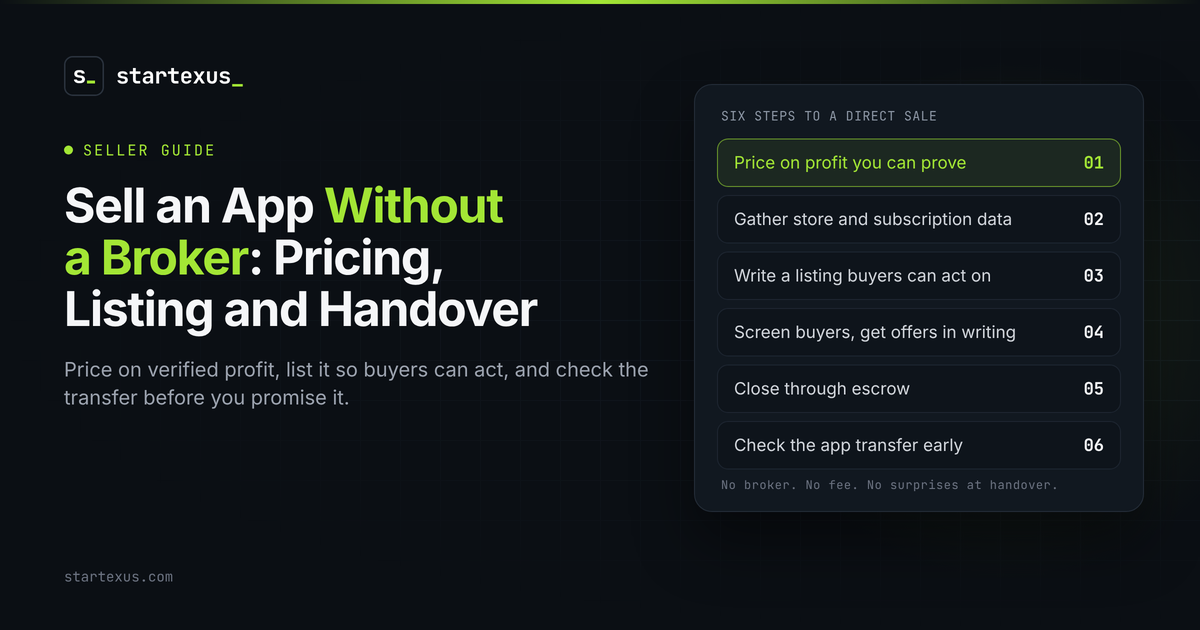
Here is how to sell an app without a broker: price it, list it so serious buyers reply, and hand it over without a nervous week in App Store Connect.
Why sell an app without a broker
Small apps suit a direct sale. The assets are clear, the revenue sits in one or two dashboards and the transfer is a documented process.
- You keep the fee. On a $20,000 sale, a broker's cut is real money.
- You know the app best. Nobody can answer a buyer's questions about churn, reviews or the paywall faster than you.
The trade-off: you do the pricing, screening and paperwork yourself.
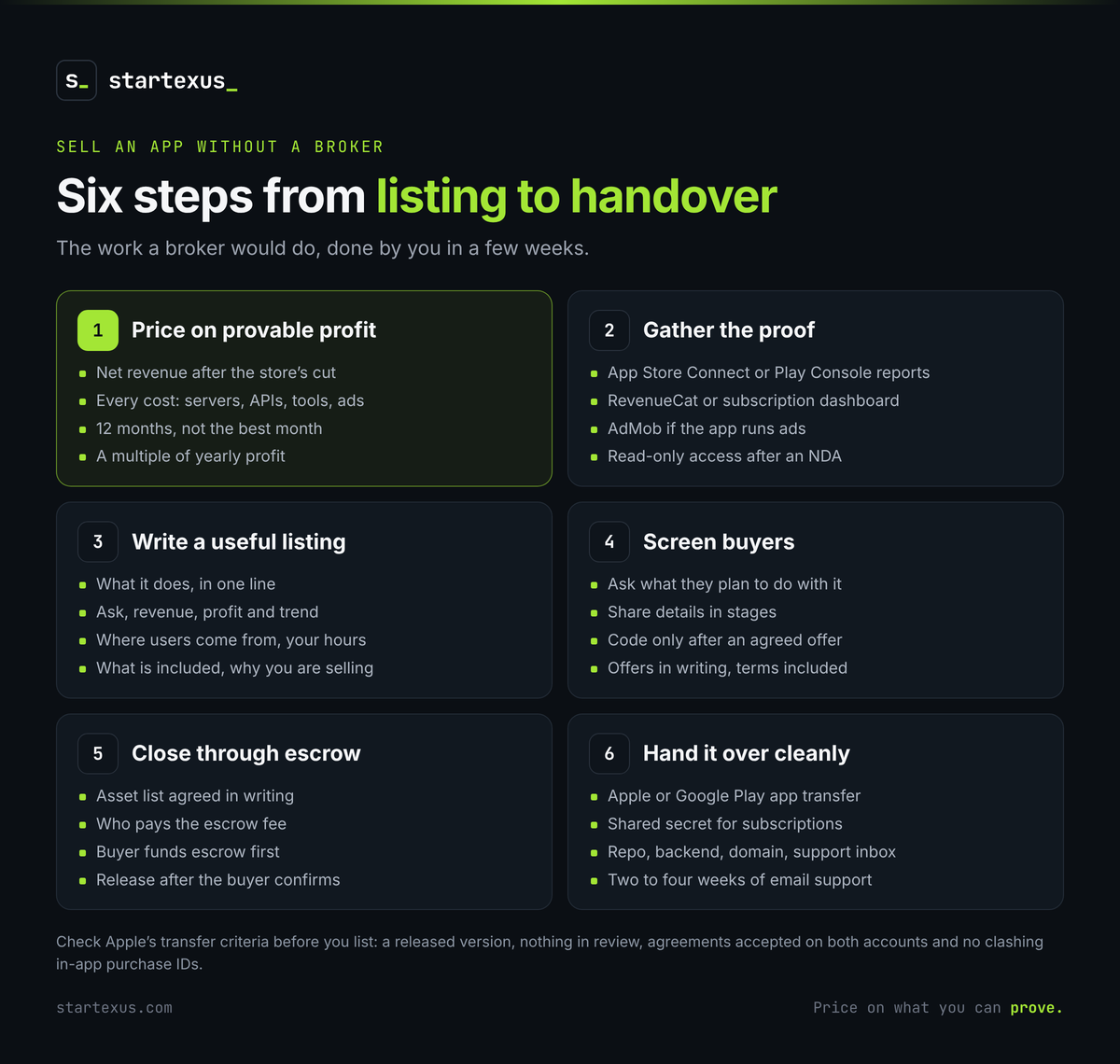
1. Price it on numbers a buyer can check
Buyers price on profit and proof. Not on downloads, and not on the month the app got featured.
- Use net revenue. What lands after Apple or Google's cut and refunds, not the gross number in your paywall tool.
- Subtract every cost. Servers, AI APIs, RevenueCat, ads, contractors, the developer account.
- Use 12 months. A steady year earns a better multiple than one good month.
- Anchor on a multiple. Small apps usually trade at a multiple of yearly profit, lower when revenue depends on one channel or on you.
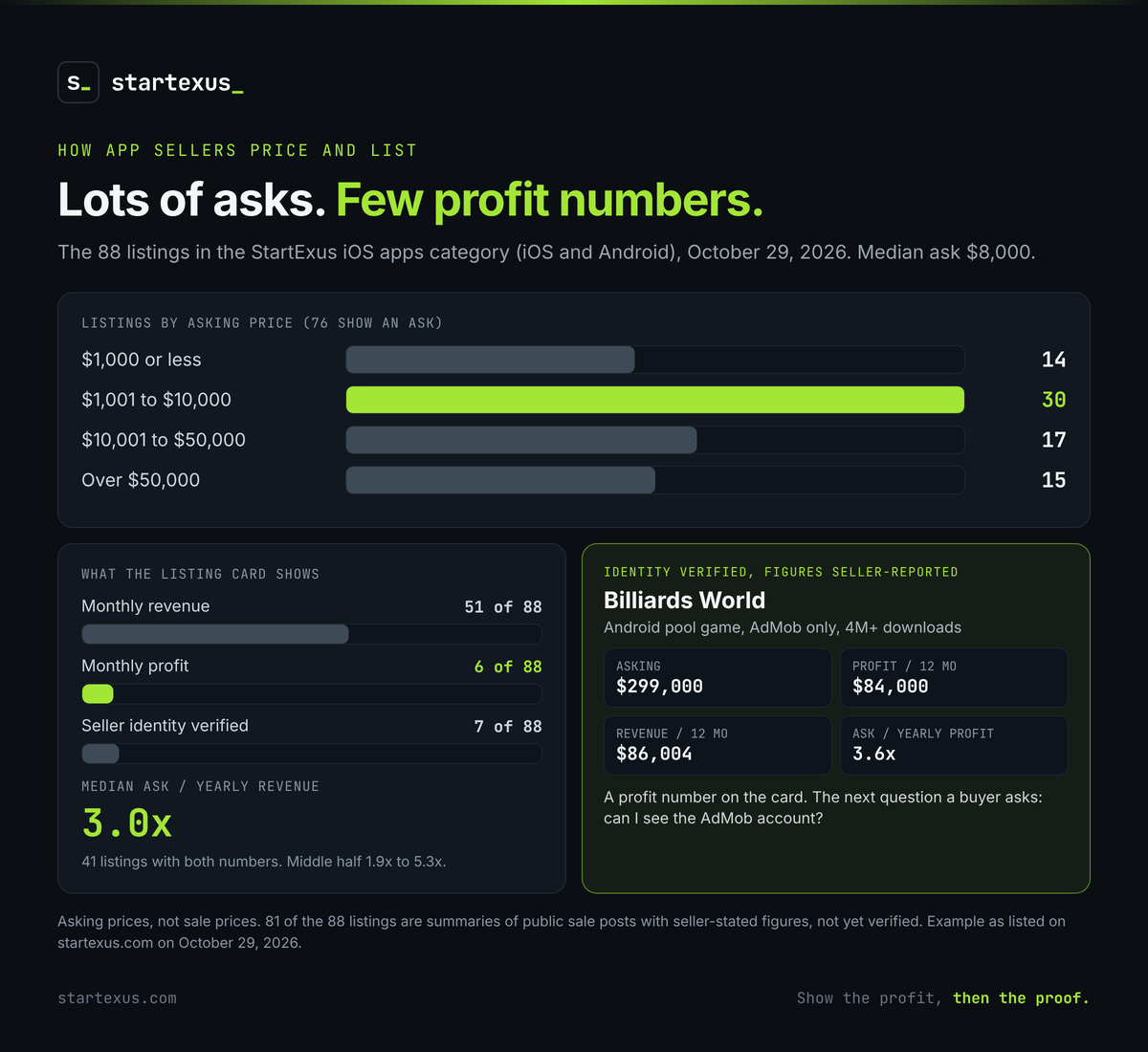
On StartExus on October 29, 2026, 41 of the 88 listings in the iOS apps category showed both an asking price and monthly revenue. Their median ask was about 3.0x yearly revenue, and the middle half ran from 1.9x to 5.3x. Those are asks, not sale prices.
Worked example: your app nets $1,500 a month after Apple's cut and spends $200 a month on servers and APIs. That is $1,300 profit, or $15,600 a year. At 2x to 3x yearly profit, a fair ask is $31,000 to $47,000. Ask for $90,000 and you will spend months explaining why.
2. Gather the proof before you list
The first serious buyer will ask for proof. Have it ready.
- Store reports. App Store Connect or Google Play Console sales and trends, 12 months or more.
- Subscription data. RevenueCat, Superwall or your own dashboard: MRR, active subscribers, trial conversion, churn.
- Ad revenue. AdMob or your mediation dashboard if the app runs ads.
- Costs. Invoices for hosting, APIs and tools, so profit is not a guess.
Read-only access beats screenshots. Offer it after an NDA.
3. Write a listing buyers can act on
A good listing answers the questions that would otherwise cost you three emails each.
- What it does, in one line. "Habit tracker for iOS with a $4.99 monthly plan" beats a paragraph of adjectives.
- The money. Asking price, monthly revenue, monthly profit and the trend.
- Where users come from. App store search, TikTok, ads, a single big referral.
- Your hours. Honest hours a week to run it, and what those hours are spent on.
- What is included. Code, app store listing, domain, social accounts, email list, design files.
- Why you are selling. Short and true.
Profit is the number most listings skip. In the same snapshot, only 6 of the 88 iOS app listings showed monthly profit on the listing card. Showing it puts you ahead of the pile.
4. Screen buyers and handle offers
Without a broker, you are the filter. Keep it simple.
- Ask what they plan to do with it. Real buyers have a plan. Tire kickers have questions.
- Share details in stages. Headline numbers in public, dashboards after an NDA, code after an agreed offer.
- Get offers in writing. Price, what is included, payment terms, transition help and a target close date.
- Watch the terms. A slightly lower all-cash offer often beats a bigger one paid over a year.
5. Close through escrow
Escrow protects both sides. The buyer pays into escrow, you transfer the app, the buyer confirms and the money is released to you.
- Agree the asset list first. Write down exactly what transfers and when.
- Agree who pays escrow fees. Splitting them is common.
- Do not transfer before funds are secured. That is the one rule that saves sellers from the worst outcome.
6. Plan the handover before you list
The handover is where a direct sale goes wrong. Check it is possible before you promise it.
- Apple app transfer. In App Store Connect, the Account Holder starts the transfer and the buyer's Account Holder accepts it within 60 days. The app keeps its reviews and ratings, and users keep getting updates.
- Check Apple's criteria. At least one released version, no version in review and accepted agreements on both accounts. In-app purchase product IDs cannot clash with the buyer's existing apps.
- Subscriptions. For auto-renewable subscriptions, share the app-specific shared secret before the transfer so the buyer can keep validating receipts.
- Google Play. Use Play Console's app transfer between developer accounts. Download your reports first, because earnings reports do not move with the app.
- Everything else. Repository, backend, RevenueCat project, analytics, domain, support inbox, socials.
- Transition help. Offer two to four weeks of email support. It makes the price easier to accept.
Example from StartExus: Billiards World, an Android pool game monetized with AdMob, is listed at $299,000 on $84,000 of seller-reported yearly profit, about 3.6x. The seller's identity is verified, and revenue and traffic are still seller-reported. That is the gap a buyer will ask about first.
Common mistakes
- Pricing on gross revenue before the store's cut.
- Listing without a profit number.
- Sending source code before an agreed offer.
- Finding out mid-sale that the app cannot be transferred as is.
- Transferring the app before the money is in escrow.
The bottom line
You do not need a broker to sell a small app. You need a price tied to verified profit, a listing that answers the obvious questions and a handover you have checked in advance.
Do those three things and most of the back and forth disappears. So does the fee.
Ready to sell? List your app for sale on StartExus for free, with no listing fee and no success fee, or browse iOS apps for sale to see how other sellers price theirs.
Tags
- ai
- roi