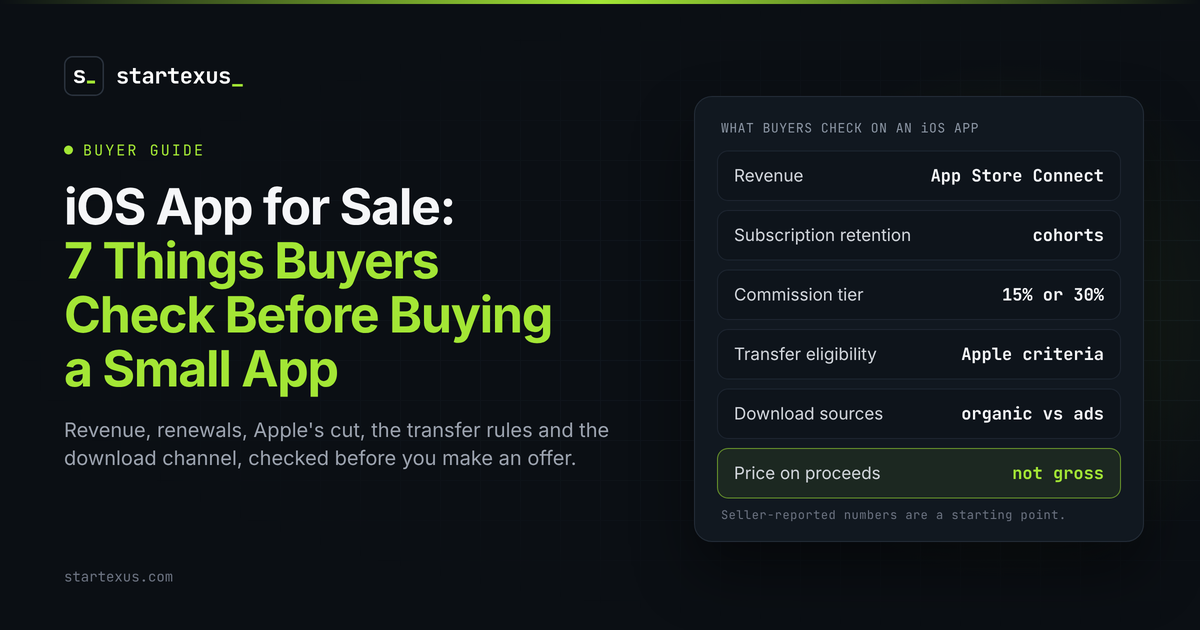
A small iOS app can be one of the cleanest online businesses you can buy. Apple handles billing, and the app moves to your developer account without losing a single review. It can also be a subscription base that quietly stops renewing the month after you pay.
The App Store adds its own layer to due diligence: Apple's commission, transfer rules, renewals and a ranking you do not control. A revenue screenshot covers none of it.
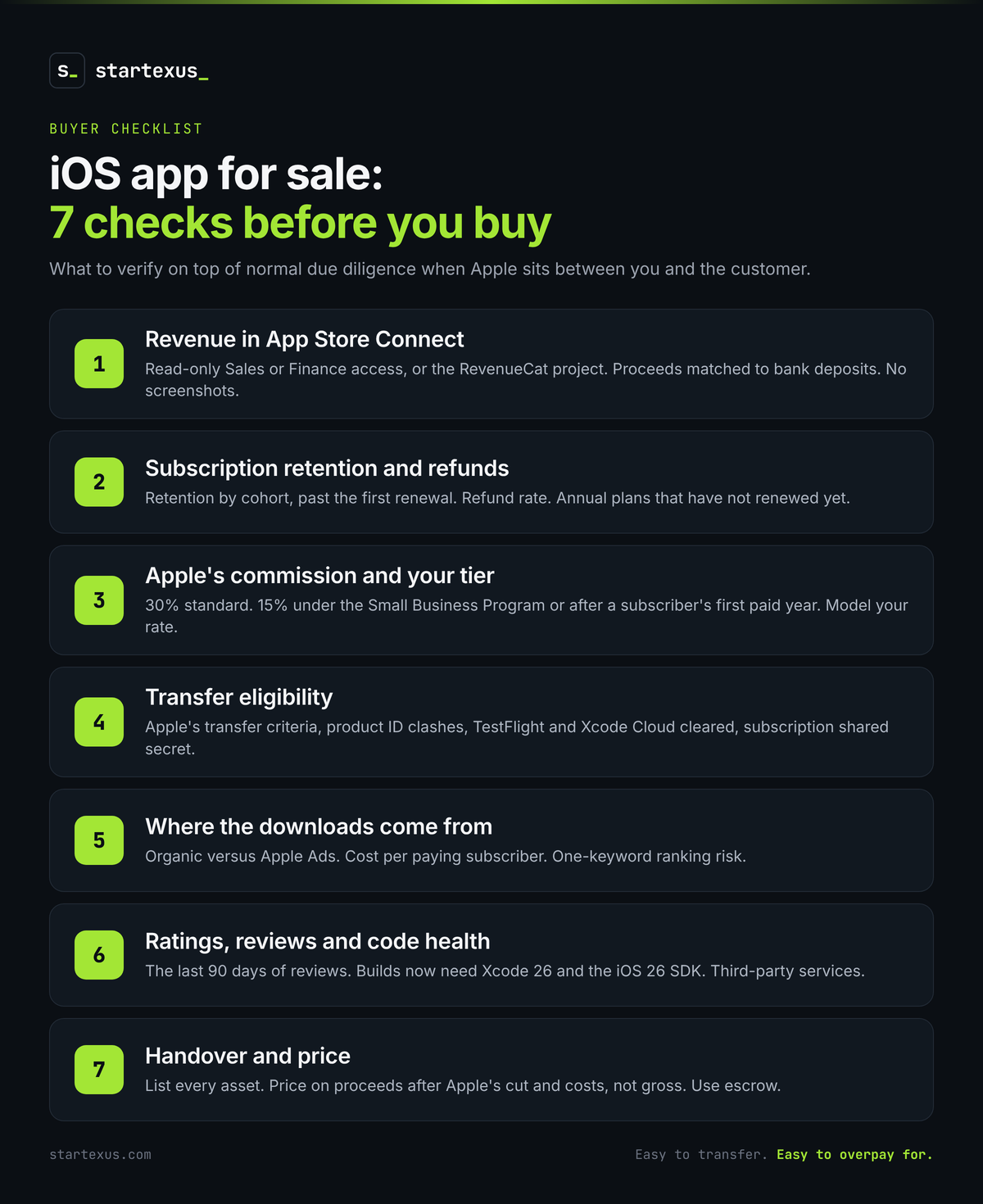
Here are the seven things I would check before making an offer on any iOS app for sale. They sit on top of normal due diligence, not instead of it.
1. Revenue in App Store Connect, not screenshots
Apple and RevenueCat already hold the real numbers. Ask to see them live.
- Ask for read-only access. The seller can add you as an App Store Connect user with the Sales or Finance role, or invite you to the RevenueCat project.
- Separate gross from proceeds. Listings often quote what customers paid. The owner gets proceeds, after Apple's commission and taxes.
- Match proceeds to bank deposits. Payments and Financial Reports should line up with the seller's bank statements.
Real data: The KPSS Exam-Prep iOS App on StartExus asks $8,000 on about $1,200 MRR, seller-reported. Its TrustMRR page showed $1,235 MRR and 447 active subscriptions, verified through a RevenueCat API key, as of October 19, 2026. About 0.56x annual revenue, checked against a live source.
2. Subscription retention and refunds
MRR is a snapshot. Retention tells you whether it will still be there next year.
- Pull retention by cohort. RevenueCat's Subscription Retention chart shows how each month's new subscribers renew. Look past the first renewal.
- Check the refund rate. A rising rate usually means the paywall promised more than the app delivers.
- Watch annual plans. MRR spreads annual payments over 12 months. If the app is under a year old, no annual subscriber has renewed yet.
3. Apple's commission and your tier
Apple's cut is not one number. It depends on the developer account and the subscriber.
- Know the standard rates. Apple's standard commission is 30%. Auto-renewable subscriptions drop to 15% once a subscriber has a year of paid service.
- The 15% follows the account. The App Store Small Business Program cuts the rate to 15% for developers with up to $1 million in proceeds in the prior calendar year. You enroll your own account. If yours does not qualify, first-year subscriptions cost you 30%.
- Transfers share the year. Apple counts a transferred app's proceeds for that calendar year toward both accounts. Bigger portfolios should check the threshold.
Worked example (hypothetical): An app sells $1,000 a month in subscriptions. At a 15% commission, proceeds are $10,200 a year. At 30%, they are $8,400. At 3x annual proceeds, that is $30,600 or $25,200 for the same app.
4. Transfer eligibility and what does not move
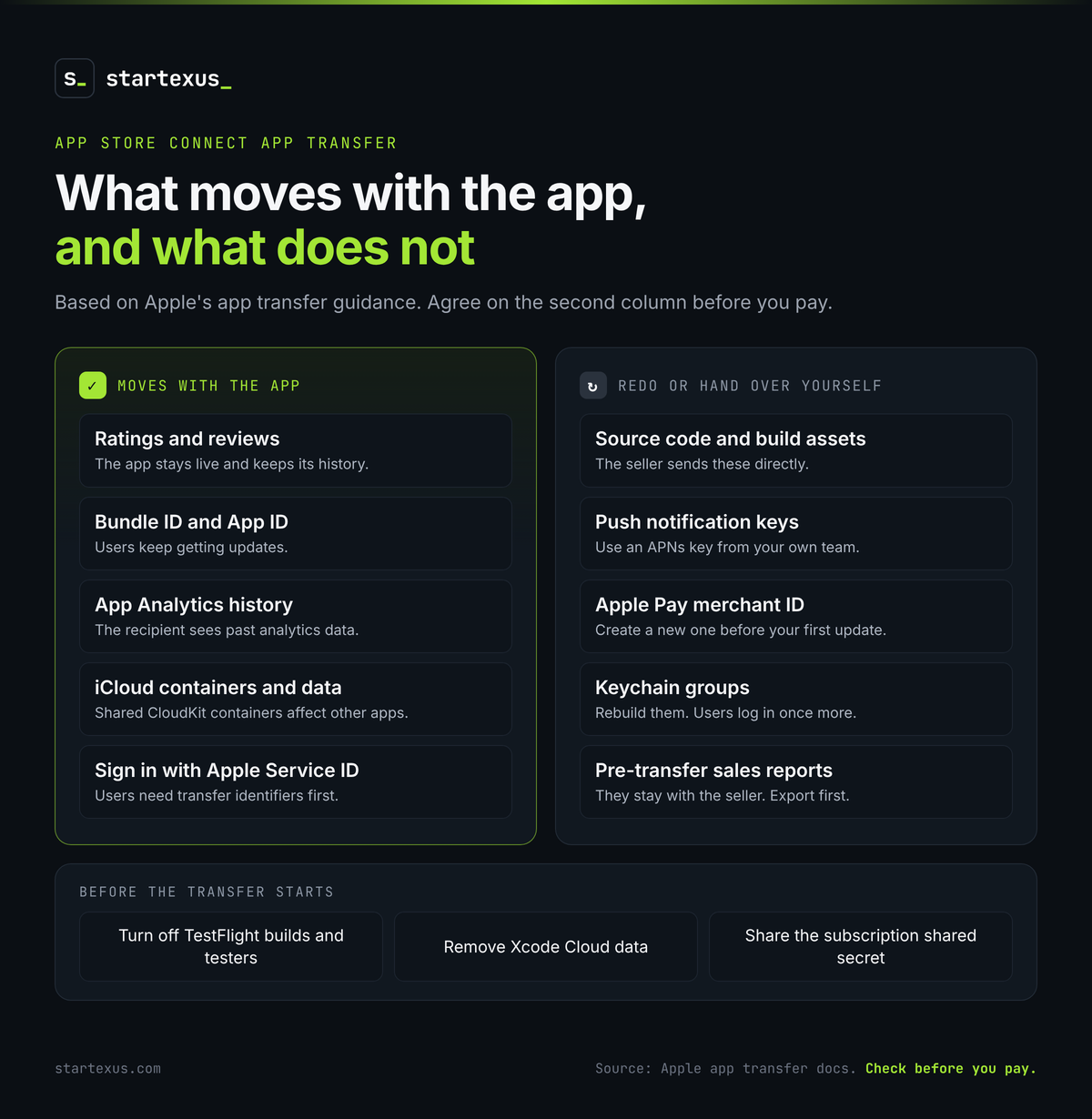
App Store Connect has a built-in app transfer. Not every app qualifies, and not everything goes with it.
- Check the criteria early. The app needs at least one released version, cannot be on pre-order or in review, and both accounts must have accepted Apple's latest agreements.
- Watch for clashes. In-app purchase product IDs cannot match any in your account. Apple Arcade apps cannot transfer at all.
- Clear TestFlight and Xcode Cloud. Apple requires beta builds, testers and Xcode Cloud data removed before the transfer starts.
- Get the shared secret. Apps with auto-renewable subscriptions need an app-specific shared secret passed to you before the transfer.
- Expect some rework. Push notification keys, Apple Pay merchant IDs and keychain groups get set up again on your team.
- Reviews stay, history splits. Ratings and reviews move with the app. Past sales and payment reports stay with the seller, so export them before closing.
5. Where the downloads come from
Most small apps live on one channel. Find out which one before you pay for it.
- Split organic from paid. App Analytics in App Store Connect breaks downloads out by source. Its App Store search figure includes ad taps, so set Apple Ads installs beside it.
- Price paid installs honestly. If growth runs on Apple Ads (formerly Apple Search Ads), get campaign exports next to revenue. The KPSS seller reports installs at about $0.14 to $0.15. Work out cost per paying subscriber, not per install.
- Check the keyword risk. If one search term drives most downloads, one ranking change can cut revenue.
6. Ratings, reviews and code health
The store page and the code show how much work you inherit.
- Read recent reviews, not the average. A 4.7 earned two years ago says little about the latest version. Read the last 90 days.
- Check when it last shipped. Since April 28, 2026, new uploads must be built with Xcode 26 and the iOS 26 SDK. An app that has not shipped in a year may need work before its next update.
- Count third-party services. Analytics, AI APIs and ad networks. Each is an account and a bill that has to move.
7. Handover and price
Agree on everything that moves before money moves. Then price what you actually keep.
- List every asset. Source code repository, the App Store Connect transfer, the RevenueCat project, domain, support email, privacy policy page and social accounts.
- Price on proceeds after costs. Apply the multiple to annual proceeds after Apple's cut and costs, not gross sales.
- Know what sellers ask. Nine iOS listings on StartExus with both an ask and monthly revenue asked between 0.47x and 5.9x annual revenue, with a median near 3x. Seller-reported asking prices, not closed sales.
- Use escrow. Release funds once the transfer is accepted and revenue shows up in your account.
Your 30-minute pre-offer checklist
- Get read-only access to App Store Connect or RevenueCat.
- Match proceeds in Payments and Financial Reports to bank deposits.
- Pull subscription retention by cohort and the refund rate.
- Rebuild the numbers at the commission your own account will pay.
- Run the app against Apple's transfer criteria.
- Split downloads by source and set ad spend against revenue.
- Read the last 90 days of reviews and check when it last shipped.
The bottom line
A small iOS app is a subscription base, an App Store listing and a codebase, held together by Apple's rules. Check all three in the tools Apple and RevenueCat already give the seller.
Then price what reaches your bank, not what customers paid. Easy to transfer. Easy to overpay for.
Browse current deals on StartExus, including iOS and mobile apps for sale, or list your app for sale for free.
Tags
- online business
- due diligence
- ai
- growth