
Every seller has two prices. The one on the listing, and the one that actually gets wired. The gap between them is where most first-time sellers either leave money on the table or scare buyers away.
Set the ask too high and nobody messages you. Set it too low and the first offer is an easy yes you will regret. The fix is not guessing. It is deciding three numbers before you list: a value, a floor and an ask.
This is the process I would walk a friend through. Every dollar figure below is an illustrative example, not market data and not a real listing.
Why the two prices differ
The asking price is an invitation. The final price is a negotiation between your numbers and a buyer's diligence. Buyers check revenue, churn and costs, then adjust what they will pay. If you know your own numbers better than they do, the gap stays small.
1. Start from a value you can defend
Pick one base: monthly profit times 12, or MRR times a multiple. Profit is the better anchor, because it is what a buyer keeps.
- Use 12 months of data. One strong month is a screenshot. A year is a trend.
- Subtract real costs. Hosting, tools, contractors, payment fees. Count your own time only if a buyer would have to replace it.
- Choose a range, not a point. Two multiples give you a low and a high.
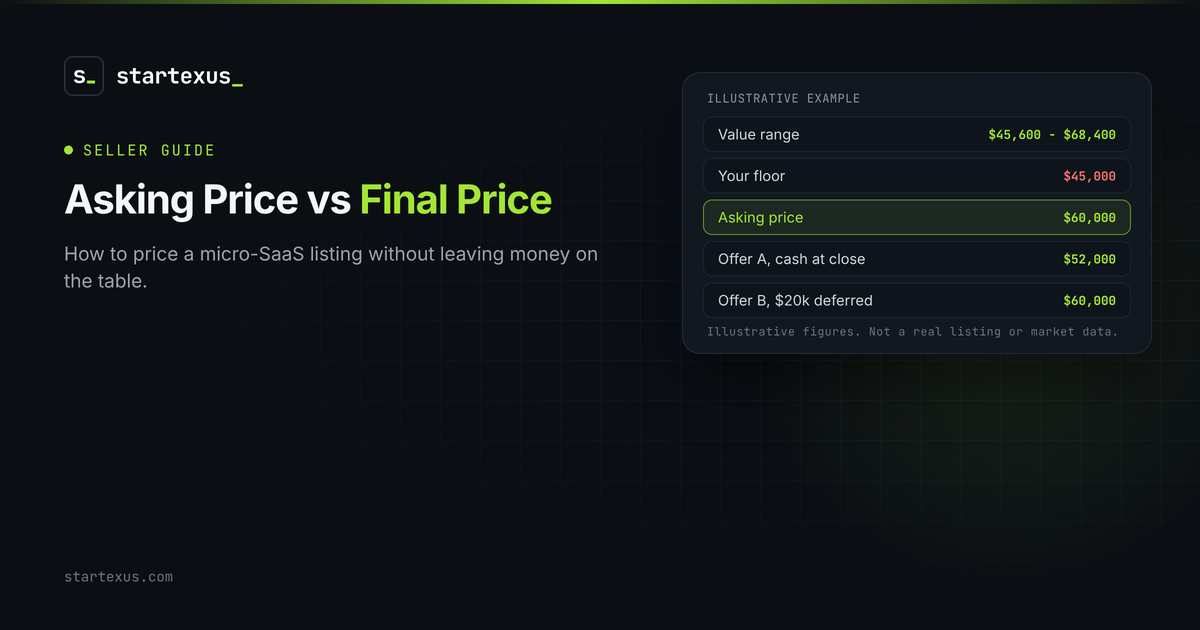
Worked example (illustrative): $2,500 MRR, $600 a month in costs. Profit is $1,900 a month, or $22,800 a year. At an illustrative 2x to 3x yearly profit, the value range is $45,600 to $68,400.
2. Adjust for what makes you better or worse
Two products with the same MRR rarely sell for the same price. Move toward the top of your range or the bottom based on facts.
- Churn. Falling cancellations push you up. Rising ones pull you down.
- Concentration. One customer paying 40 percent of MRR is a discount a buyer will ask for.
- Handover effort. Clean code, documentation and simple infrastructure are worth more than a product only you understand.
- Proof. Figures a buyer can confirm are easier to pay for than figures they must take on trust.
3. Decide your floor before you list
Your floor is the lowest price you would accept, in cash, at close. Write it down before the first message arrives. Without it, a polite buyer and a tight deadline will set your price for you.
Ask yourself what else you could do with the money, and with the time. If the product costs you ten hours a week for $1,900 a month, that answer changes your floor.
4. Set the ask with headroom
Your ask should sit above your floor so there is room to move. How much room depends on how firm you want to look.
- Ask near the top of your value range. Buyers will negotiate down. Let them.
- Do not pad past the evidence. An ask 50 percent over what the numbers support gets ignored, not negotiated.
- Keep the ask explainable. You should be able to say why in one sentence.
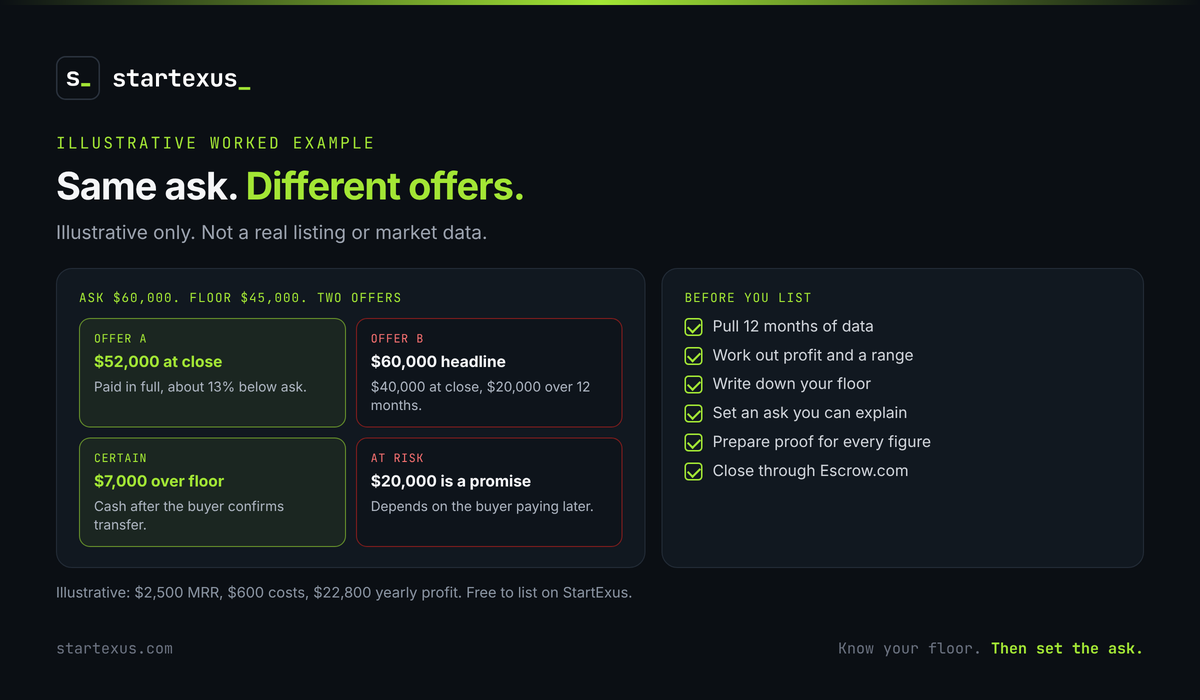
Worked example (illustrative): floor $45,000, ask $60,000. That is $15,000 of room, 25 percent of the ask. An offer at $52,000 is about 13 percent below ask and still $7,000 over your floor.
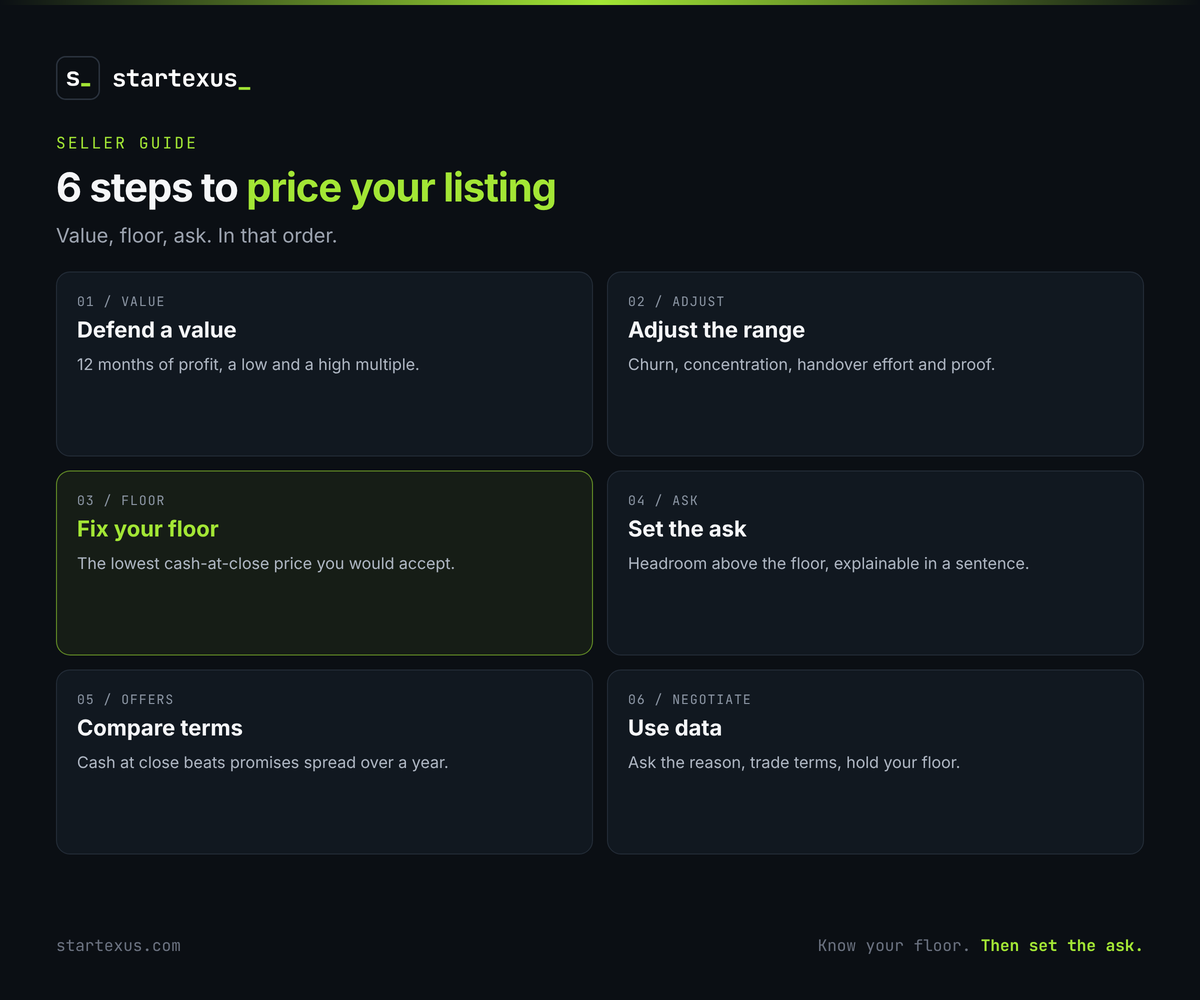
5. Compare offers on terms, not the headline
A higher headline can be the worse offer. Read how the money arrives.
- Cash at close. Money you hold after the buyer confirms the transfer is certain. Money promised later is not.
- Deferred payments. Seller financing and earnouts turn part of the price into a bet on the buyer.
- Contingencies. Ask what must happen before the buyer commits, and by when.
A $52,000 offer paid in full at close is often better than a $60,000 offer with $20,000 spread over twelve months.
6. Negotiate with data, not feelings
When a buyer pushes the price down, ask what they found. Then answer with documents.
- Ask for the reason. A vague discount request is a test. A specific one is a concern you can address.
- Trade, do not just cut. Offer a longer handover, or a documented transition, before you drop the price.
- Hold the floor. Walking away from a bad offer is a valid outcome. Another buyer may arrive next week.
Your pre-listing checklist
- Pull 12 months of revenue and cost data.
- Work out yearly profit and a low and high value.
- Adjust for churn, concentration and handover effort.
- Write down your floor, in cash at close.
- Set an ask you can explain in one sentence.
- Prepare proof for every figure in the listing.
- Plan to close through Escrow.com, so funds are released only after the buyer confirms the transfer.
The bottom line
The final price is rarely the asking price. It is closer to it when your numbers are clean, your floor is fixed and your terms are simple.
Know your value, know your floor, then let the ask do its job.
Ready to sell? List your business for free on StartExus: no listing fee, no success fee, human review, and Escrow.com recommended at close. Or browse current listings to see how other sellers price theirs.
Tags
- saas
- ai