
Most sellers ask the same question first: how long will this take? Nobody can promise a date. Some small SaaS deals close in a few weeks. Others sit for months and then die quietly.
The honest answer is a range, and most of it is in your control. Deals slow down because of missing documents, a vague price and slow replies, not because buyers are scarce.
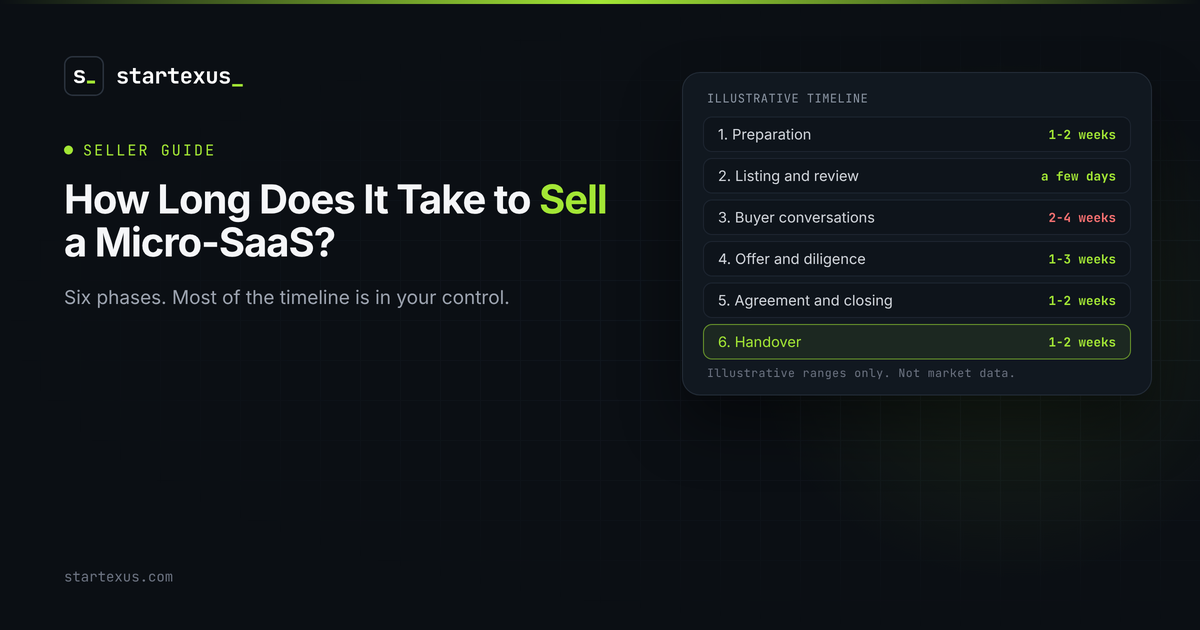
This is the timeline I would hand a friend before they list a micro-SaaS. Every duration below is an illustrative planning range, not market data and not a promise.
Why the timeline matters
A long sale costs money. You keep supporting customers, the MRR can drift, and a buyer who waits eight weeks starts to wonder what changed. A prepared seller moves faster and holds the price better. Think in phases, then fix the slowest one.
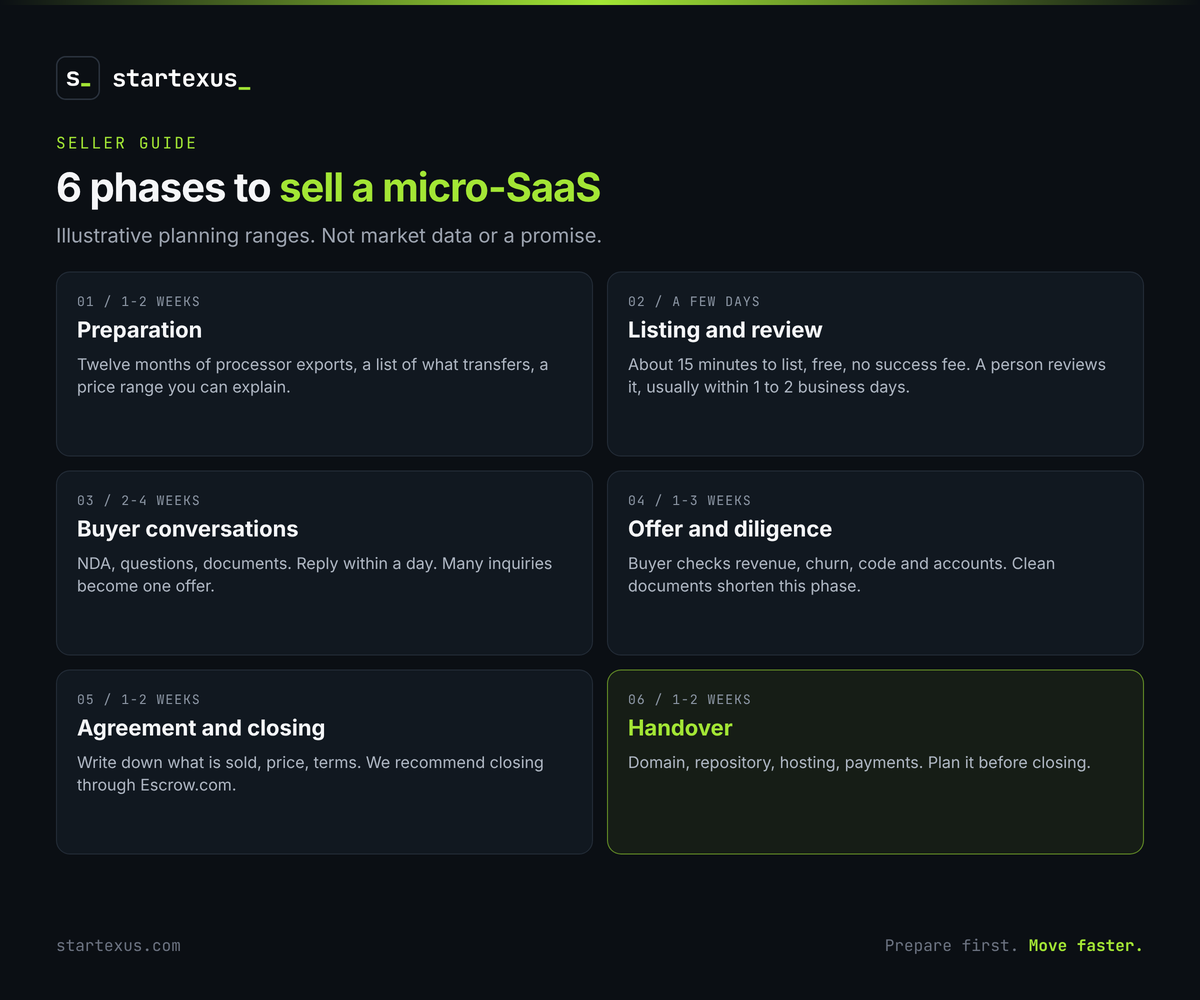
1. Preparation: 1 to 2 weeks
This is the phase you fully control, and the one most sellers skip.
- Gather proof. Twelve months of Stripe or processor exports, an analytics screenshot and a list of costs.
- List what transfers. Domain, code repository, hosting, third-party accounts and customer data.
- Pick a price range. A number you can explain beats a number you hope for.
2. Listing and review: a few days
Creating a listing on StartExus takes about 15 minutes in five short steps. It is free to list, with no success fee when it sells. A person then reviews the submission, usually within 1 to 2 business days. Claims we cannot confirm are labeled seller-reported, so accurate details save time here.
3. Buyer conversations: 2 to 4 weeks
This is the most variable phase. Serious buyers sign the NDA, read the details and ask questions.
- Reply within a day. Slow answers cool a good buyer faster than a high price does.
- Answer with documents. A sentence is a claim. An export is proof.
- Expect some silence. Many inquiries go nowhere. Plan for several conversations, not one.
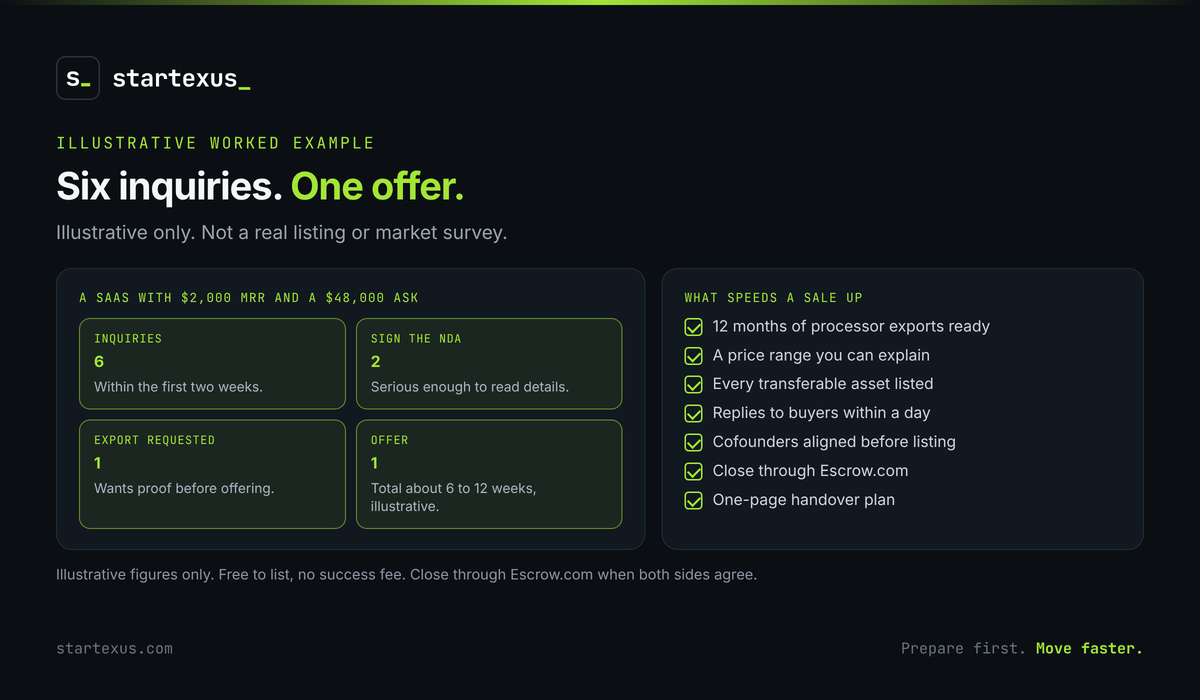
Worked example (illustrative, not a real listing): a SaaS with $2,000 MRR and a $48,000 ask draws six inquiries in two weeks. Two sign the NDA, one asks for the full export and makes an offer. Six inquiries become one offer. That is normal.
4. Offer and due diligence: 1 to 3 weeks
Once terms are agreed, the buyer checks what they are buying.
- Revenue and churn. They compare your numbers with processor data.
- Code and accounts. They confirm you own what you listed.
- Price changes. A discovered gap usually means a lower offer, so surprises cost both time and money.
Clean documents shorten this phase more than anything else.
5. Agreement and closing: 1 to 2 weeks
Write down what is sold, the price, the payment terms and the handover period. We recommend closing through Escrow.com. The buyer funds escrow, and you are paid once they confirm every asset has transferred. Neither side has to trust the other with the full price.
6. Handover: 1 to 2 weeks
Move the domain, repository, hosting and payment accounts, then introduce the buyer to customers if you agreed to. A handover plan written before closing prevents a long tail of small requests.
What makes a sale slower
Each of these can add weeks.
- A price with no reasoning behind it.
- Revenue claims with no processor proof.
- Code or accounts held by a cofounder who has not agreed to sell.
- Slow replies to buyer questions.
- Changing the terms after an offer.
Test question: "If a buyer asked for every proof document today, could I send it within an hour?" If not, start there.
Your pre-listing checklist
- Export 12 months of revenue from your payment processor.
- Write down monthly costs and your weekly hours.
- List every asset that transfers and who controls it.
- Set a price range you can defend.
- Prepare the listing details and screenshots.
- Decide how fast you will reply to buyers.
- Plan to close through Escrow.com.
- Draft a one-page handover plan.
The bottom line
An illustrative total is 6 to 12 weeks from preparation to handover, and the range depends on you more than the market. Prepare first, price with reasons and reply fast.
Do that and the timeline shortens. Skip it and the deal drifts.
Ready to start? Browse online businesses for sale on StartExus, or list your business for free: no listing fee, no success fee, human review, and Escrow.com recommended at close.
Tags
- online business
- due diligence
- saas
- ai