
Finding a listing you like is the easy part. The offer is where buyers get nervous. Offer too low and the seller ignores you. Offer too high and you pay for a problem you did not find.
A good offer is not a number. It is a number, a payment schedule and a short list of conditions. Get those three right and the rest of the deal gets simpler.
This is the process I would walk a friend through. Every dollar figure below is an illustrative example, not market data and not a real listing.
Why the offer is more than the price
Two offers with the same price can be very different deals. One pays everything at close. The other pays part of it over a year and leaves you exposed. Sellers read the whole offer, so write the whole offer.
1. Do your homework before you write anything
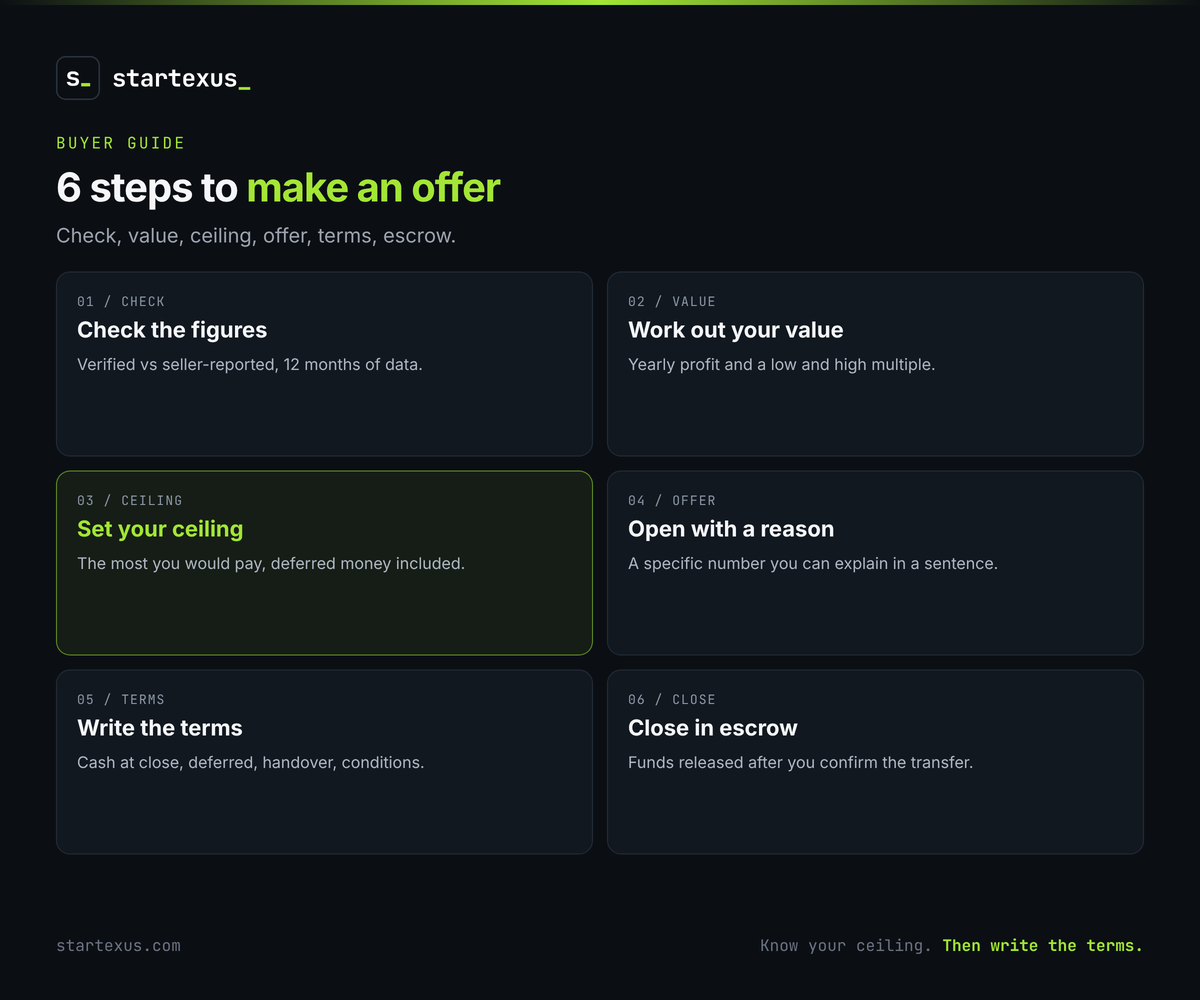
An offer built on a screenshot is a guess. Sign the NDA, open the financials and check the figures first.
- Separate verified from seller-reported. Figures a platform has confirmed against the payment processor carry less risk than figures you must take on trust.
- Look at 12 months, not one. Check trend, churn and the biggest customers.
- Write down what you could not confirm. Those gaps become conditions in step 5.
2. Work out your own value
Do not anchor on the asking price. Decide what the business is worth to you, then compare.
- Start from profit. Monthly revenue minus real costs, times 12.
- Apply a range. Use a low and a high multiple, not one number.
- Price your own time. If the product needs ten hours a week from you, that cost is real.
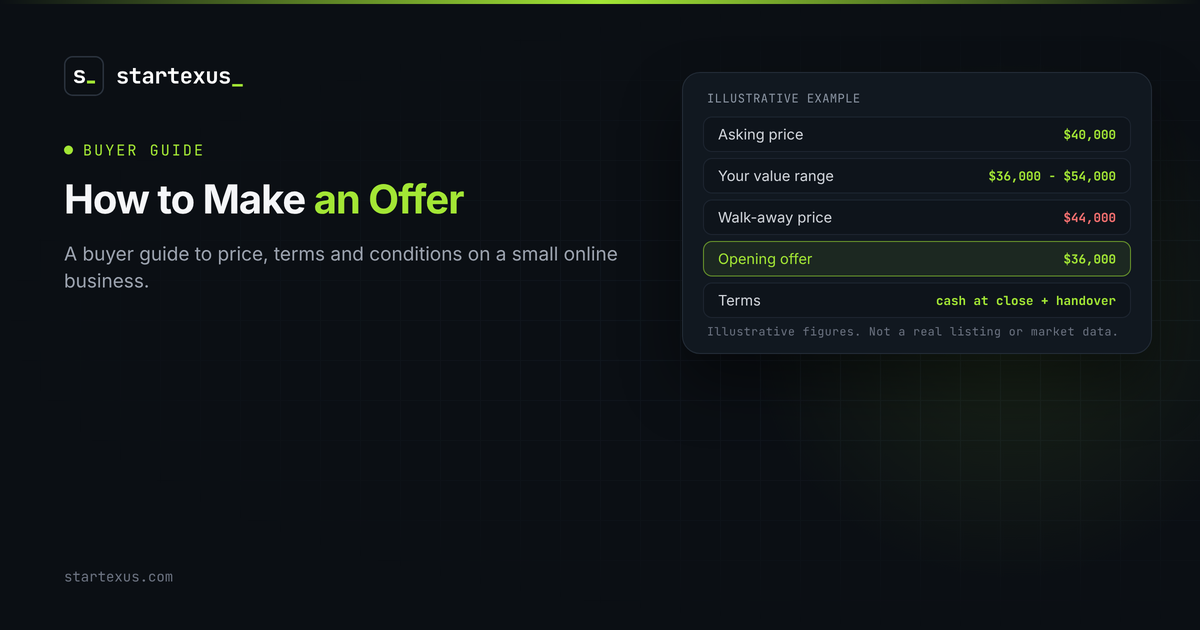
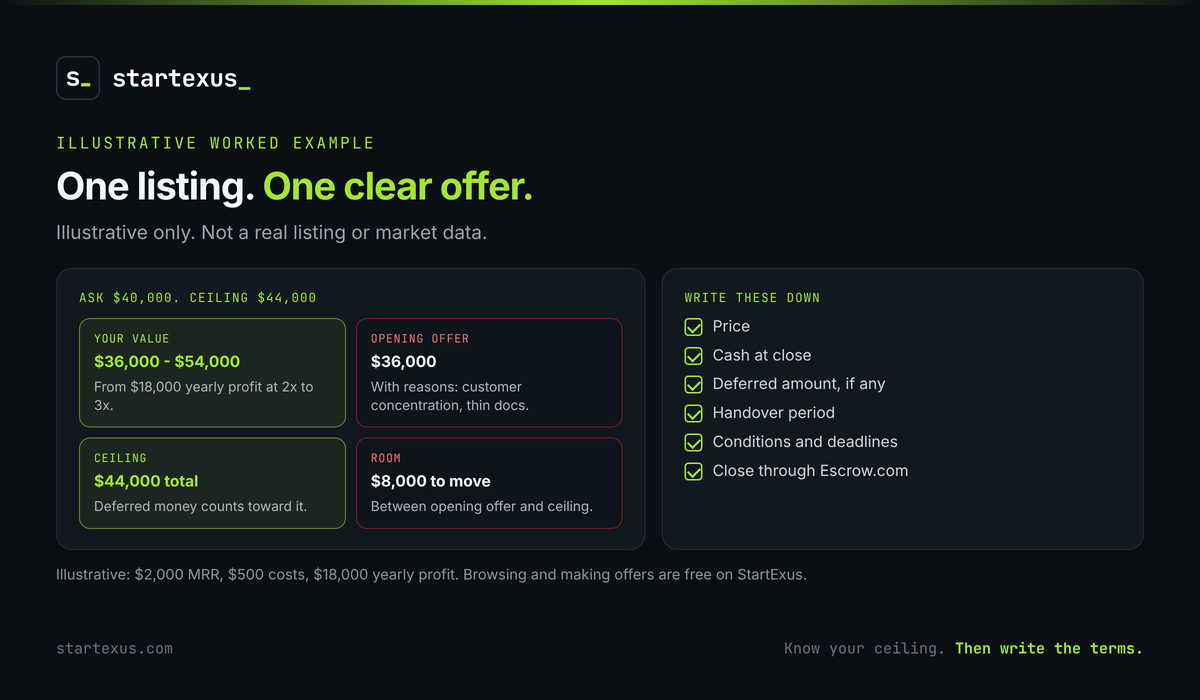
Worked example (illustrative): a listing asks $40,000. It reports $2,000 MRR and $500 a month in costs. Profit is $1,500 a month, or $18,000 a year. At an illustrative 2x to 3x yearly profit, your range is $36,000 to $54,000. The ask sits inside it.
3. Decide your walk-away price first
Your ceiling is the most you would pay in total, including anything deferred. Write it down before you start talking. Without it, a friendly seller and a tight deadline will set your price for you.
4. Choose an opening offer you can explain
You do not need a lowball. You need a number with a reason. Sellers respond to reasons.
- Tie it to evidence. Rising churn, one customer at a large share of MRR or thin documentation all justify a lower number.
- Leave room to move. Open below your ceiling, so a counter does not push you past it.
- Be specific. An exact figure with a reason reads as serious. A round number with no reason reads as a test.
Worked example (illustrative): ceiling $44,000. Opening offer $36,000, with a note that the largest customer is a meaningful share of MRR and the code has little documentation.
5. Write the terms, not just the price
This is the part first-time buyers skip. A clear offer covers more than money.
- Cash at close. How much is paid when the transfer is confirmed.
- Deferred payments. If part of the price is paid later, say how much, when and what happens if the business declines.
- Handover period. Ask for a fixed window of support, such as answering questions about code, customers and billing.
- Conditions. List what you still need to confirm, such as revenue against the payment processor or access to the domain, and by when.
- Assets included. Domain, code, customer list, accounts and documentation.
Short and specific beats long and vague. A seller can say yes to a clear offer in one reading.
6. Read counteroffers like a buyer, not a fan
A counter is information. Look at what the seller moved on and what they held.
- Compare on terms. A higher price with more cash at close can be better than a lower price with a long deferral.
- Trade, do not just concede. Offer a faster close or fewer conditions in return for a better number.
- Hold your ceiling. Walking away is a valid outcome. There will be other listings.
7. Close through escrow
Once you agree, protect both sides. Escrow is optional on StartExus, but for most deals it is the sensible choice. We recommend Escrow.com: you fund escrow, and funds are released only after you confirm every asset has transferred. Escrow.com charges its own fee, so factor that into your budget.
Your pre-offer checklist
- Sign the NDA and read the financials.
- Note what is verified and what is seller-reported.
- Work out yearly profit and a low and high value.
- Write down your walk-away price, including deferred money.
- Pick an opening number and one sentence of reasoning.
- Spell out cash at close, deferred amounts, handover and conditions.
- Plan to close through Escrow.com.
The bottom line
A strong offer is calm, specific and easy to say yes to. It shows the seller you did the work and know your limit.
Know your value, know your ceiling, then write the terms down.
Ready to buy? Browse current listings on StartExus, where browsing, messaging and making offers are free. Not sure what a business is worth? Try the free valuation tool. Or list your own business for free.
Tags
- online business
- valuation
- ai