
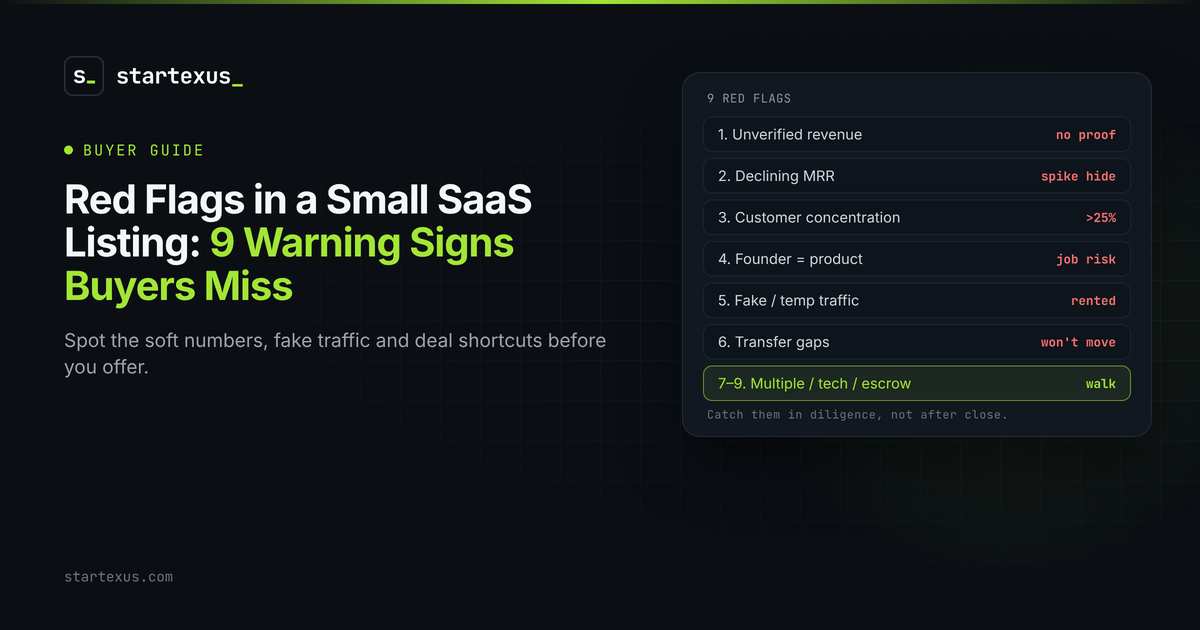
A polished listing can hide a soft business. The screenshots look fine. The MRR chart trends up. The asking price sits inside a familiar multiple. Then you dig in and the numbers stop lining up.
Most buyers miss the same warning signs. Not because they are careless, but because the listing was written to sell a story, not to survive due diligence.
This is the red-flag list I would hand a friend before they make an offer on a micro-SaaS or other small online business for sale. The dollar figures below are illustrative examples, not real listings.
Why these red flags matter
A bad deal rarely announces itself in the title. It shows up as a missing Stripe export, a traffic spike that dies after launch week, or a seller who will not use escrow. Catching that early saves you weeks of diligence and a deposit you should never have put down.
1. Revenue that cannot survive a spreadsheet
Revenue is the first place listings stretch. Treat every chart as a claim until bank and processor data say otherwise.
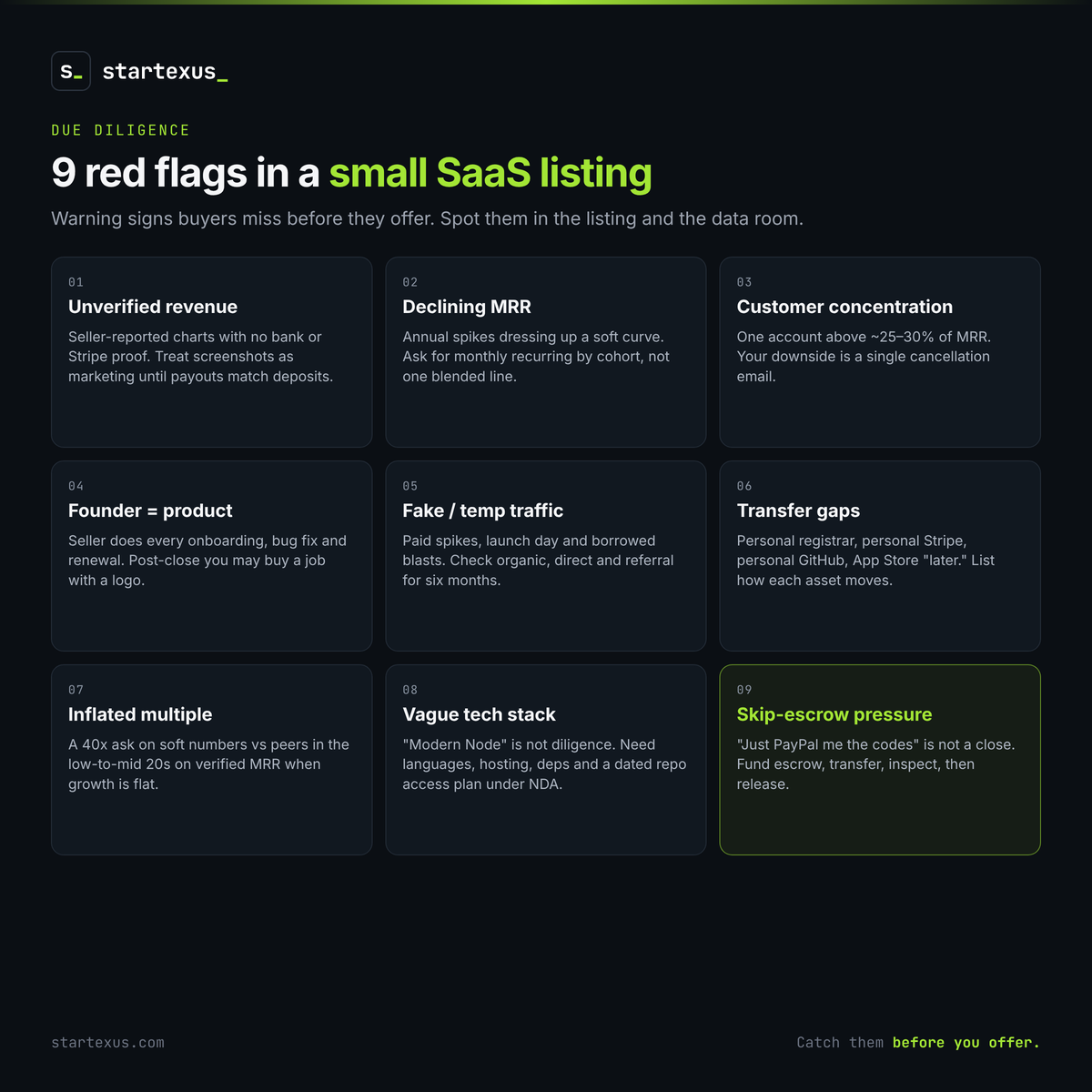
- Seller-reported revenue with no bank or Stripe proof. Screenshots and Notion dashboards are marketing. Ask for trailing twelve months of Stripe (or PayPal) payouts matched to bank deposits. If the seller stalls, walk.
- Declining MRR hidden by annual spikes. One big annual renewal can make a soft month look healthy. Ask for monthly recurring revenue by cohort, not a single blended line. Example: $3,200 in "MRR" that is really $1,800 true monthly plus one $1,400 annual prepay booked as current month.
- Profit that ignores the founder's time. A $1,500 "profit" month that required 40 hours of unpaid support is not free cash flow. Rebuild SDE with a realistic owner wage.
Worked example (illustrative, not a real listing): a listing claims $2,000 MRR and asks $72,000 (36x). Stripe payouts for the last six months average $1,450. Two customers make 55% of that. At a peer multiple of 24x on verified MRR, the same business is closer to $34,800 before concentration risk. The gap is the red flag working.
2. Customers and founders who cannot transfer
A SaaS is only as transferable as its relationships. If the money or the product depends on one person, you are buying a job with a logo.
- Single-customer concentration. If one account is more than about 25–30% of MRR, your downside is a cancellation email. Ask for a ranked customer list by revenue share and churn history for the top five.
- The founder is the product and the support. When every onboarding call, every bug fix and every renewal reminder goes through the seller, post-close churn is likely. Ask who answers tickets today and what a two-week handover actually covers.
- Contracts that do not assign. Agency-style or enterprise side deals sometimes bar assignment without consent. Confirm you can step into every material agreement.
3. Traffic, tech and transfer gaps
Buyers often fall in love with growth charts and skip the boring questions. Growth that cannot move with you is not growth you own.
- Fake or temporary traffic. Paid spikes, Product Hunt day, and borrowed newsletter blasts look great for 30 days. Ask for organic search, direct and referral by month for at least six months. A 40% drop in organic after a launch campaign is a warning, not a blip.
- Transferability issues. Domains on a personal registrar, Stripe under a personal SSN, GitHub under a personal account, or App Store listings the seller "will figure out later" are deal killers. List every asset and how it moves before you offer.
- Vague tech stack with no repo access plan. "Modern Node stack" is not diligence. You need languages, hosting, key dependencies, admin access and a dated plan for read-only repo access under NDA.
4. Price pressure and shortcuts on the deal
Even a clean product turns into a bad buy when the process is rushed or the multiple ignores the peers.
- Inflated multiple versus peers. A $5K–$50K micro-SaaS often clears in the low-to-mid 20s on verified MRR when growth is flat. A 40x ask on soft numbers needs a reason you can defend in writing, not vibes.
- Pressure to skip escrow. "Just PayPal me and I will send the codes" is not a closing plan. Use escrow, fund it, transfer, inspect, then release. On StartExus we recommend closing through Escrow.com for that reason.
- No written handover. If the seller will not put domain, code, billing and customer steps on a dated checklist, assume the handover will be improvisation.
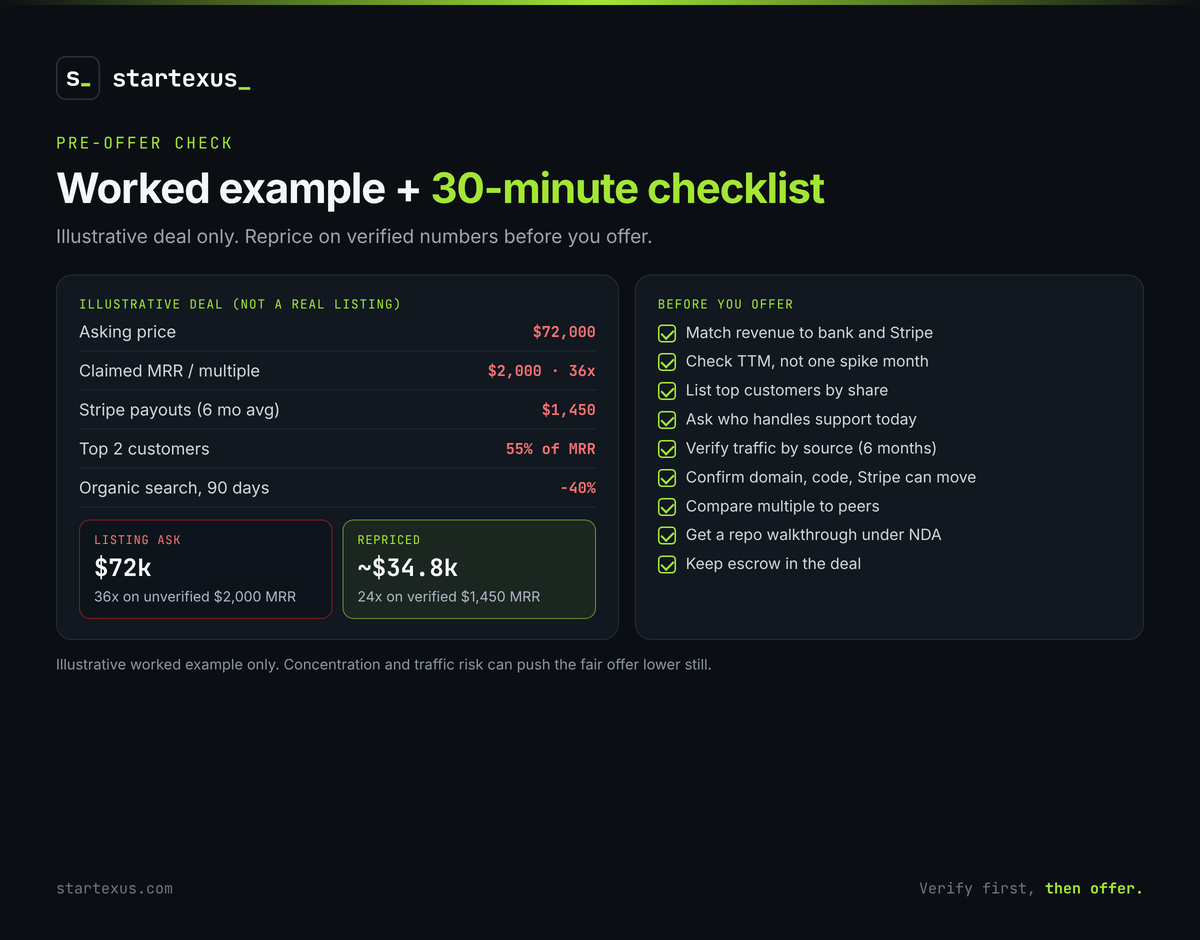
Your 30-minute pre-offer checklist
- Match claimed MRR to Stripe (or PayPal) and bank deposits for at least six months.
- Separate true monthly recurring from annual prepays and one-off invoices.
- Rank the top five customers by revenue share and note any above ~25%.
- Ask who does support today and what the post-close support window covers.
- Pull traffic by source for six months; ignore a single launch spike.
- List domain, repo, hosting, Stripe and email accounts and how each transfers.
- Compare the ask to peer multiples on verified numbers, not listing screenshots.
- Get a repo walkthrough plan under NDA before you wire anything.
- Keep escrow in the deal. No exceptions for "simple" micro-SaaS.
The bottom line
Red flags in a small SaaS listing are usually quiet. Unverified revenue. A declining curve dressed up as a spike. One customer holding the P&L. A founder who is the product. Traffic that was rented. Assets that will not move. A multiple that ignores peers. A tech story with no repo. Pressure to skip escrow.
Walk when the seller will not open the books. Offer only when the numbers, the customers and the transfer path survive a boring checklist.
Ready for your next deal? Browse SaaS businesses for sale on StartExus, or list your business for sale for free.
Tags
- online business
- due diligence
- saas
- ai
- growth