
A seller says the business makes $3,000 a month. A buyer hears $36,000 a year in profit. Neither is lying. They are just using different numbers.
Small online businesses get priced off three figures: MRR, net profit and SDE. Each one answers a different question. Mix them up and you can overpay by tens of thousands, or leave that much on the table as a seller.
This is the plain-English guide I would hand a friend before their first offer. The figures below are illustrative examples, not real listings and not market averages.
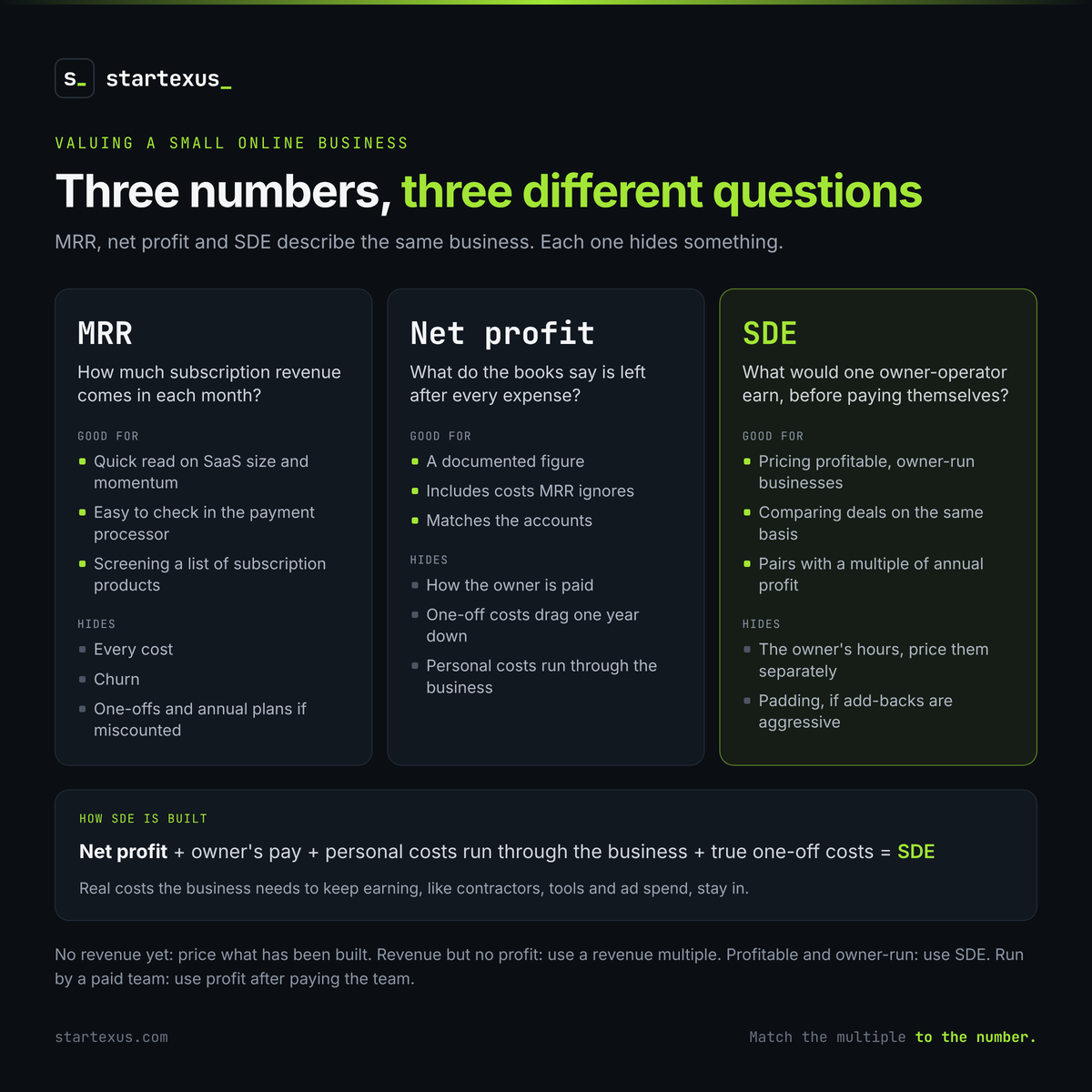
1. MRR: how much subscription revenue comes in
MRR is monthly recurring revenue. It is the subscription money that comes in every month, before any costs.
- What it is good for. A fast read on the size and momentum of a SaaS. Easy to check in Stripe or another payment processor.
- What it hides. Every cost. Hosting, AI API bills, payment fees, contractors. A $3,000 MRR product with $2,000 of costs is a different business from one with $300.
- Watch the definition. One-off sales, setup fees and annual plans counted in full in one month are not MRR. Ask how it was calculated.
- Churn matters. MRR that stays is worth more than MRR replaced every month by new signups.
Our guide to MRR multiples covers how revenue multiples relate to profit multiples for micro-SaaS.
2. Net profit: what the books say is left over
Net profit is revenue minus every expense on the books. It is what your accountant or tax return shows.
- What it is good for. A real, documented figure. It includes costs that MRR ignores.
- What it hides. How the owner is paid. If you pay yourself a salary through the business, net profit looks smaller than the business really earns.
- One-off costs distort it. A redesign or a legal bill last year drags down a single year of profit.
- No salary, no gap. If the seller pays themselves nothing, net profit and SDE end up close.
3. SDE: what the business earns for one owner
SDE is seller's discretionary earnings. It is the profit one full-time owner-operator would take home, before paying themselves.
- Start from net profit. Then add back a short list of items.
- Add back the owner's pay. Salary or draws paid to the seller.
- Add back personal costs. Expenses run through the business that a new owner would not have.
- Add back true one-offs. A rebuild or legal bill that will not repeat.
- Do not add back real costs. Contractors, tools and ad spend the business needs to keep earning stay in.
Small owner-run businesses are usually priced on this number. The StartExus valuation calculators ask for profit as revenue minus costs, before paying yourself. That is SDE in everyday words.
4. Which number to use when
Pick the number that matches the stage of the business. Then use the same number on both sides of the table.
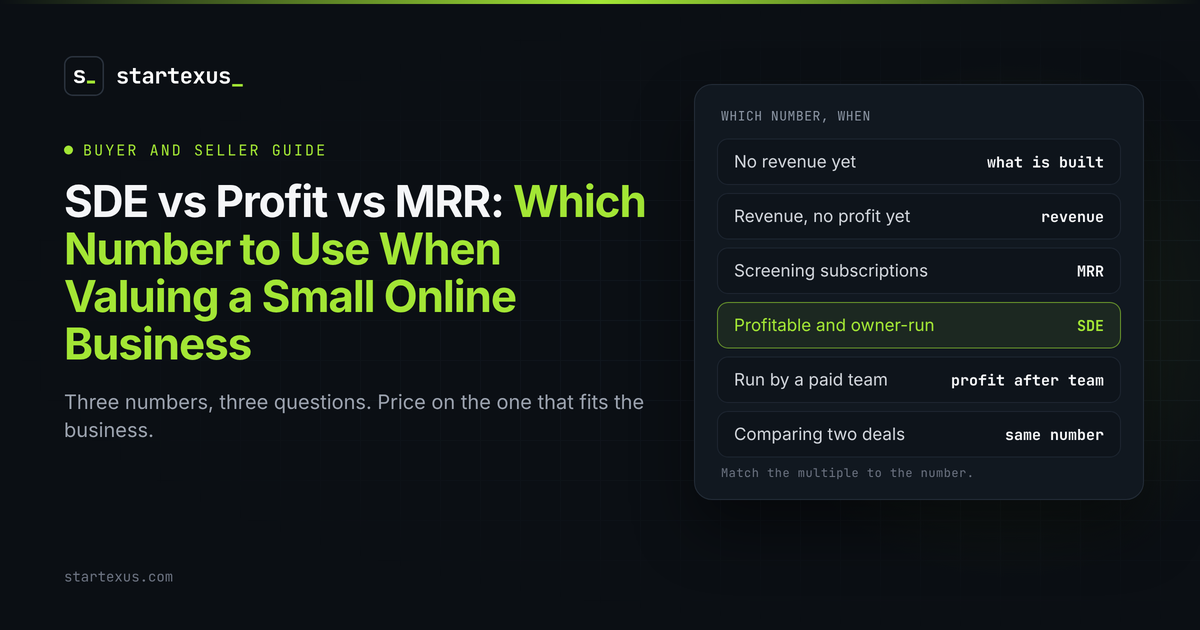
- No revenue yet. None of the three. The price is for what has been built: code, domain, brand and users.
- Revenue, but no profit yet. A multiple of revenue. The SaaS calculator falls back to annual revenue in this case.
- Screening subscription products. MRR, to sort a list quickly. Then check profit before you make an offer.
- Profitable and owner-run. SDE, as a multiple of annual profit.
- Run by a paid team. Profit after paying that team, because the buyer will have to pay them too.
5. Turn it into a price
A multiple only means something next to the number it was built for.
- Use a full year. Twelve months of profit, not the best month times twelve.
- Match the multiple to the number. Profit multiples go with SDE. Revenue multiples go with revenue.
- Adjust for owner hours. SDE assumes the buyer does the work. A business that needs 30 hours a week is worth less than one that needs 3.
- Adjust for risk. Churn, growth, one big customer or one platform move the multiple up or down.
For blogs, our content site valuation guide walks through the same steps.
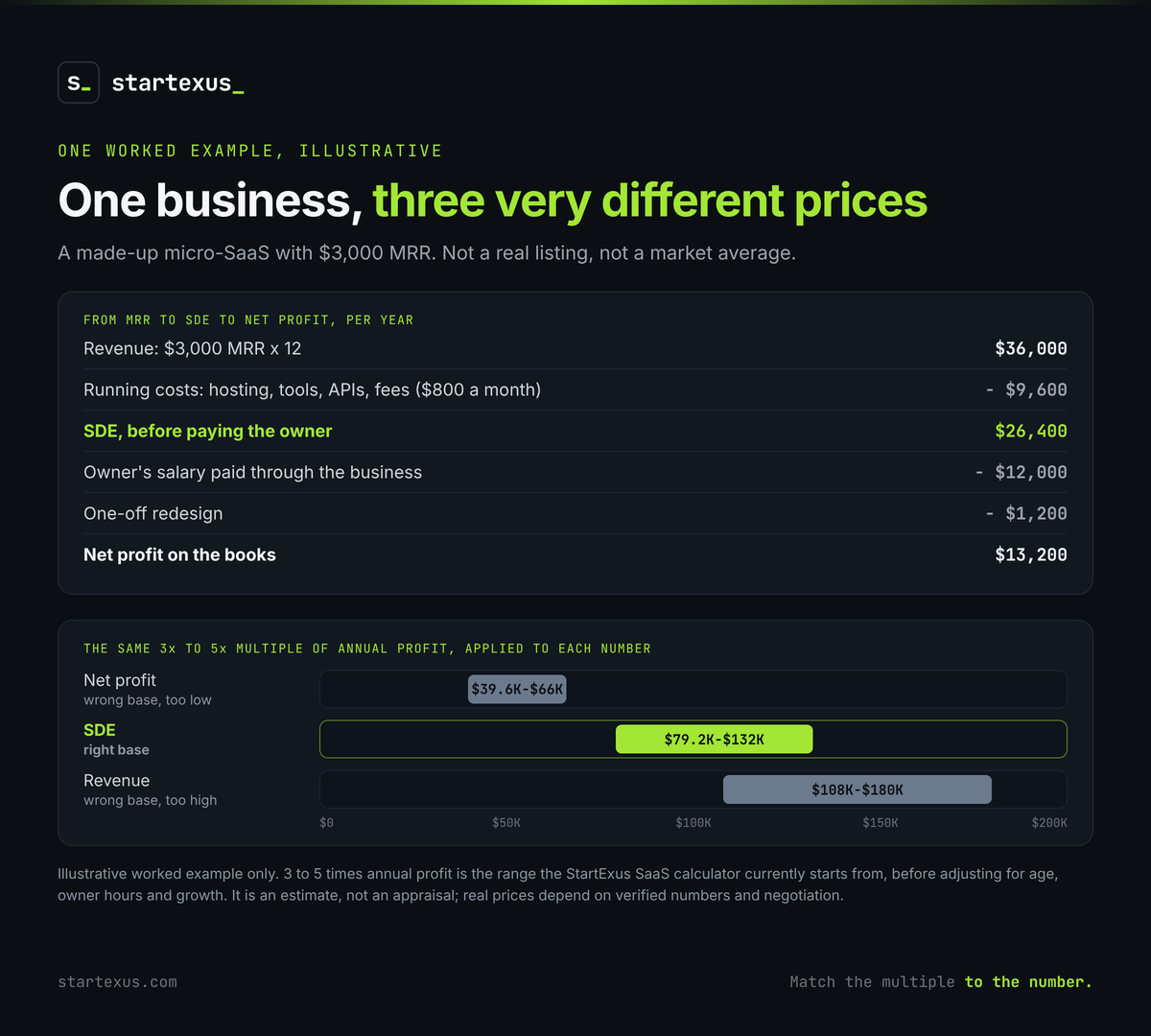
Worked example (illustrative, not a real listing): a micro-SaaS has $3,000 MRR, so $36,000 a year in revenue. It costs $800 a month to run, or $9,600 a year. The owner pays himself $12,000 a year and spent $1,200 once on a redesign. Net profit is $13,200. SDE is $26,400, which is $13,200 plus the $12,000 salary and the $1,200 one-off. At the 3 to 5 times annual profit the StartExus SaaS calculator currently starts from, SDE gives about $79,200 to $132,000. Apply that same multiple to net profit and you get $39,600 to $66,000. Apply it to revenue and you get $108,000 to $180,000. One business, three very different prices.
6. Check the number before you trust it
Any figure is only as good as its proof.
- Revenue and MRR. Payment processor exports, matched to bank deposits.
- Costs. Twelve months of invoices for hosting, tools, APIs and contractors.
- Add-backs. Ask for a line-by-line list. Each one should come with a receipt and a reason it will not repeat.
- Badges on StartExus. Listings show which figures were verified against a source, such as Stripe, and which are seller-reported. Ask for proof of anything seller-reported.
Our due diligence checklist goes deeper.
Common mistakes
- Applying a profit multiple to MRR or revenue.
- Treating annual plans or one-off sales as MRR.
- Adding back costs the business actually needs, like contractors or ads.
- Using SDE without pricing the owner's hours.
- Valuing on the best month instead of the last twelve.
- Comparing one listing's SDE with another's net profit.
The bottom line
MRR tells you how big the revenue is. Net profit tells you what the books say. SDE tells you what one owner would actually earn. For most small, owner-run online businesses, SDE is the number to price on.
Whichever you use, name it, prove it and match the multiple to it. The StartExus calculators give an estimate, not an appraisal. The final price still comes down to verified numbers and negotiation.
Ready to put a number on it? Get a free valuation, browse online businesses for sale on StartExus, read the FAQ, or list your business for sale for free, with no listing fee and no success fee.
Tags
- online business
- due diligence
- valuation
- saas
- ai
- growth