
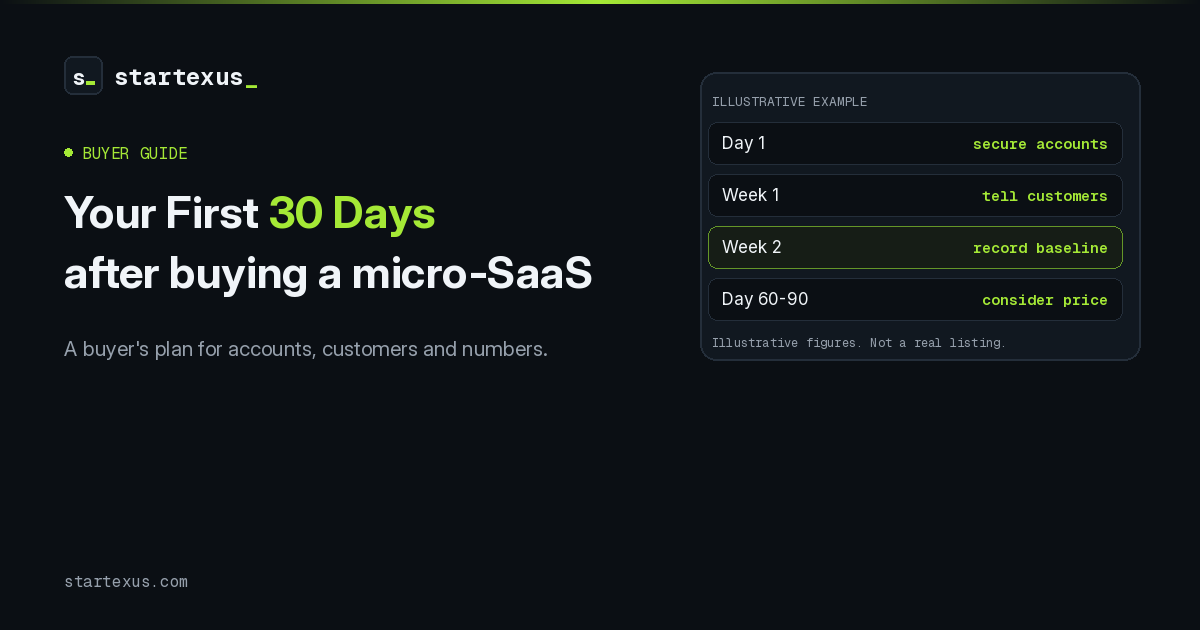
Closing is not the finish line. It is the day the problems become yours.
The first 30 days after you buy a micro-SaaS decide whether you keep the customers you paid for or slowly lose them. Most buyers either do nothing and drift, or change everything at once and break what worked.
This is the plan I would hand a friend who just got the keys. Every figure below is an illustrative example, not market data and not a real listing.
Why the first month matters
You bought a stream of revenue, and the customers behind it did not choose you. They signed up for the old owner's product. Any surprise in the first weeks, such as a failed login, a late reply or a changed price, is a reason to cancel. Your goal for 30 days is simple: keep it running, learn it and earn trust.
1. Secure every account on day one
Do this before anything else. Until you control the keys, you do not fully own the business.
- Change every password. Domain registrar, hosting, payment processor, email, analytics, code repository. Use a password manager.
- Turn on two-factor authentication. Use your own device, not the seller's phone number.
- Move billing to you. Hosting, domains and tools should charge your card, so nothing lapses by surprise.
- Remove old access. Take out the seller, past freelancers and any shared logins you do not recognise.
2. Keep the seller close for the handover window
A good seller does not vanish at closing. Agree a window up front, often two to four weeks, and use it well.
- Book short calls. Two or three 30-minute sessions beat a hundred scattered messages.
- Ask for the unwritten stuff. Which customers are fussy, which tasks run on a schedule, which tool breaks every few months.
- Get it in writing. Turn each answer into a short note you can find later.
Pro tip: ask the seller, "What do you do every week that is not written down anywhere?" The answer is usually the part of the business that breaks first.
3. Tell customers who you are, calmly
Customers should hear about the change from you, not discover it. Send one short, plain message in the first week.
- Say what stays the same. Same product, same price, same support address.
- Introduce yourself in two lines. Who you are and how to reach you.
- Do not oversell. No big roadmap promises yet. Reliability is the message.
4. Learn the numbers before you change anything
For the first two weeks, watch. Write down the baseline so you can tell later whether a change helped or hurt.
- Track MRR, customer count and churn. Note them weekly, using the payment processor as the source.
- Read every support message. The inbox is the cheapest market research you will get.
- List the costs. Hosting, tools, contractors and fees, so you know your real margin.
Here is an illustrative example. Say you bought a micro-SaaS with 50 customers paying $30 a month. That is $1,500 MRR. If 3 customers cancel in the first month, churn is 6 percent. That is useful to know. It is not a reason to panic or to cut the price.
5. Fix the small stuff before the big stuff
Your first changes should be boring. Broken links, slow pages, confusing emails and unanswered tickets cost more than a missing feature.
- Reply faster than the old owner did. A same-day answer is a visible upgrade.
- Fix known bugs. Start with the ones customers have actually reported.
- Update the basics. Contact details, legal pages and the billing descriptor should show your name.
6. Delay price changes and big rewrites
It is tempting to raise prices or rebuild the product in month one. Do not. You do not yet know why customers stay.
- Hold pricing for 60 to 90 days. Change it once you understand who pays and why.
- Ship one small improvement. Something customers asked for, released calmly.
- Avoid big migrations. New hosting, new payment provider or a full rewrite can wait.
7. Set up backups, monitoring and a simple routine
A small business survives on routine. Build one before you need it.
- Back up the database and code. Test one restore so you know it works.
- Add uptime alerts. You should hear about an outage before your customers do.
- Block weekly time. One hour for support, one for numbers, one for improvements.
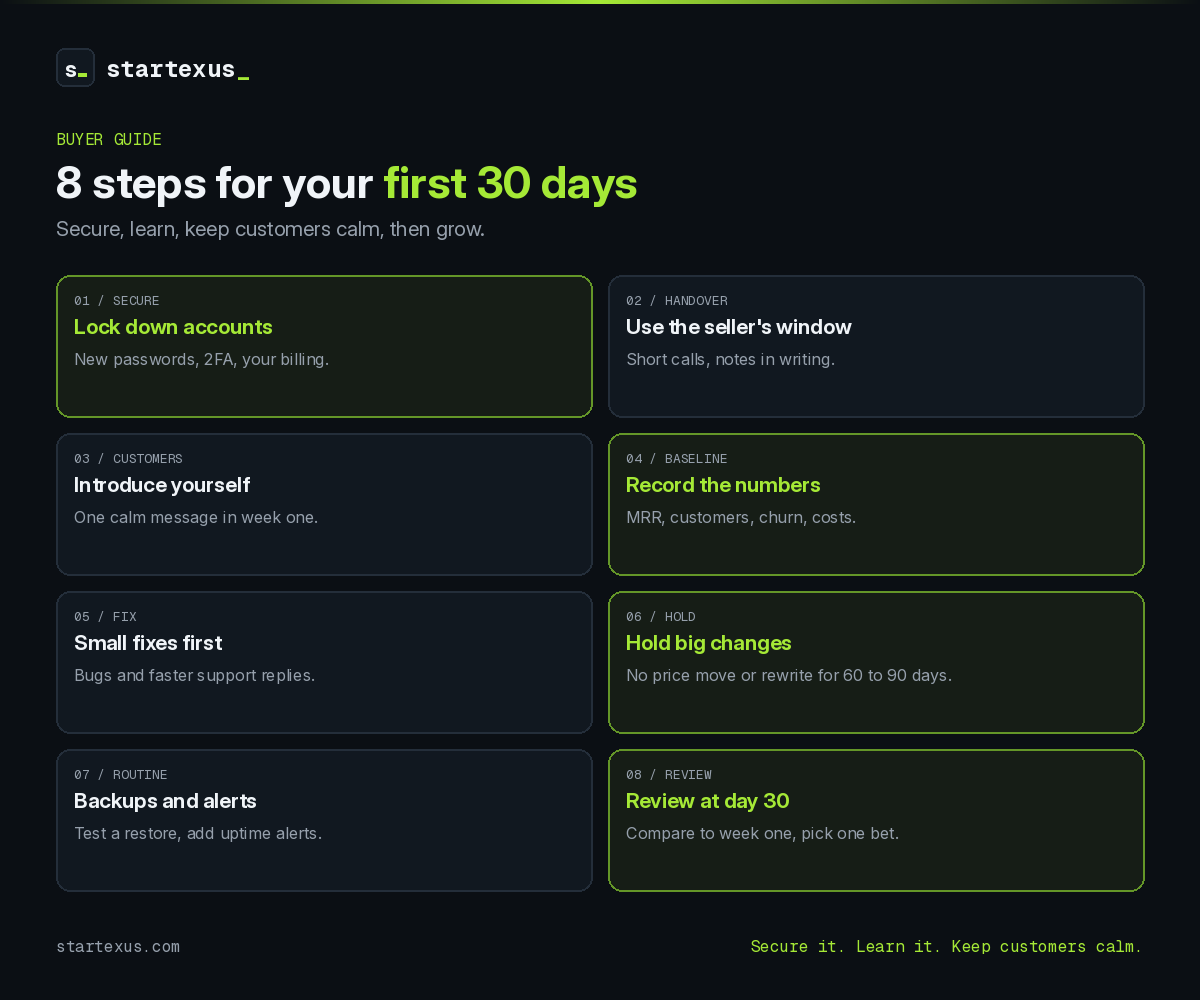
8. Review at day 30 and decide what is next
At the end of the month, compare the baseline with where you are. Be honest about what you learned.
- Compare the numbers. MRR, customers and churn against week one.
- Check your time. Did the business take 5 hours a week or 25? Plan around the real figure.
- Pick one growth bet. A single channel or feature for the next 30 days, not five.
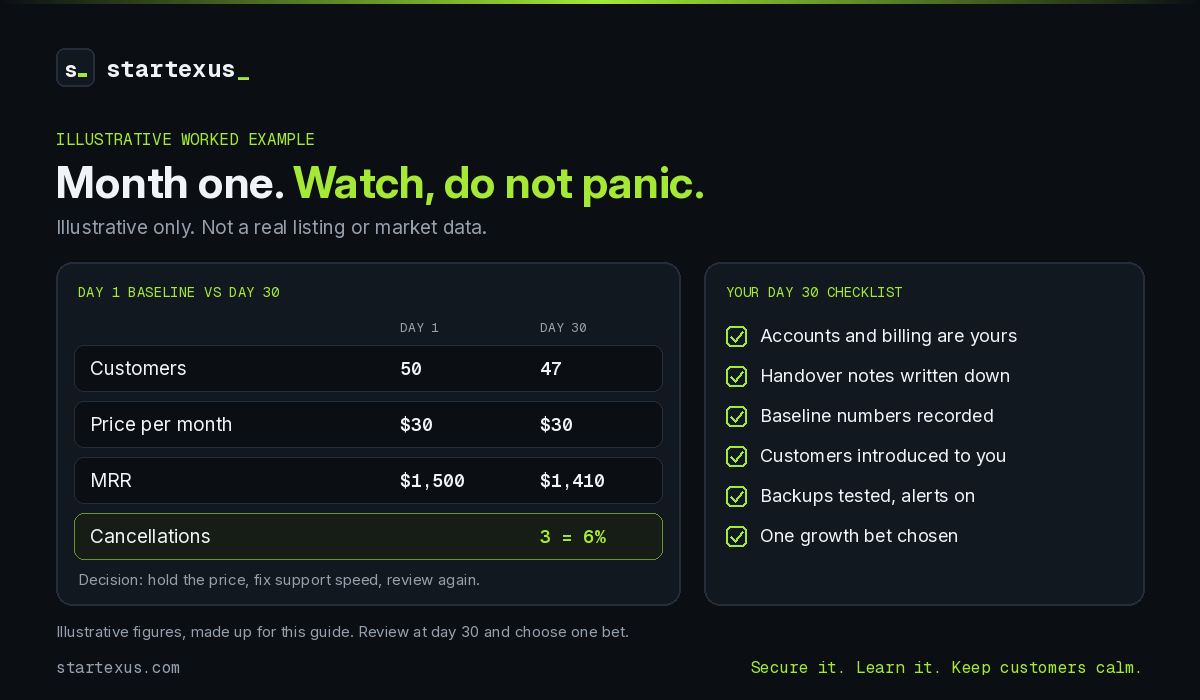
Your first 30 days checklist
- Change passwords, turn on two-factor authentication and move billing to you.
- Schedule handover calls and write down what the seller tells you.
- Send customers one calm introduction message.
- Record baseline MRR, customers, churn and costs.
- Fix small bugs and answer support faster.
- Hold price changes and big rewrites for 60 to 90 days.
- Set up backups, uptime alerts and a weekly routine.
- Review at day 30 and choose one growth bet.
The bottom line
The first month is not about growth. It is about not losing what you bought. Secure it, learn it, keep customers calm.
Do that and the second month is when the real work starts, with a business you understand.
Still looking for the right one? Browse current listings on StartExus, where we review every listing and show which figures are verified and which are seller-reported, or try the free valuation tool first. Selling instead? List your business for free on StartExus.
Tags
- valuation
- saas
- ai
- growth