
Most small online business deals are simple. The buyer pays, the seller hands over the keys, and it is done in a week or two.
Then a gap shows up. The seller wants $40,000. The buyer has $25,000, or does not fully trust the revenue yet. That is where seller financing and earnouts come in.
Both can get a deal closed when cash or trust is short. Both can also turn a clean sale into a year of awkward emails. This is the plain-English version I would hand a friend on either side of the table. The numbers below are illustrative examples, not typical terms, and none of this is legal or tax advice.
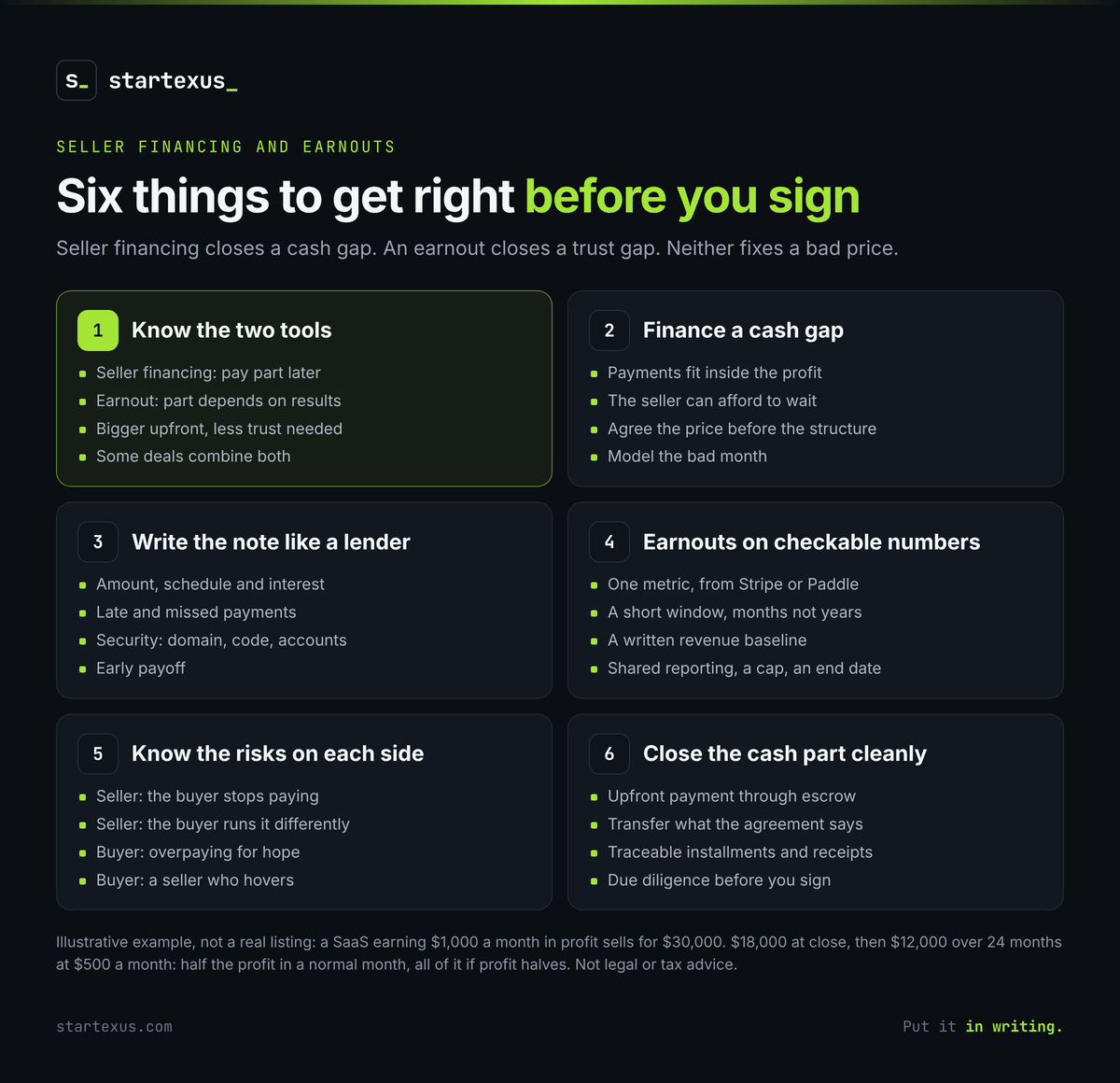
1. Know the two tools
They sound alike. They solve different problems.
- Seller financing. The seller lets the buyer pay part of the price later, in installments. It closes a cash gap.
- Earnout. Part of the price depends on how the business performs after the sale. It closes a trust gap.
- The upfront payment. Whatever is paid at closing. The bigger it is, the less either side has to trust the other.
- The combination. Some deals use both: cash at close, a fixed note and a small performance-based piece.
2. Use seller financing for a cash gap
Seller financing works when the buyer believes the numbers but cannot pay it all today.
- The business can carry the payments. Installments should fit inside the profit, with room to spare.
- The seller can wait. Deferred money is only useful to a seller who does not need it all now.
- The price is fair first. Agree on value before structure. Check it with the free valuation tool and our guide to MRR multiples.
- Plan for the bad month. Model the installments against a weak month, not the best one.
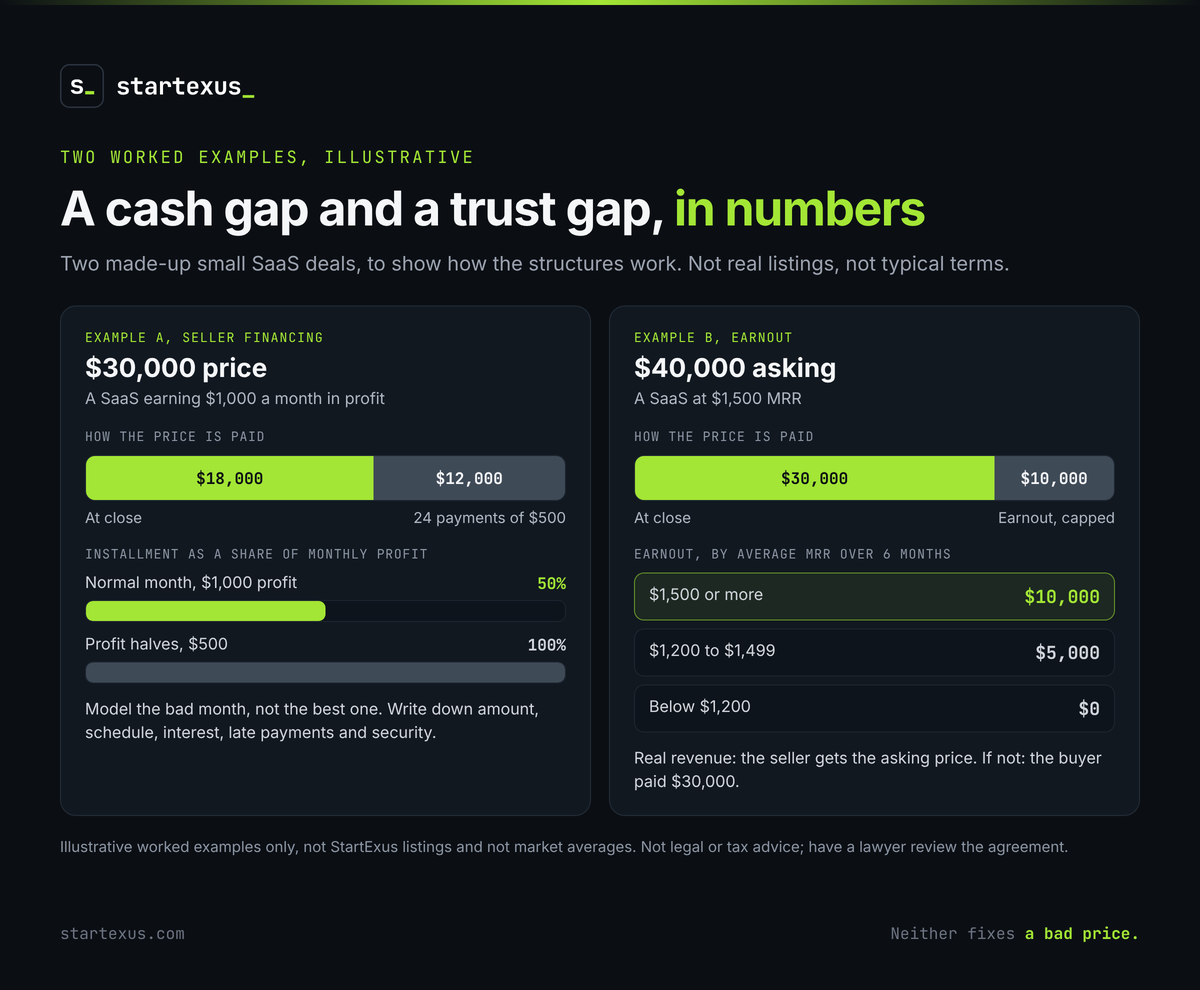
Example (illustrative, not a real listing): a SaaS earns $1,000 a month in profit and sells for $30,000. The buyer pays $18,000 at close and the remaining $12,000 over 24 months, $500 a month. In a normal month the installment takes half the profit. If profit halves, it takes all of it, and the buyer covers anything extra out of pocket.
3. Write the note like a lender would
A seller-financed deal is a loan. Treat it like one, in writing.
- Amount, schedule and interest. How much, how often, for how long, and whether interest applies.
- Late and missed payments. A grace period, and exactly what happens after it.
- Security. What the seller can take back if payments stop, such as the domain, code or accounts.
- Early payoff. Whether the buyer can pay the balance early.
Put these terms in the purchase agreement, or in a separate note it references. Our asset purchase agreement guide covers what else belongs in it.
4. Tie an earnout to numbers both sides can check
An earnout is only as good as its definition. Vague terms are how they end in arguments.
- One clear metric. Revenue or MRR from Stripe or Paddle is easier to check than profit, which the buyer controls through costs.
- A short window. Months, not years. The longer it runs, the less of the result the seller controls.
- A written baseline. What counts as revenue: refunds, annual plans, upgrades.
- Shared visibility. Read-only reporting for the seller, so nobody has to take the other's word.
- A cap and an end date. The maximum payment and when the earnout stops.
Example (illustrative, not a real listing): a SaaS at $1,500 MRR is listed at $40,000. The buyer offers $30,000 at close plus an earnout of up to $10,000. If average MRR over the next six months stays at $1,500 or more, the seller gets the full $10,000. At $1,200 or more, $5,000. Below that, nothing. If the revenue is real, the seller gets the asking price. If it is not, the buyer paid $30,000.
5. Know the risks on each side
Deferred money shifts risk. Know which way it moves before you agree.
- Seller: the buyer stops paying. Your money becomes a collection problem. Security and a solid upfront payment are your protection.
- Seller: the buyer runs it differently. A price change or neglect can sink an earnout you no longer control.
- Buyer: you overpay for hope. A large deferred piece on optimistic numbers is still overpaying.
- Buyer: the seller hovers. An earnout gives the seller a reason to question every decision you make.
6. Close the cash part cleanly
Structure aside, the handover works like any other deal.
- Upfront payment through escrow. On StartExus, Escrow.com is available for closing. It holds the buyer's money until the transfer is complete and the buyer confirms it.
- Transfer what the agreement says. If the seller keeps anything as security until the note is paid, write down what and until when.
- Traceable installments. Pay by a method that leaves a record, and keep the receipts.
- Verify before you sign. Deal terms do not fix bad numbers. Run the due diligence checklist first.
Your deal-structure checklist
- Is the upfront payment large enough that the seller is comfortable?
- Can the business cover installments in a bad month?
- Are the amount, schedule, interest, late payments and security in writing?
- Is the earnout tied to one metric both sides can see?
- Is there a cap and an end date?
- Has a lawyer reviewed the agreement?
The bottom line
Seller financing closes a cash gap. An earnout closes a trust gap. Neither fixes a bad price.
Keep the deferred part modest, the terms written and the metrics checkable. Then both sides can stop worrying and get on with it.
Ready to make an offer? Browse businesses for sale on StartExus, check what a listing is worth with the free valuation tool, or list your business for sale for free, with no listing fee and no success fee.
Tags
- online business
- due diligence
- valuation
- saas
- ai