
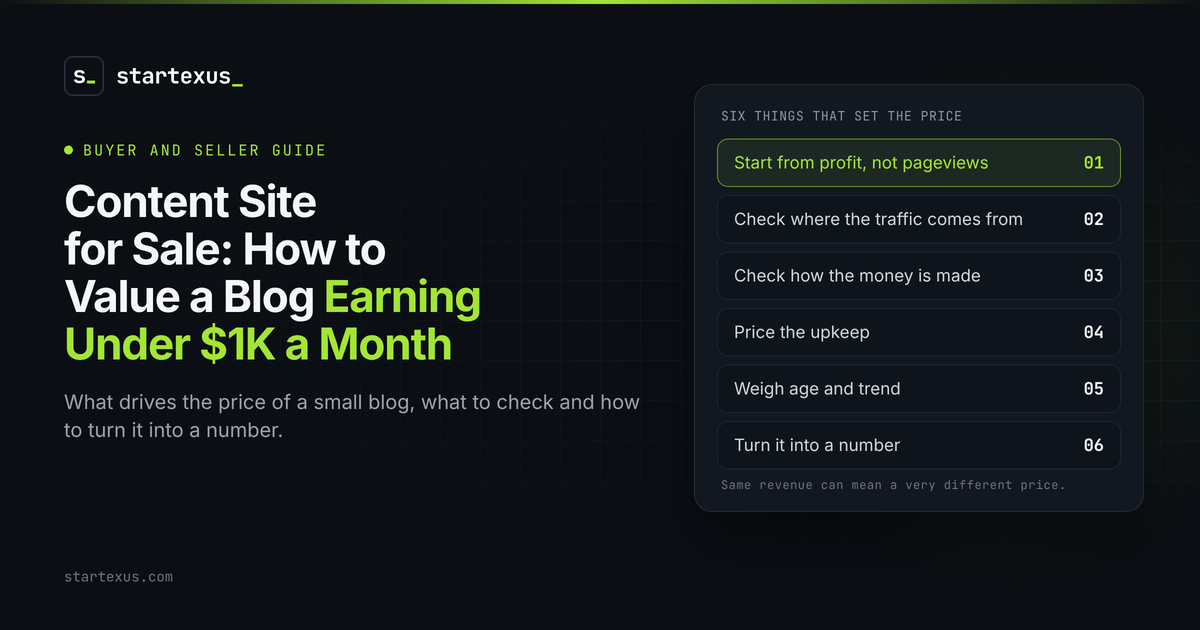
A blog earning $500 a month looks like a small thing. To the right buyer it is a cash-flowing asset that runs on a few hours a week. To the wrong one it is a pile of articles that stops earning the month after Google changes its mind.
Both can be true of the same site. The price depends on which one you are looking at.
This is the guide I would hand a friend who wants to buy or sell a content site earning under $1K a month. It covers what drives the price, what to check and how to turn it into a number. The figures below are illustrative examples, not real listings, and not typical prices.
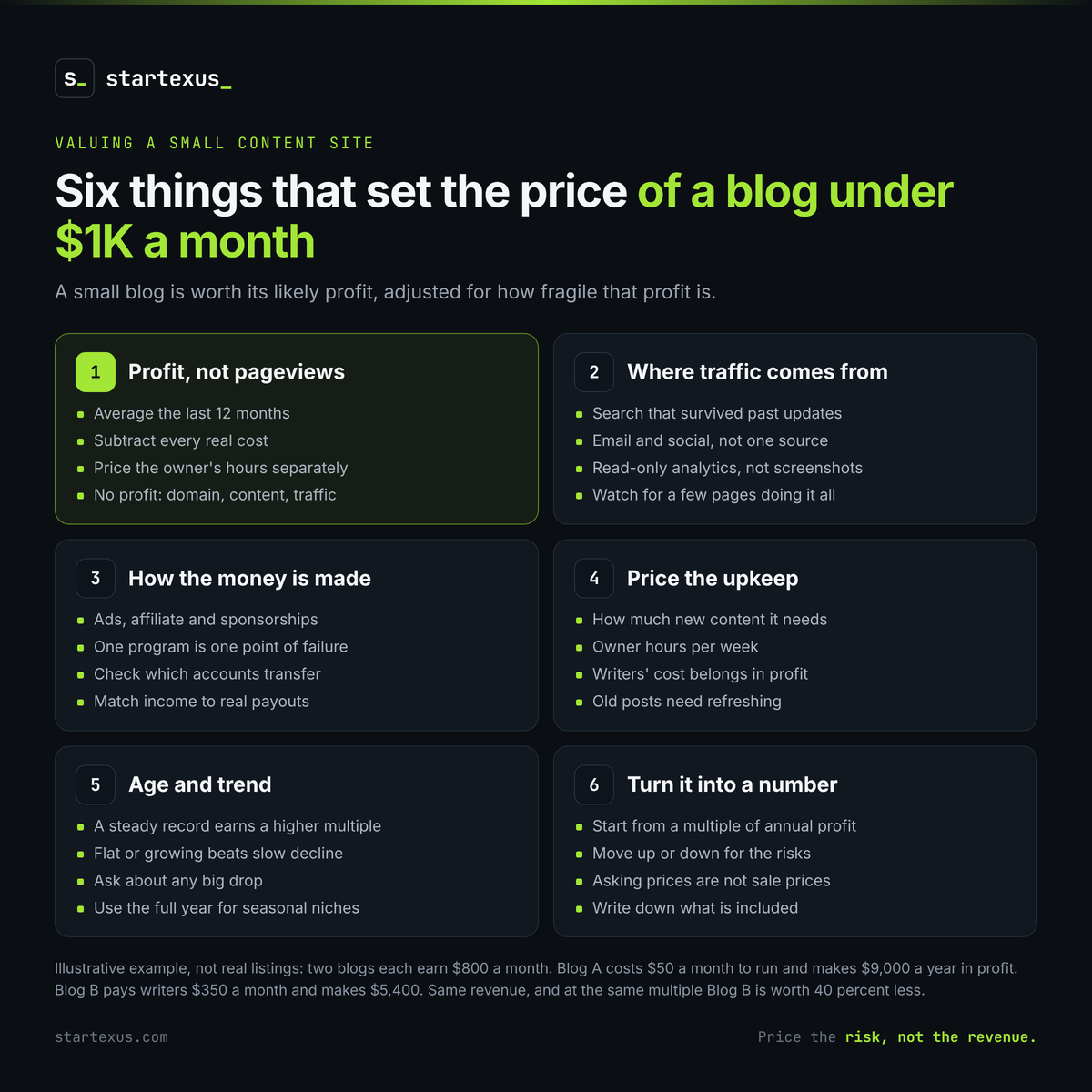
1. Start from profit, not pageviews
Small content sites usually sell for a multiple of annual profit. Traffic matters, but only because it produces income.
- Use the last 12 months. One good month is not a run rate. Average the year.
- Subtract every real cost. Hosting, plugins, email tools, and above all paid writers.
- Count your own time. Profit is before paying yourself, so the buyer prices your hours separately.
- No profit yet? Then the price is mostly for the domain, content and traffic. Our guide to pre-revenue and tiny-MRR projects covers that case.
2. Check where the traffic comes from
Traffic is the engine. Its sources decide how risky the income is.
- Search traffic with history. Traffic that has held up through past algorithm updates is worth more than a recent spike.
- More than one source. Email subscribers and social followers soften a bad search month.
- Proof, not screenshots. Ask for read-only access to Google Analytics or Search Console.
- Concentration. If a handful of pages bring most of the traffic, you are buying those pages.
3. Check how the money is made
Two blogs with the same revenue can carry very different risk.
- Several income streams. Display ads, affiliate links and sponsorships together are safer than one program.
- One affiliate program. If most of the income comes from one program, a commission cut hits the whole site.
- Transferable accounts. Some affiliate and ad accounts cannot simply change hands. Confirm what the buyer will need to reapply for.
- Payouts, not dashboards. Match the reported income to actual payouts.
4. Price the upkeep
A content site that needs a new article every few days is a job, not an asset.
- Content cadence. How much new content keeps traffic steady, and who writes it today.
- Owner hours. Fewer hours per week usually means a higher multiple.
- Freelance costs. If writers stay after the sale, their cost belongs in the profit figure.
- Old content. Outdated posts need refreshing. That is work the buyer inherits.
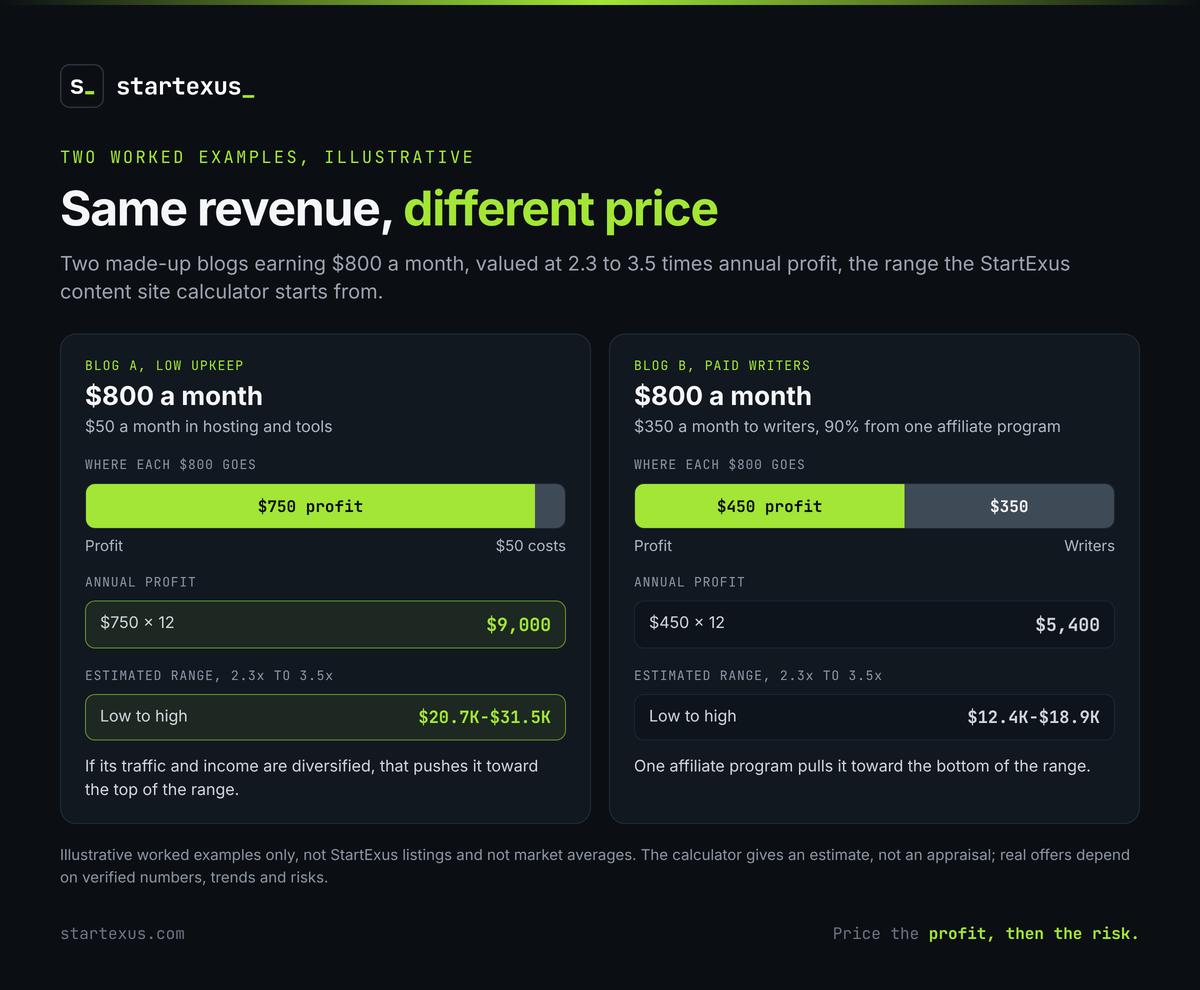
Example (illustrative, not real listings): two blogs each earn $800 a month. Blog A costs $50 a month to run, so it makes $750 in profit, $9,000 a year. Blog B pays writers $350 a month, so it makes $450, $5,400 a year. Same revenue. At the same multiple, Blog B is worth 40 percent less. And if 90 percent of Blog B's income comes from one affiliate program, it belongs at the low end of any range.
5. Weigh age and trend
History is what lets a buyer trust the next 12 months.
- Age. Older sites with a steady record tend to sell at higher multiples.
- Direction. Flat or growing traffic is worth more than a slow decline, even at the same profit.
- Big drops. Ask what happened and whether traffic came back.
- Seasonality. Some niches earn most of their money in a few months. Use the full year.
6. Turn it into a number
Once you have a clean profit figure and a view on the risks, put a range on it.
- Start from a range. The StartExus content site calculator currently starts from 2.3 to 3.5 times annual profit, then adjusts for age, owner hours and growth. It is an estimate, not an appraisal.
- Move within it. Diversified traffic, evergreen articles and several income streams push you up. One traffic source or one affiliate program pushes you down.
- Compare asking prices. See what similar content sites and blogs for sale are listed at. Asking prices are not sale prices.
- Agree what is included. Domain, content, email list, social accounts and any brand assets. Our asset purchase agreement guide covers putting it in writing.
Worked example (illustrative): Blog A's $9,000 of annual profit at 2.3 to 3.5 times gives roughly $20,700 to $31,500. Blog B's $5,400 gives roughly $12,420 to $18,900, and its single affiliate program pulls it toward the bottom.
Your 20-minute pre-offer checklist
- Is the profit figure based on 12 months, with every cost included?
- Have you seen read-only analytics, not screenshots?
- How much income depends on one traffic source or one program?
- How many hours a week does it really take?
- Is traffic flat, growing or declining?
- Is it clear which accounts, lists and assets transfer?
The bottom line
A small blog is worth what its profit is likely to be, adjusted for how fragile that profit is. Traffic sources, income streams and upkeep decide where in the range it lands.
Check the numbers, price the risks, then make the offer. On StartExus, listings show whether revenue and traffic were checked against the payment processor or analytics, or are seller-reported. Do your own due diligence either way, and close through Escrow.com so the buyer's money is held until the transfer is confirmed.
Ready to look? Browse content sites and blogs for sale on StartExus, get a range with the free valuation tool, or list your blog for sale for free, with no listing fee and no success fee.
Tags
- due diligence
- valuation
- ai
- growth